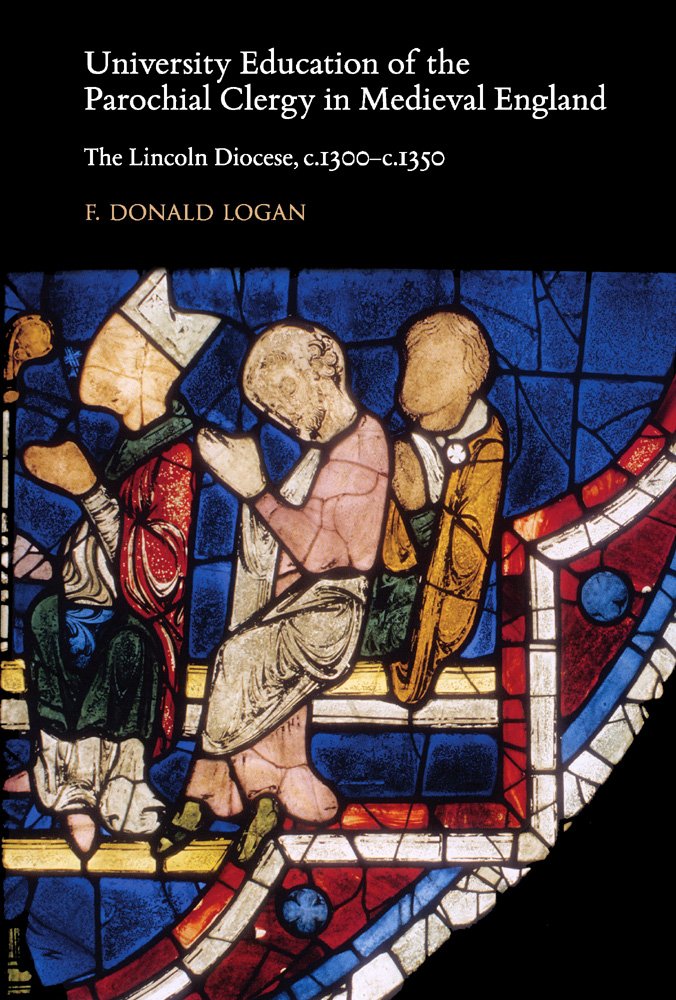
University Education of the Parochial Clergy in Medieval England: The Lincoln Diocese, c.1300-c.1350 (Studies and Texts)
$65.00
by F. Donald Logan



The need for an educated parochial clergy had been seen from early times and during the Middle Ages was articulated by popes, councils and generations of canonists. Uneducated parish priests, it was frequently said, were like the blind leading the blind, both in peril of falling into the pit. Various efforts were made to remedy this problem, culminating in 1298 with the decretal of Pope Boniface VIII Cum ex eo , which allowed non-priest rectors of parish churches to absent themselves for up to seven years to attend university. When their studies were completed, they had to become priests within one year. This study set out to examine how this decretal was implemented over the next fifty years in the diocese of Lincoln, the largest in England. The bishops' registers, however, revealed a much wider practice. In addition to dispensations granted by virtue of Cum ex eo , a substantial number of licences to study were also granted to rectors who were already priests, particularly after 1320. In total, over twelve hundred rectors of Lincoln diocese received permissions to study during this half-century period. A comparison with two other dioceses shows that the granting of such permissions was not peculiar to Lincoln diocese and occurred elsewhere at similar rates. This is suggestive of a wider English phenomenon. The Appendix lists the names of those rectors of parishes in the Lincoln diocese who went to university and the details for each rector/student. "The education of priests has been a concern of popes, bishops and councils for centuries. The publication in 1298 of Pope Boniface VIII's constitution, Cum ex eo , has come to be seen as a landmark in the provision of university education for the parish clergy, but the actual workings of that decree and its effectiveness have remained obscure and debatable. Donald Logan's meticulous study allows us to see in detail for the first time how this decree was implemented in one of England's largest dioceses. In compiling this evidence, Logan discovers that fourteenth century English bishops increasingly supplemented the papal dispensation in Cum ex eo with their own, distinct, episcopal licenses permitting priests to be absent from their parish for the sake of study. This co-ordination of papal dispensations and episcopal licenses for study represents an important discovery in the history of clerical education. The evidence on which Logan bases his arguments is conveniently assembled in a very useful appendix listing all the known rectors of parishes in Lincoln diocese who went to university, c.1300-c.1350." - Joseph Goering, University of Toronto F. Donald Logan holds a Licentiate as well as a Doctorate from the Pontifical Institute of Mediaeval Studies. He has taught at Emmanuel College, Boston, where he is now Professor Emeritus of History. A sometime Fulbright Scholar and Guggenheim Fellow, he is also a fellow of the Royal Historical Society and Society of Antiquaries of London, and Honorary Fellow of the Institute. He is the author of Excommunication and the Secular Arm in Medieval England: A Study in Legal Procedure from the Thirteenth to the Sixteenth Century (1968), Runaway Religious in Medieval England, c.1240-1540 (1996), and The Medieval Court of Arches (2005), together with numerous articles. A History of the Church in the Middle Ages , released first in 2002, appeared in a second edition in 2013, and The Vikings in History , published originally in 1983, was translated into Spanish, German, Romanian, and Italian before being reissued in a third edition in 2005.