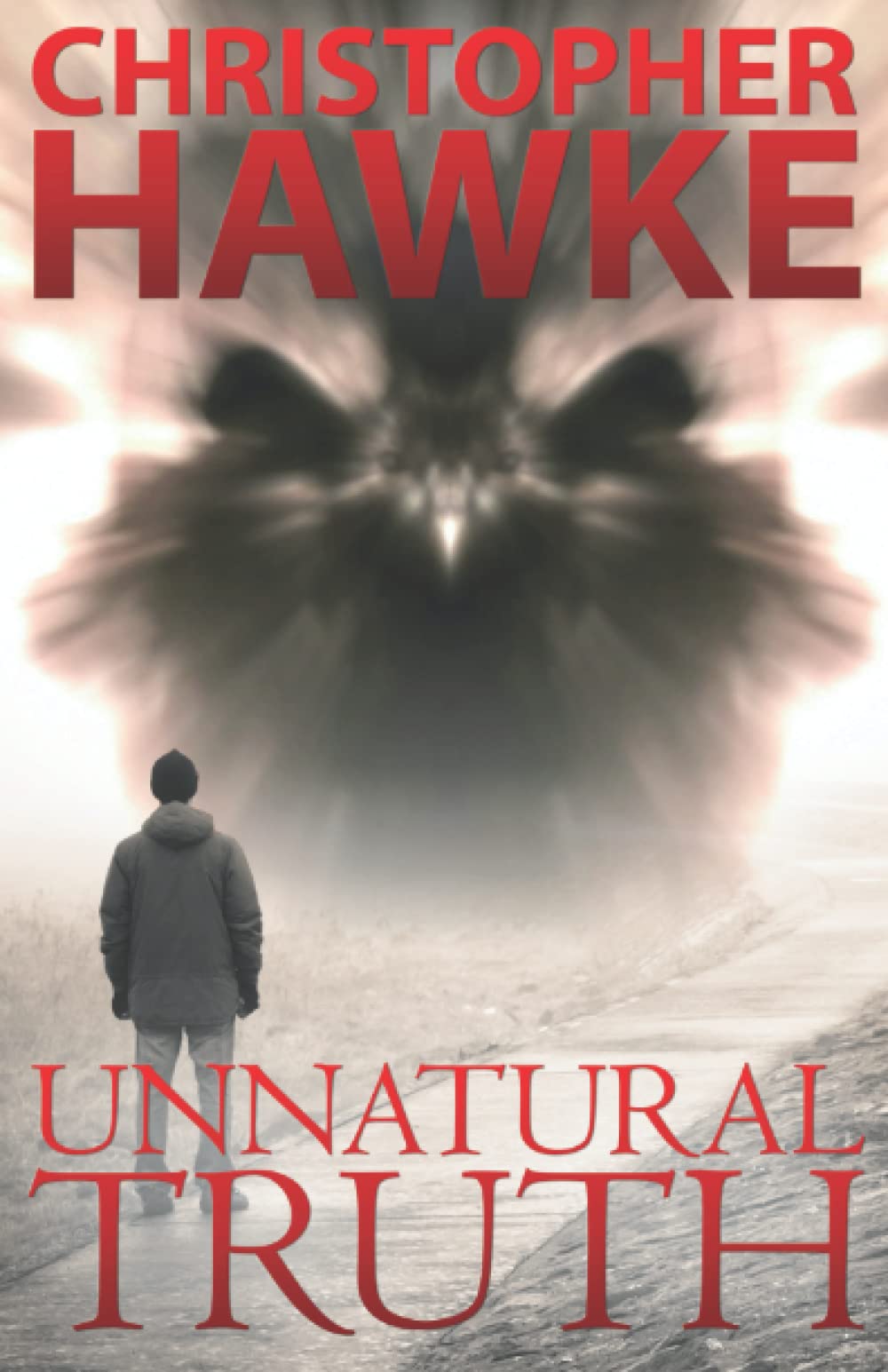



How do we fight our own demons? This question haunts Brendan McGovern when his grief and weakness send him on a journey across the country and into his own dark center. Unnatural Truth takes the reader though the layers of Brendan’s reality as he treads a tightrope between hell and redemption.Playing against his demonic nemesis, Brendan seeks to find his wife, Jane, and their daughter, Ashley, while battling for his own sanity. " Unnatural Truth is a tour de force about reality. It is written in first person by a character whose name, Brendan McGovern, we don't learn until Chapter 3. I found this disconcerting, but brilliant. Names are usually our first identifier. Instead, readers must learn about the substance of the man and what drives him. His name becomes secondary. We soon discover that Brendan is schizophrenic. He is also a philosopher, a teacher, and perhaps, a murderer. He writes about all his experiences as if they are real, and yet, like Brendan himself, we can't be sure. Brendan sees demons as part of his reality. Do we chalk it up to his mental illness, or understand it is a metaphor for a truth we all share--that everyone fights his/her own demons now and again, even if we can't see them. And what is reality? No two people witness a car accident in exactly the same way. As Brendan says in Chapter 14, 'In a sense, we all have our own reality and an ever-growing fear of the actuality of ourselves. This is the reality of which we are truly afraid.' I believe this one statement is the heart and soul of Unnatural Truth . After I knew Brendan had hallucinations and sometimes wrote about things that didn't happen except in his own mind, I read the rest of the book wondering if he was in and out of a lucid state, or if the entire book was his imagination. Was anything or anyone real? Did it even matter? I began to feel slightly schizophrenic myself--which is a good thing, a testament to Mr. Hawke's writing skills. I make it sound as though the book drove me crazy. Not so. The entire book is rich in very original similes. Hawke's descriptions of people, places, and objects are rarely more than a paragraph long, but are rife with so many adjectives, I can actually 'see' what is described. He doesn't ramble on, using descriptive passages just to fill a page. Every description is clean, crisp, and to the point, noticing things in detail that most of us just gloss over. And he certainly has a way with a phrase that can unexpectedly hit me in the solar plexus. A few of my favorite passages: '...marinating in the tang of pride', '...brief moments of clarity overcome by suffocating normalcy', 'I want to lead people back to the real world. Give them a place they can go where it feels more awkward to lie than to tell the truth. A place where true life is so apparent you don't have to look for it.' 'I want people to experience how everything is interconnected.' 'We borrow others' spirituality until we find our own.' Yes, indeed! And the thoughts just keep coming. I am only hitting some highlights here. The book is so much more, I'm afraid I don't have the adequate words to really do it justice , nor do I want to ruin anyone's reading experience. It truly is a book whose time has come; a book to ponder and read again and again; a book to remind us that, in these days of a swiftly-changing world, it really is okay to form our own individual reality, simply to cope, if for no other reason. Unnatural Truth , I dare say, is a masterpiece. Bravo, Mr. Hawke!" --Patricia Harreld "Over the course of my literate life, I'm confident I've read somewhere between 800-1000 full length novels. Because of this, so very often when reading a new book I can list at least two or three other works from which the author had apparently chosen to "borrow" extensively. After all, it's all been done before...right? Well, Unnatural Truth is the exception. This book took me places I've never been - places I never would have thought I wanted to go. I purchased it this morning, and I only set it down a few minutes ago after the last words were read. I'm shaking while writing this review, and I'm greatly looking forward to the next few hours I'm likely to spend absorbing what it is I've read. As I said...this is something completely new, but people (myself included) appreciate comparisons when deciding whether to give an unfamiliar author a shot. The realities portrayed in the book along with my own sense of self being so completely tossed aside to be replaced by the awareness of the protagonist reminded me of Zelazny's The Chronicles of Amber . Only, this feeling eventually wore off while I was still reading Zelazny, but it maintained itself through to the end while reading Hawke. The concepts and philosophy can only be compared to Adam's God's Debris: A Thought Experiment . That is...if God's Debris were an unearthed bullet casing and Unnatural Truth were a war currently being fought around you as you tried to