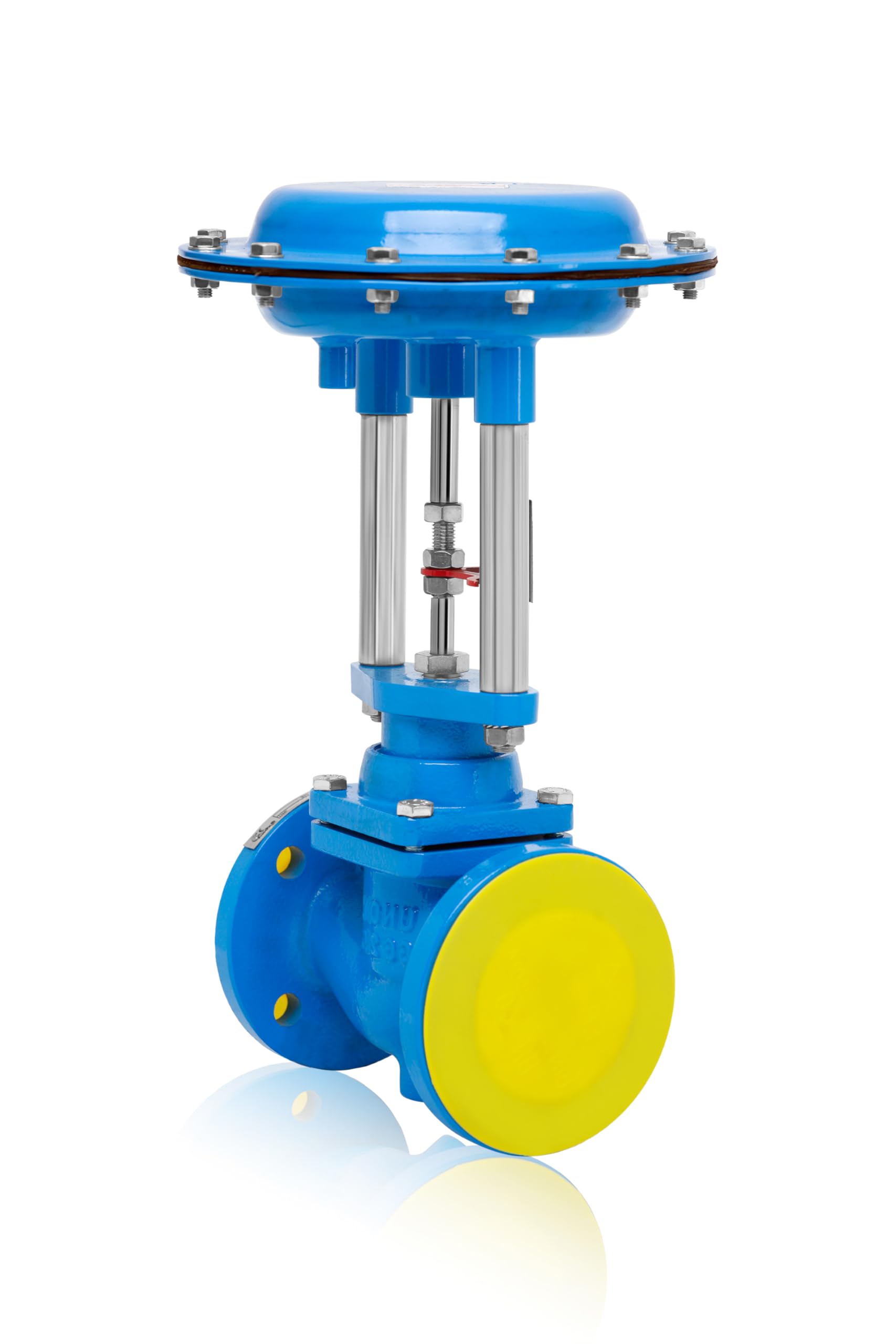



High durability: Crafted from premium cast iron for exceptional longevity and corrosion resistance in harsh industrial environments. Efficient performance: Capable of operating effectively at temperatures up to 220°C and pressure levels of PN25, making it suitable for a variety of applications. Secure installation: Equipped with ANSI Class150 flanged connections to ensure a robust and leak-proof setup. Precise control: Features two-way pneumatic functionality for reliable on-off operation, enhancing system response and stability. Versatile use: Designed to manage steam, water, air, and unheated oils, providing flexible solutions across multiple industrial sectors.-Made in Türkiye A multi-spring pneumatic control valve is a type of valve that uses multiple springs to regulate the flow of fluid through the valve. These valves are commonly used in process control applications to control the flow of liquids such as water, steam or gases in pipelines. The valve consists of a stem, valve plug and a set of springs. The valve plug is connected to a stem that protrudes from the valve body and is used to operate the valve. Springs are located around the stem and are used to apply a force that holds the valve plug in a specific position. The valve plug position is controlled by the pressure of the fluid on the valve plug and the force of the springs. When the fluid pressure is greater than the spring force, the valve plug is pushed open and fluid is allowed to flow through the valve. When the fluid pressure is less than the spring force, the valve plug is pushed closed, preventing fluid from flowing through the valve. The On-Off operating principle refers to a control system in which a device or system is fully open or fully closed with no intermediate states. This type of control is often used in simple systems where there is a need to turn a device or system on or off based on a particular condition or input. An example of the On-Off principle of operation is a thermostat that controls the heating or cooling system. When the thermostat is set to a certain temperature, it turns the system on or off as needed to maintain that temperature. If the temperature in the room falls below the set point, the heating system is turned on, if the temperature rises above the set point, the heating system is turned off. The On-Off working principle is often used in simple control systems, as it is relatively easy to implement and understand.