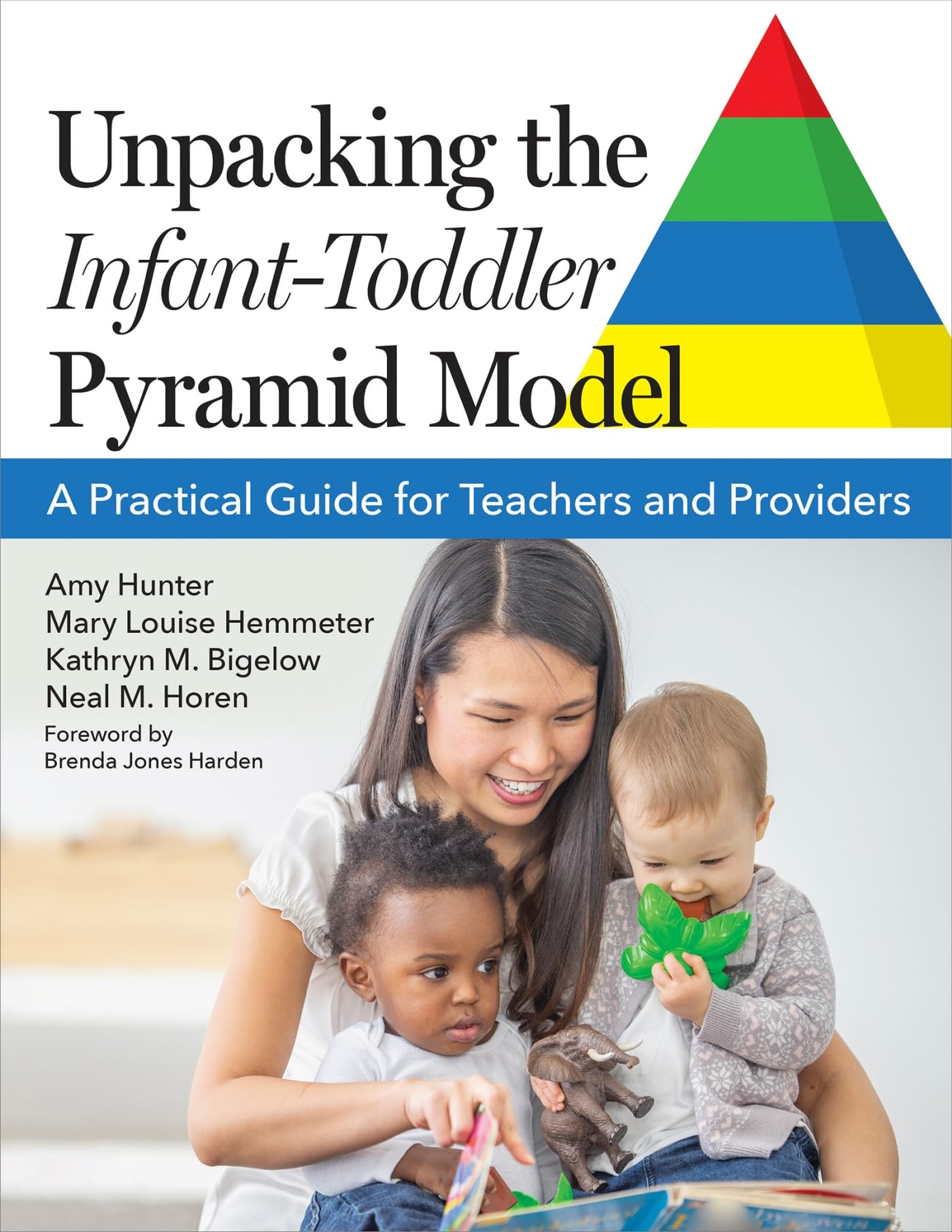
Unpacking the Infant–Toddler Pyramid Model: A Practical Guide for Teachers and Providers
$49.95
by Amy Hunter MSW LICSW



The highly anticipated follow-up to Unpacking the Pyramid Model, this one-of-a-kind book is the first to provide a comprehensive, step-by-step overview of the widely used Pyramid Model Practices for infants and toddlers from birth to three. With this accessible training guide, teachers and providers will use research-based practices to meet the unique needs of infants and toddlers—and boost their social-emotional development in the critical first years of life. Created by the Pyramid Model developers and experts with extensive training experience, this book gives readers a complete introduction to the framework, plus in-depth guidance, evidence-based practices, and helpful checklists for implementing all levels of the Pyramid Model: universal, targeted, and individualized. Teachers and providers will learn how to: Address their own well-being to prepare for their important work - Build positive partnerships with families and colleagues - Develop predictable and responsive schedules, routines, and transitions - Promote children’s social skills and emotional competencies - Support children’s active engagement with their environment and peers - Create an anti-racist and inclusive early care environment - Meet the needs of young children who have experienced trauma - Understand, prevent, and effectively respond to challenging behavior - Provide individualized support for children with persistent needs related to social-emotional development and behavior - Use data to monitor Pyramid Model practice implementation and effects Ideal for use in preservice and inservice training, this book will expertly prepare infant–toddler teachers and providers to give the youngest children a strong foundation of social-emotional competence. PRACTICAL MATERIALS : Checklists of Effective Practices for each main topic covered; tools for observation, planning, and reflection; vignettes and photos illustrating classroom examples. Explore more Pyramid Model resources from Brookes . Amy Hunter is Assistant Professor at Georgetown University’s Center for Child and Human Development. Currently, Amy oversees the mental health section of the Head Start National Center on Early Childhood Health and Wellness. Amy is also faculty on the Substance Abuse and Mental Health Services Administration-funded National Center of Excellence on Infant/Early Childhood Mental Health Consultation. Previously, Amy served in many positions at ZERO TO THREE: National Center for Infants, Toddlers, and Families, including as Director of Program Operations for the Early Head Start National Resource Center and Project Director for the Infant Toddler Center on the Social Emotional Foundations of Early Learning project. For 20 years, Amy has been involved in early childhood mental health, including providing training and technical assistance on early childhood mental health consultation to individuals and groups around the country. Mary Louise Hemmeter, Ph.D., is Professor in the Department of Special Education at Vanderbilt University. Her research focuses on effective instruction, social-emotional development, challenging behavior, and on coaching teachers. She has been a principal investigator (PI) or co-PI on numerous projects funded by the U.S. Departments of Education and Health and Human Services. Through her work on the National Center on Social Emotional Foundations for Early Learning and Institute of Education Sciences (IES)–funded research projects, she was involved in the development of the Pyramid Model for Supporting Social Emotional Competence in Young Children and practice-based coaching, a model for supporting teachers in implementing effective practices. She is currently the PI on on an IES–funded development project on programwide supports for implementing the Pyramid Model , a co-PI on an IES developmental project on implementing the Pyramid Model in infant–toddler settings, and a co-PI on an IES efficacy study examining approaches to supporting teachers in implementing embedded instructions. She is a co-author on the Connect4Learning Early Childhood Curriculum and the Teaching Pyramid Observation Tool (TPOT™). She was a coeditor of the Journal of Early Intervention and President of the Council for Exceptional Children’s Division for Early Childhood (DEC). She received the Merle B. Karnes Service to the Division Award and the Mary McEvoy Service to the Field Award. Kathryn Bigelow, Ph.D. , is an Assistant Research Professor at the Juniper Gardens Children's Project in the Institute for Life Span Studies at the University of Kansas. Her research focuses on interventions for culturally and linguistically diverse children and families experiencing multiple risks. Specifically, her work has addressed early childhood language and social-emotional development and the translation of evidence-based interventions for parents, care providers, home visitors, and early intervention providers within both center-based and home-