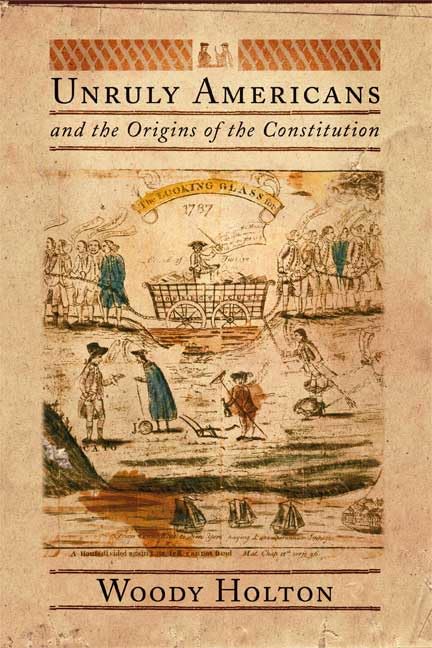



Average Americans Were the True Framers of the Constitution Woody Holton upends what we think we know of the Constitution’s origins by telling the history of the average Americans who challenged the framers of the Constitution and forced on them the revisions that produced the document we now venerate. The framers who gathered in Philadelphia in 1787 were determined to reverse America’s post–Revolutionary War slide into democracy. They believed too many middling Americans exercised too much influence over state and national policies. That the framers were only partially successful in curtailing citizen rights is due to the reaction, sometimes violent, of unruly average Americans. If not to protect civil liberties and the freedom of the people, what motivated the framers? In Unruly Americans and the Origins of the Constitution , Holton provides the startling discovery that the primary purpose of the Constitution was, simply put, to make America more attractive to investment. And the linchpin to that endeavor was taking power away from the states and ultimately away from the people. In an eye-opening interpretation of the Constitution, Holton captures how the same class of Americans that produced Shays’s Rebellion in Massachusetts (and rebellions in damn near every other state) produced the Constitution we now revere. Unruly Americans and the Origins of the Constitution is a 2007 National Book Award Finalist for Nonfiction. The motivation of the framers of our constitution is a constant and often hotly debated topic among historians. At one extreme are those who see the framers as brilliant, democratic politicians who did a masterful job of juggling competing interests while remaining true to the ideal of personal liberty. At the other extreme are the economic determinists who view the founders as members of the privileged classes, insistent upon protecting their interests from the encroachments of the masses. Holton certainly would be most comfortable in the latter camp, but his arguments here are free of dogmatism, and he offers some interesting twists on old assertions. He maintains that the delegates to the convention were attempting to limit the democratic tendencies of the individual state legislatures by curbing their powers to issue paper money and offer relief to debtors. Faced with vehement popular opposition to ratification, the Bill of Rights, Holton claims, was promised only to tip the balance in favor of ratification. Although he makes a credible case that some delegates feared the dangers of democracy, he glosses over the commitment many showed to protecting personal freedom as their top priority. Freeman, Jay "Holton demonstrates a lucid and systematic dismantling of the myths surrounding the making of our national government. His succinct account persuasively revives the economic interpretation of the Constitution in terms well-suited for our times, and it will surely become the essential work for students of the founding era. The Constitution enabled the ascent of the United States to great political and economic power, Holton makes plain, but at a profound cost to democracy. If Americans today find our national politicians entrenched in office, out of touch with their constituents, and responsive to lobbyists for the rich, they will understand why after reading this compelling book." --Robert A. Gross, James L. And Shirley A. Draper Professor of Early American History, University of Connecticut, and author of The Minutemen and Their World "Woody Holton reframes the coming of the Constitution, revealing the rich debate Americans conducted over the cause of capital in the new land. In this account, real people--farmers, soldiers, taxpayers, speculators, creditors and entrepreneurs--replace images of the Founders, and intimate issues like tax fairness, economic effects, and electoral accountability matter far more than abstractions. The result is a new and compelling history." --Christine Desan, Professor of Law, Harvard Law School "Woody Holton invites us to revise most of what we think we know about the origins of the United States Constitution. In this account the Founding Fathers do not appear as selfless philosophers journeying to Philadelphia to explore competing theories of republican government. Rather, Holton describes them as deeply anxious men, determined to contain a surge of popular democracy that seemed to threaten their financial interests. In this brilliantly researched study Holton thus revives an economic interpretation of the Constitution and in the process reminds us that ordinary American farmers after the Revolution imagined a strikingly different nation from the one that the Founders gave us." --T.H. Breen, Director, Center for Historical Studies, Northwestern University "Here is a book that helps answer the puzzle of how in 1787 the framers of the Constitution curbed what they considered 'the excess of democracy' in the states and at the same time accommodate