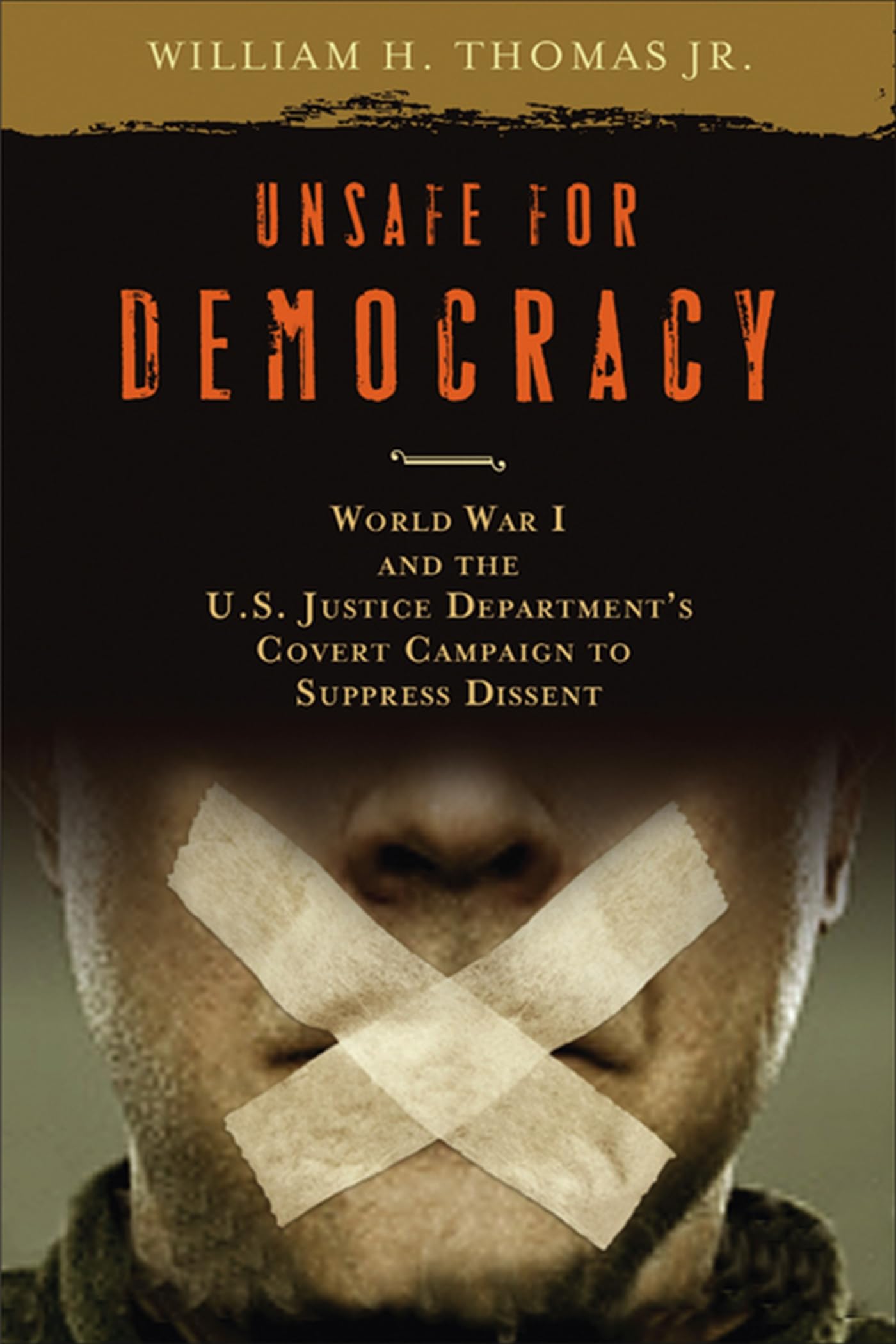
Unsafe for Democracy: World War I and the U.S. Justice Department's Covert Campaign to Suppress Dissent (Studies in American Thought and Culture)
$30.97
by William H. Thomas Jr



During the First World War it was the task of the U.S. Department of Justice, using the newly passed Espionage Act and its later Sedition Act amendment, to prosecute and convict those who opposed America’s entry into the conflict. In Unsafe for Democracy , historian William H. Thomas Jr. shows that the Justice Department did not stop at this official charge but went much further—paying cautionary visits to suspected dissenters, pressuring them to express support of the war effort, or intimidating them into silence. At times going undercover, investigators tried to elicit the unguarded comments of individuals believed to be a threat to the prevailing social order. In this massive yet largely secret campaign, agents cast their net wide, targeting isolationists, pacifists, immigrants, socialists, labor organizers, African Americans, and clergymen. The unemployed, the mentally ill, college students, schoolteachers, even schoolchildren, all might come under scrutiny, often in the context of the most trivial and benign activities of daily life. Delving into numerous reports by Justice Department detectives, Thomas documents how, in case after case, they used threats and warnings to frighten war critics and silence dissent. This early government crusade for wartime ideological conformity, Thomas argues, marks one of the more dubious achievements of the Progressive Era—and a development that resonates in the present day. Best Books for Special Interests, selected by the American Association of School Librarians “Recommended for all libraries.”—Frederic Krome, Library Journal "Thomas has dug deeper than any previous scholar into the records of the U.S. Justice Department during World War I, and unearthed a new history of what it meant to be an obedient citizen in wartime." - Christopher Capozzola, author of Uncle Sam Wants You: World War I and the Making of the Modern American Citizen. "Now, thanks to this excellent study, readers learn of the department's covert campaign to silence a diverse variety of critics." Justus D. Doenecke, The Historian . "[T]hose now fretting that the Patriot Act has snatched civil liberties away from Americans might read this brief account and come away comforted that things could be worse--much, much worse." --Harry Levins, St. Louis Post-Dispatch . “An important and timely book. . . .An invaluable contribution to our understanding of the history of the FBI and of the pernicious legacy of national security policy on the right to dissent.”—Athan Theoharis, Marquette University, author of The FBI and American Democracy “Thomas . . . reveals that actual prosecution was merely the tip of a very large iceberg of political browbeating. . . . Recommended for all libraries.”— Library Journal “[A] timely addition to the discussion of the US government’s responses to critically important times.”— Choice “A cautionary tale about what can happen to our freedoms if we take them too lightly.”—Dave Wood, Hudson Star-Observer “ Unsafe for Democracy raises important questions about the role of the state in modern society [and] draws a direct line between the embryonic surveillance-and-suppression state of the 1910s and the more sinister elements of the national security state of our own time.”— Journal of American History “ Unsafe for Democracy poses in a modern idiom the question Abraham Lincoln asked: ‘Must a government be too strong for the liberties of its people or too weak to maintain its own existence?’. . .Thomas has produced a book that both adds to our knowledge of this troubling episode in American history and invites thoughtful consideration of such questions.”— Journal of American History “A well-researched, richly detailed account of the US government’s illiberal and covert wartime activities. . . .What the book does suggest, and quite powerfully, is how war can cause a country to jettison its core principles and, in so doing, undermine the values that compelled it to fight in the first place.”—Jonathan Rosenberg, The International History Review Studies in American Thought and Culture Paul S. Boyer, Series Editor William H. Thomas Jr., an independent scholar, received his Ph.D. in history from the University of Iowa. He lives in O'Fallon, Illinois.