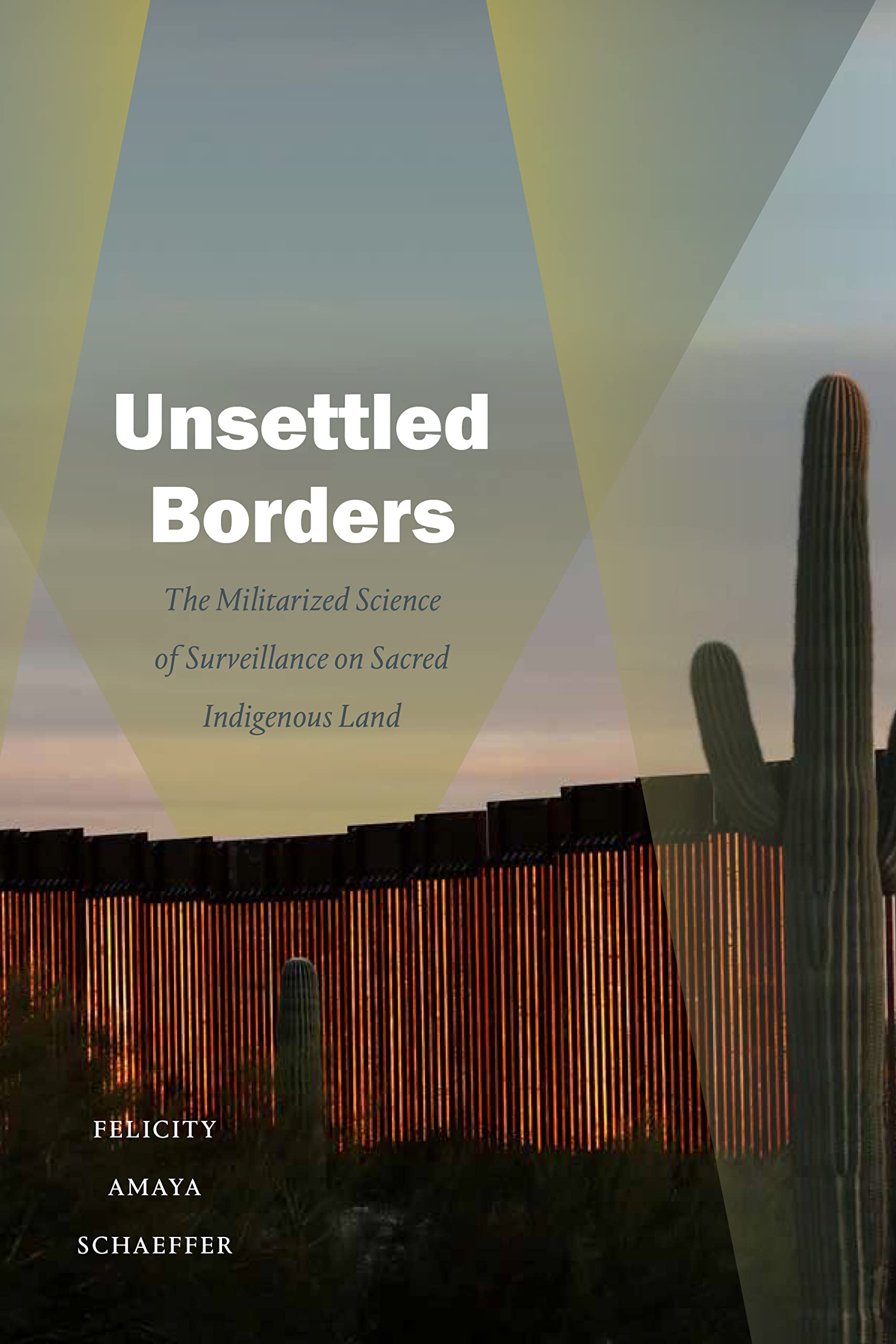
Unsettled Borders: The Militarized Science of Surveillance on Sacred Indigenous Land (Dissident Acts)
$26.95
by Felicity Amaya Schaeffer



In Unsettled Borders Felicity Amaya Schaeffer examines the ongoing settler colonial war over the US-Mexico border from the perspective of Apache, Tohono O’odham, and Maya who fight to protect their sacred land. Schaeffer traces the scientific and technological development of militarized border surveillance across time and space from Spanish colonial lookout points in Arizona and Mexico to the Indian wars, when the US cavalry hired Native scouts to track Apache fleeing into Mexico, to the occupation of the Tohono O’odham reservation and the recent launch of robotic bee swarms. Labeled “Optics Valley,” Arizona builds on a global history of violent dispossession and containment of Native peoples and migrants by branding itself as a profitable hub for surveillance. Schaeffer reverses the logic of borders by turning to Indigenous sacredsciences: ancestral land-based practices that are critical to reversing the ecological and social violence of surveillance, extraction, and occupation. “[ Unsettled Borders ] includes an impressively documented bibliography. The text ultimately succeeds in telling a story of violence against Indigenous peoples and their cultures, perpetrated in the name of border security, and documenting the use of surveillance technology, which has permanently altered the landscape. Recommended.”― G. Christensen , Choice " Unsettled Borders makes an outstanding contribution to replacing some of the missing pieces while incorporating neocolonialism and interethnic borders into state border studies. Its author, Felicity Amaya Schaeffer, builds a great basis for a problem that is gaining greater visibility, exposing an equal criminalization of migrant people and indigenous communities."― Tania Porcaro , Journal of Borderlands Studies "I loved the big picture and provocative ideas that expanded my own understanding of topics I have studied for many years. . . . The book centers Indigenous perspectives to demonstrate not only the contributions Indigenous science has made to (or rather, been appropriated by) the military-industrial/border-security complex, but also the ways that Indigenous scholarship contributes to our understanding of this dynamic from a critical thinking perspective. The primary focus of the book is U.S. borders and Arizona features prominently therein, but the lessons go well beyond this geography as approaches to border security have become globalized."― Kenneth D. Madsen , Indigenous Religious Traditions " Unsettled Borders is a rich and skillful analysis of military discourse, settler technoscience, and ethnographic materials primarily devoted to events in the Arizona-Sonora borderlands, but with resonances across other settler colonial spaces (within and beyond the United States)."― Iván Chaar López , Postcolonial Studies “ Unsettled Borders successfully crafts new spaces of solidarity. It is theoretically nuanced, data-rich, and artfully executed.”― Fantasia Painter , American Indian Culture and Research Journal “ Unsettled Borders brings together an extraordinary range of disciplines to offer a refreshing new perspective on the histories and futures of surveillance and Indigenous exclusion in the U.S.– Mexico borderlands.”― Sheila McManus , Wicazo Sa Review "Amaya Schaeffer reframes and widens the scope of analysis regarding borders, immigration, security, militarization, surveillance, and human rights. ... Unsettled Borders puts forth new ways of understanding and problem-solving that emerge from [the] unlikely interdisciplinarity."― Raquel Madrigal , American Ethnologist “In this innovative and transformative book, Felicity Amaya Schaeffer locates Indigenous studies within border studies in ways that are both timely and refreshing. By holding the complexities of indigeneity as the land-based practices, knowledges, and identities of those detained, policed, and displaced by borders, she offers a truly exciting reframing of conversations that are only too relevant to the new present of the United States and its dependence on technology, control, and borders.” -- Jodi A. Byrd, author of ― The Transit of Empire: Indigenous Critiques of Colonialism Felicity Amaya Schaeffer is Professor of Feminist Studies and Critical Race and Ethnic Studies at the University of California, Santa Cruz, author of Love and Empire: Cybermarriage and Citizenship across the Americas , and coeditor of Precarity and Belonging: Labor, Migration, and Noncitizenship .