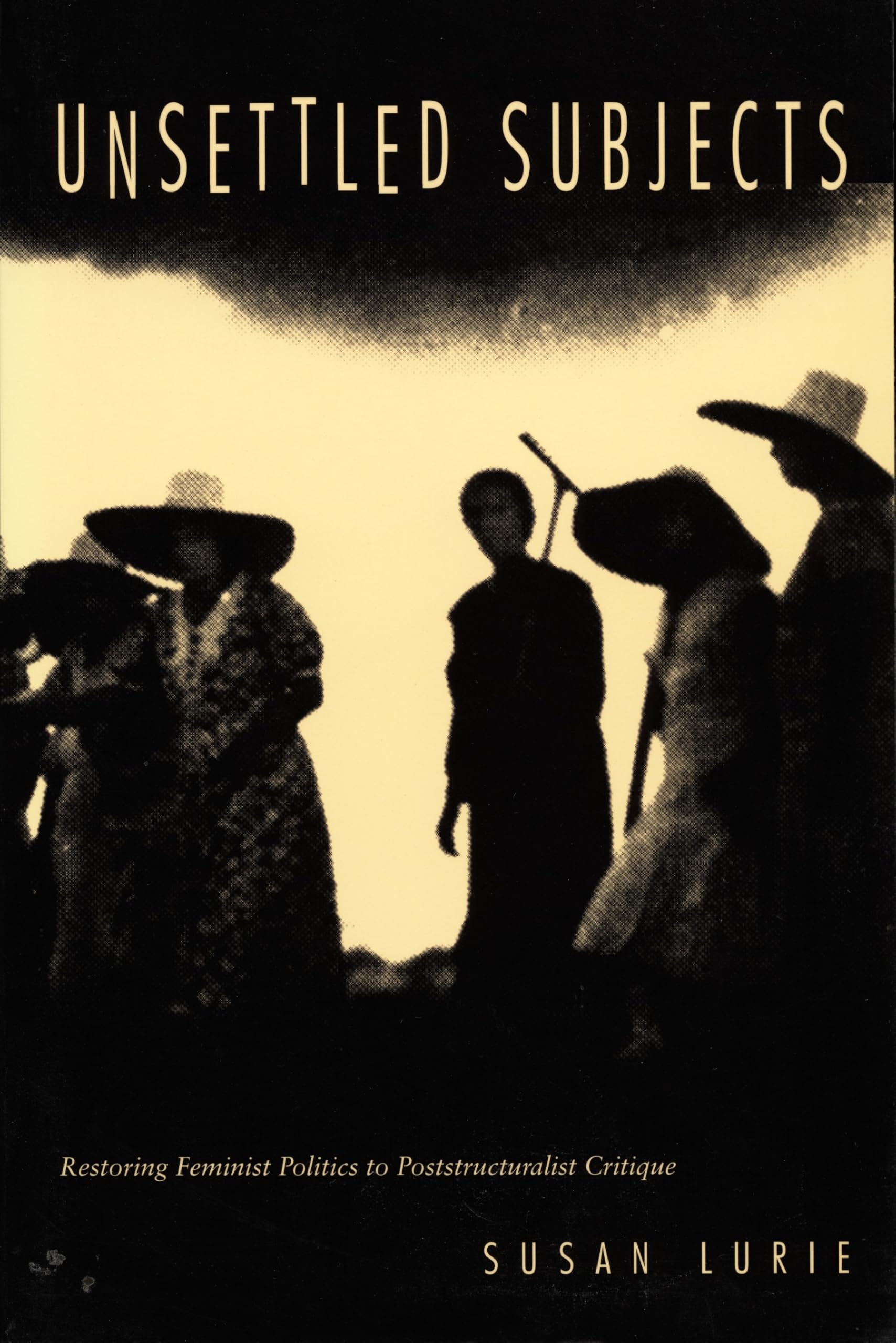
Unsettled Subjects: Restoring Feminist Politics to Poststructuralist Critique (New Americanists)
$109.95
by Susan Lurie



During the 1980s much of the work of feminist theory aimed to fully account for issues of class, race, and sexuality that previously had been overlooked. Susan Lurie argues that this work tended to privilege questions of race and class at the expense of gender, and frequently, if inadvertently, left patriarchal power unquestioned. Developing a feminist model that keeps multiple political forces in view, Lurie returns to three literary feminists from earlier parts of the century: Ellen Glasgow, Zora Neale Hurston, and Elizabeth Bishop. As Lurie argues, each of these women shows that both resistance to male domination and alliances between different oppositional politics rely on recognizing how power regulates a subject’s multiple beliefs. In her analysis, Lurie traces each author’s strategies for revealing and challenging the ways that patriarchal gender ideology profits from what is always plural and contested female subjectivity. Only such an inquiry, Lurie demonstrates, can explain the impasses that have steered poststructuralist feminism away from gender as a category of analysis and can point toward the models necessary for a more complete feminist critique of patriarchal power. “ Unsettled Subjects will establish Susan Lurie as a central figure within feminist and postcolonialist theory as she intervenes courageously within perhaps the most heated and long-lasting of feminist debates.”—Kaja Silverman, University of California, Berkeley “The critical project of Unsettled Subject s is both necessary and daring. It articulates the postmodern impasse for white feminism that deconstruction’s destabilizing of the category ‘woman’ has generated and, through very thorough readings of modern American women writers, demonstrates how this impasse may be overcome.”—Lora Romero, Stanford University "The critical project of "Unsettled Subject"s is both necessary and daring. It articulates the postmodern impasse for white feminism that deconstruction's destabilizing of the category 'woman' has generated and, through very thorough readings of modern American women writers, demonstrates how this impasse may be overcome."--Lora Romero, Stanford University Susan Lurie is Associate Professor of English at Rice University. Unsettled Subjects Restoring Feminist Politics to Poststructuralist Critique By Susan Lurie Duke University Press Copyright © 1997 Duke University Press All rights reserved. ISBN: 978-0-8223-2003-6 Contents Acknowledgments, Introduction, Chapter 1: Poststructuralist Feminist Subjects, Chapter 2: Antiracist Rhetorics and the Female Subject: The Trials of Zora Neale Hurston, Chapter 3: Women's Development and "Composite" Subjectivity: Feminism and Social Evolution in Ellen Glasgow, Chapter 4: "Caught in a Skein of Voices": Feminism and Colonialism in Elizabeth Bishop, Epilogue: Toward a Poststructuralist Feminist Counterhegemony, Notes, Works Cited, Index, CHAPTER 1 POSTSTRUCTURALIST FEMINIST SUBJECTS Even as feminists increasingly investigate the relation between unstable female subjects and dominant gender ideology, I have argued, it is important to interrogate the impasses that have impeded and continue to compete with such promising developments. These impasses occur when the preoccupation with the critique of feminist identity, a critique that importantly destabilizes the category of "woman," also functions to deflect attention from the analysis of patriarchal power. And the complementary approach to the critique of identity, the celebration of a female subject's capacity for resignification, most often theorizes future possibilities that remain unformulated. Together these modes of analysis have led poststructuralist feminism away from feminist analysis, a trajectory that has been authorized in radical democratic terms; for feminism is frequently deemed most oppositional when it performs or advocates self-critique. When such oppositional insistence on differences between women functions primarily to shift categories of analysis from gender to other ones (e.g., race, class, nation), however, patriarchal power is granted an immunity to interrogation. In this chapter I discuss three essays that respond to this impasse by attempting to reformulate politicized referents for the female and/or feminist subject. What all three demonstrate is why models of subjectivity that direct attention to how gendered domination relies on as well as succumbs to a subject's self-difference have been difficult both to formulate and to pursue. At issue is a competition between possible new oppositional formulations of subjectivity and reigning ones, which often retain their predominance. On the occasions when new models succeed in emerging, they remain vulnerable to displacement by the prevailing models that privilege for feminist politics the critique of identity and the valorization of multiple reference as emancipatory. These difficulties in formulating a countermodel of th