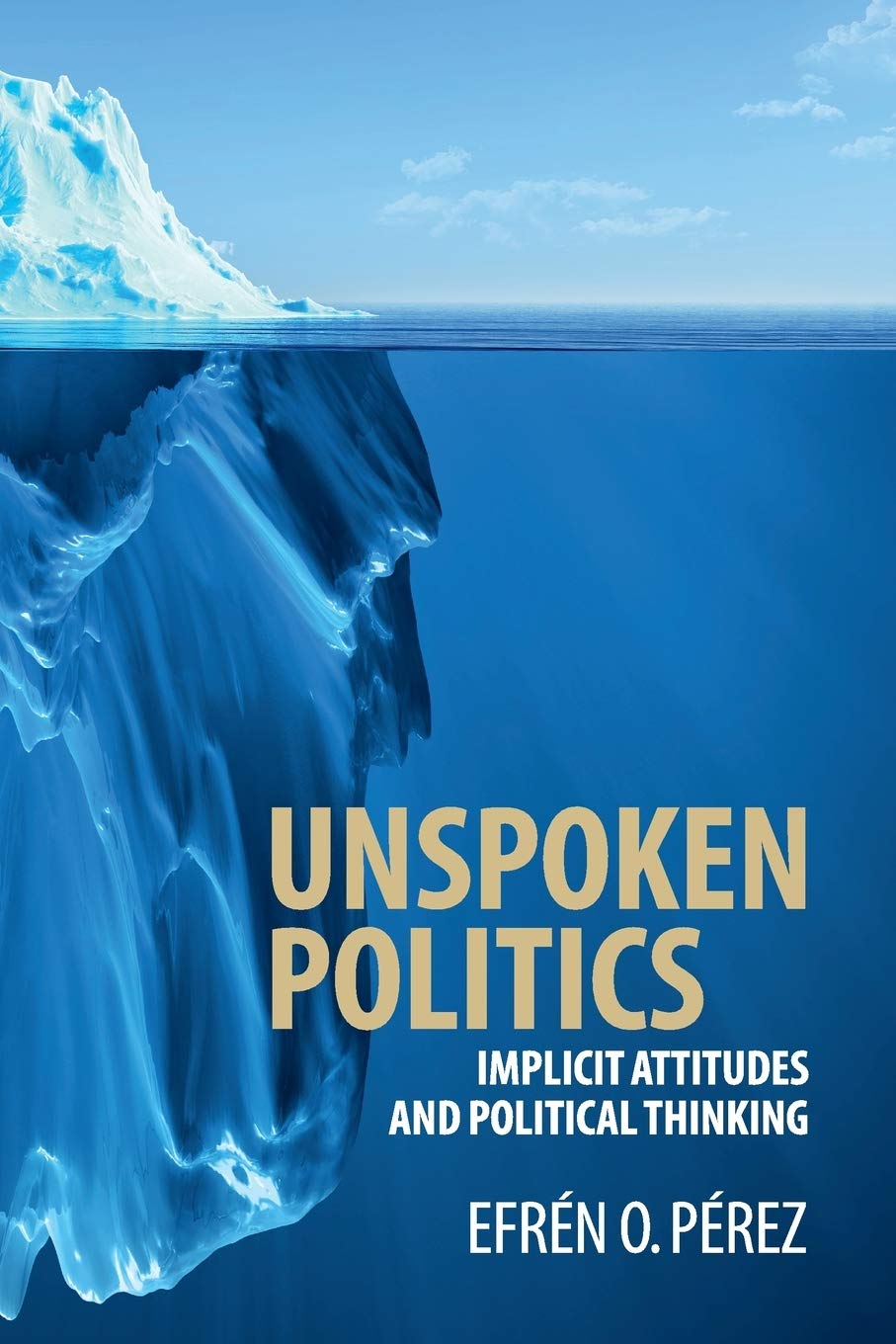
Unspoken Politics: Implicit Attitudes and Political Thinking (Cambridge Studies in Public Opinion and Political Psychology)
$29.99
by Efrén O. Pérez



This book explains why people acquire implicit attitudes, how they affect political thinking, and where in the mass public they have their strongest - and weakest - influences. A theoretically ambitious book, Unspoken Politics establishes that implicit attitudes exist outside the tightly controlled confines of the laboratory, showing that they emerge in a public opinion survey setting, which underlines their real-world impact. It also lays bare, in painstaking detail, the mechanics of a leading measure of implicit attitudes, the implicit association test (IAT). Accordingly, it outlines the strengths and limitations of this measure, while providing an illustration of how to develop an IAT for one's own purposes. By explaining how to analyze and interpret the data produced by the IAT, this book leads to a better understanding of people's unspoken cognitions and the impacts these have on the politics that individuals openly profess. "Unspoken Politics will be essential reading for understanding the psychological underpinnings, or implicit attitudes, of our political decisions. Pérez convincingly and systematically demonstrates the link between anti-Latino sentiment and support for exclusionary immigration policies. Unspoken Politics underscores the ever-important role of race in the political thinking of the American public." Marisa Abrajano, University of California, San Diego "Unspoken Politics is a persuasive account of white Americans' implicit attitudes about racial and ethnic minorities and how these 'implicit expectations' influence political decision-making. Pérez's fine book is essential reading for students of political psychology, public opinion, and the politics of race and ethnicity in the United States." Jane Yunhee Junn, University of Southern California "Pérez offers a creative and timely examination of the role that implicit attitudes play in shaping public opinion on immigration. This deeply theoretical and meticulously researched project provides new insights into one of the most divisive debates in contemporary American politics." Vincent L. Hutchings, University of Michigan "Pérez is interested in the dynamics of public opinion about immigration in the US. The book is one of the first to explore the role of implicit rather than explicit attitudes in this domain. Pérez makes a convincing empirical case that automatic and non-conscious attitudes are particularly important here. This is also among the first works to demonstrate that attitudes about Latinos in particular, not ethnocentrism in general, powerfully drive immigration policy opinion in the US. It is a beautifully reasoned and persuasive book." Nicholas Valentino, University of Michigan "The threads of the immigration debate in the US seem as numerous and interwoven as the immigrant groups in the country. Pérez employs experimental and survey research methods to show that a single attitude shapes Americans’ views of this complicated debate: an implicit, or automatic and subconscious, bias against Latinos. [His] key findings are arresting … [his] rigor and determination to move "beyond the lab [into] 'the Wild' of politics" distinguish his work from other explorations of how motivated reasoning influences political attitudes … Highly recommended." R. P. Seybm, Choice '… Unspoken Politics points us in the right direction, serving as an important leap in our understanding of how our unconscious deliberations and judgments matter for our interactions with the political world.' Ashley Jardina, Public Opinion Quarterly This book offers a comprehensive look at the conceptualization, measurement, and political impacts of implicit attitudes. Efrén Pérez is an Assistant Professor at the Department of Political Science of Vanderbilt University, Tennessee. His research uses psychological insights to investigate the political attitudes and behaviors of US racial and ethnic groups. Substantively, he studies implicit political cognition, group identity, and language and political thinking. Methodologically, he designs and implements experiments, especially in the realm of racial and ethnic politics. He has published articles on these topics in the American Journal of Political Science, Political Analysis, and Political Behavior. His research on implicit cognition is a recipient of the Lucius Barker Award for the best paper on race/ethnicity and politics at the annual meeting of the Midwest Political Science Association.