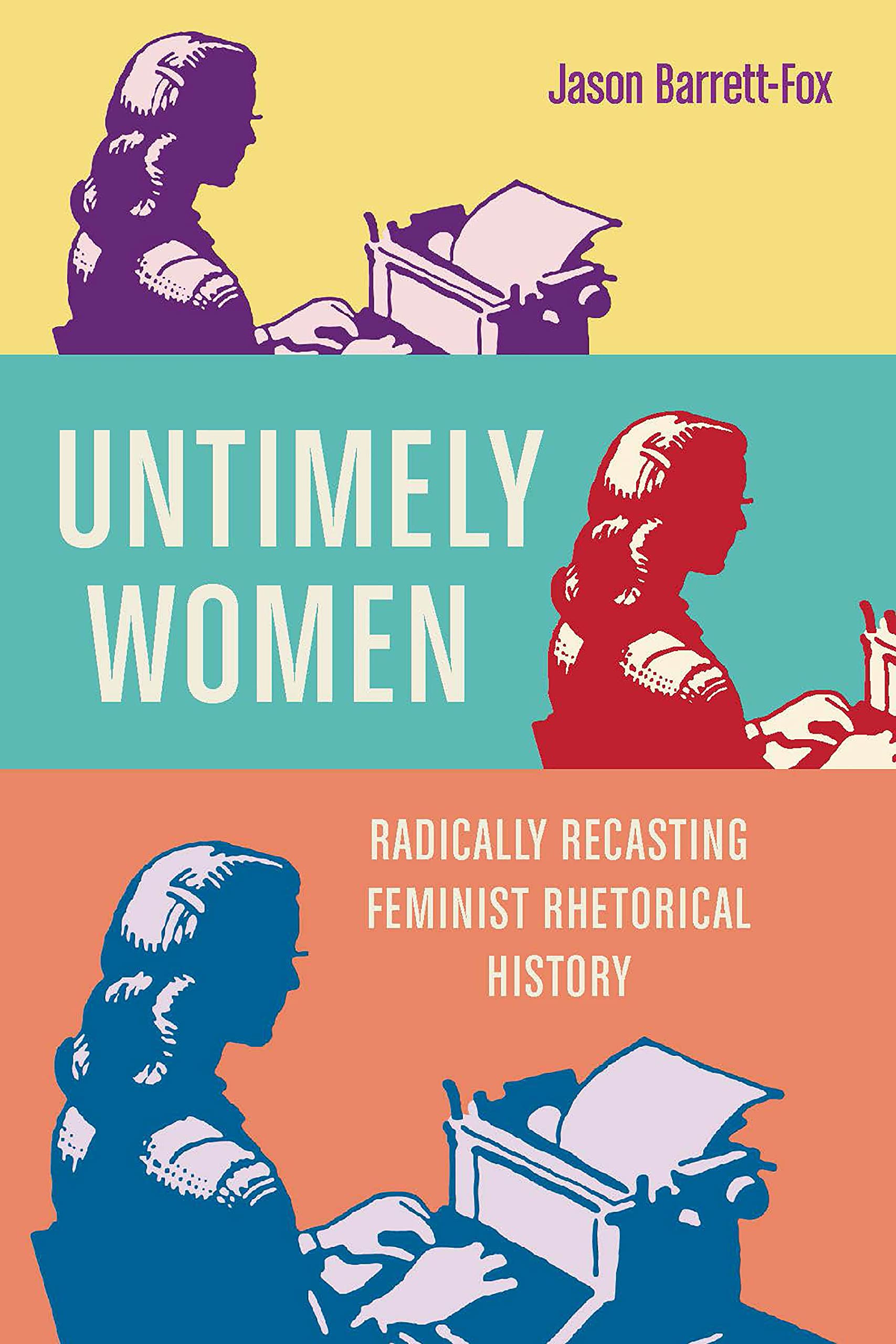
Untimely Women: Radically Recasting Feminist Rhetorical History (New Directions in Rhetoric and Materiality)
$34.95
by Jason Barrett-Fox



Untimely Women recovers the work of three early-twentieth-century working women, none of whom history has understood as feminists or rhetors: cinema icon and memoirist, Mae West; silent film screenwriter and novelist, Anita Loos; and journalist and mega-publisher, Marcet Haldeman-Julius. While contemporary scholarship tends to highlight and recover women who most resemble academic feminists in their uses of propositional rhetoric, Jason Barrett-Fox uses what he terms a medio-materialist historiography to emphasize the different kinds of political and ontological gender-power that emerged from the inscriptional strategies these women employed to navigate and critique male gatekeepers––from movie stars to directors to editors to abusive husbands. In recasting the work of West, Loos, and Haldeman-Julius in this way, Barrett-Fox reveals the material and ontological ramifications of their forms of invention, particularly their ability to tell trauma in ways that reach beyond their time to raise the consciousness of audiences unavailable to them in their lifetimes. Untimely Women thus accomplishes important historical and rhetorical work that not only brings together feminist historiography, rhetorical materialism, and posthumanism but also redefines what counts as feminist rhetoric. “Barrett-Fox’s scholarship is impressively interdisciplinary, and his medio-materialist historiography will be of great interest to feminist rhetorical scholars eager to move past the limiting practice of recovering discrete individuals, and to move past recovery more generally.” —Sarah Hallenbeck, author of Claiming the Bicycle: Women, Rhetoric, and Technology in Nineteenth-Century America Jason Barrett-Fox is Associate Professor of English and Director of Composition at Weber State University. In Pink-Slipped: What Happened to Women in the Silent Film Industries? feminist historian Jane M. Gaines reminds us that very few women in silent film made it on to the historical record—for reasons of taste, capacity, or constraint—and, most troublingly, because historians “implicitly prioritized the study of women ‘approved’ or preferred by feminism’” (116). More than an oversight of historical sensibility, it turns out, such systematic exclusions tend to define the historical record rather than prove its exception. Diving in, Gaines extrapolates a troubling ontological resonance from this seemingly innocuous lacuna, arguing that “for all intents and purposes there were ‘no women’” (116; emphasis mine). Gaines’s deployment of the existential verb suggests that to be disappeared in this fashion hinges on a prior ontological contingency conferred on women. “We count not one but three disappearances,” she explains, “first from the limelight and second from historical records, the second a function of the first” (18). Finally is the third and most worrying erasure, which is “effectively a disappearance in a movement when they might have been discovered and therefore the most difficult for another generation to fathom (18). Women’s erasure from the historical record feeds and is fed by a self-perpetuating and epicyclic ontological obliteration that demands interruption. Despite history’s failure to recognize them, we know women not only existed but thrived in the silent film industries, working in far greater proportions—and in more leadership roles—than they did in the studio system only decades later, directing, writing, producing, and distributing films. Industry women inscribed their (own) stories outside the lines of suffragist feminism, creating what this book identifies as an incipient and powerful albeit heterogenous feminism of their own, which conveyed in various ways their struggles with gender-power but tended to demure regarding the constellation of issues around women’s voting rights. Some of these women, silent film scenarist Anita Loos, for example, shoulder part of the blame for their problematic relation with history. When asked during a 1970s silent film retrospective for her take on women’s liberation, Loos decried the women who “keep getting up on soapboxes and proclaiming that women are brighter than men” (Hutchinson par. 1), not because she disagreed with their message but because “it should be kept quiet or it ruins the whole racket” (par. 1). Untimely Women tackles the question of how to approach these long-silenced working women, rhetors and writers who eschewed the feminist zeitgeist or were unintelligible to it. It also seeks to reconfigure historiographical paradigms linked to accepted definitions of women’s agency in the early twentieth century, suggesting that liberal humanism might do more harm than good to women’s rhetorical history. As a start, we should recognize for this project that all histories, stories of what was, rest (explicitly or not) on some theory of being, some sense of what is, which demands unpacking, perhaps especially if the subjects under investigation are women and their inroads