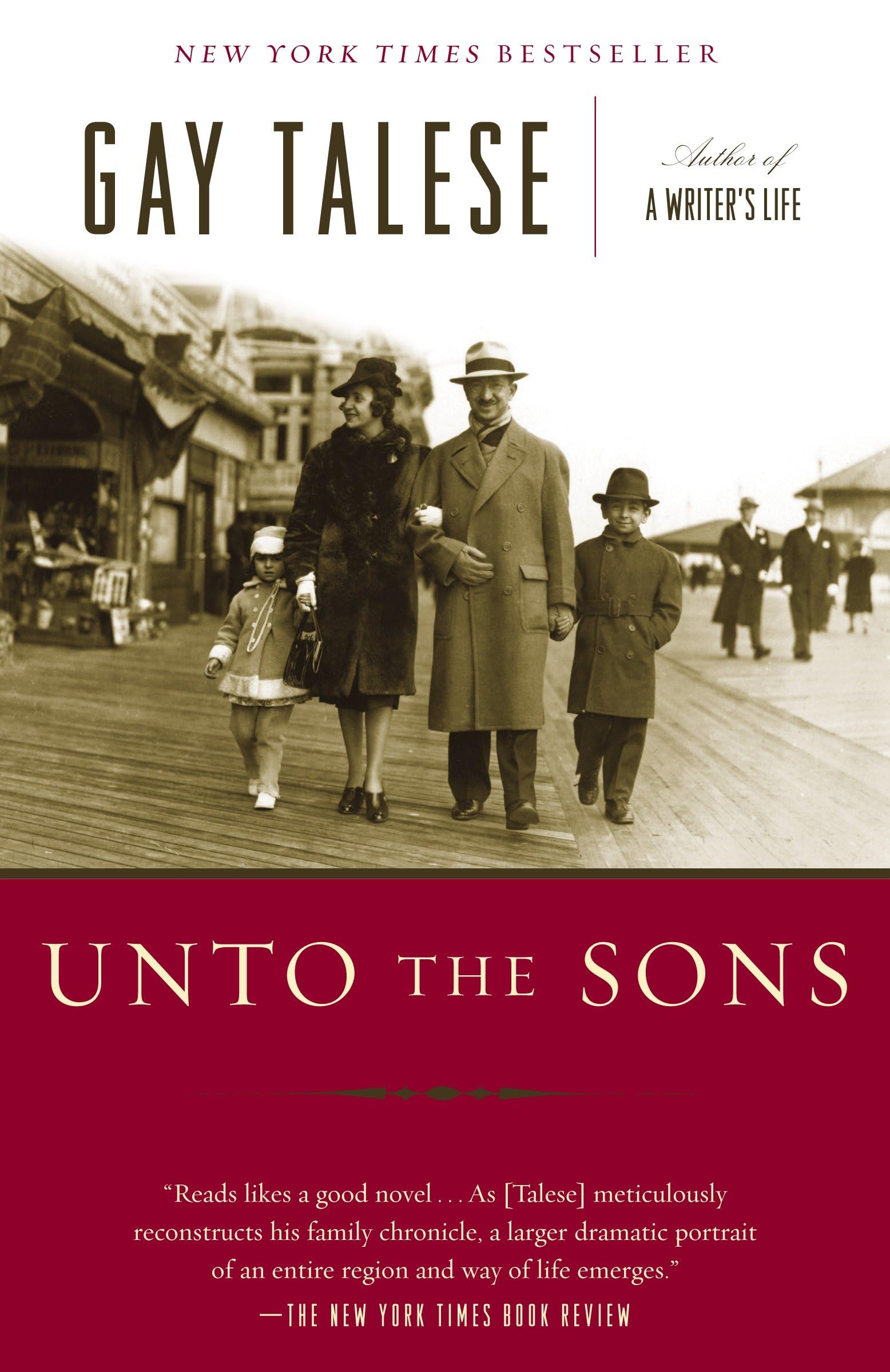



"An Italian ROOTS." —The Washington Post Book World At long last, Gay Talese, one of America's greatest living authors, employs his prodigious storytelling gifts to tell the saga of his own family's emigration to America from Italy in the years preceding World War II. Ultimately it is the story of all immigrant families and the hope and sacrifice that took them from the familiarity of the old world into the mysteries and challenges of the new. "An Italian ROOTS." The Washington Post Book World At long last, Gay Talese, one of America's greatest living authors, employs his prodigious storytelling gifts to tell the saga of his own family's emigration to America from Italy in the years preceding World War II. Ultimately it is the story of all immigrant families and the hope and sacrifice that took them from the familiarity of the old world into the mysteries and challenges of the new. "From the Paperback edition. Gay Talese was a reporter for The New York Times from 1956 to 1965. Since then he has written for The New York Times , Esquire , The New Yorker , Harper's Magazine, and other national publications. He is the author of 13 books. He lives with his wife, Nan, in New York City. 1. The beach in winter was dank and desolate, and the island dampened by the frigid spray of the ocean waves pounding relentlessly against the beachfront bulkheads, and the seaweed-covered beams beneath the white houses on the dunes creaked as quietly as the crabs crawling nearby. The boardwalk that in summer was a festive promenade of suntanned couples and children’s balloons, of carousel tunes and colored lights spinning at night from the Ferris wheel, was occupied in winter by hundreds of sea gulls perched on the iron railings facing into the wind. When not resting they strutted outside the locked doors of vacated shops, or circled high in the sky, holding clams in their beaks that they soon dropped upon the boardwalk with a splattering cluck. Then they zoomed down and pounced on the exposed meat, pecking and pulling until there was nothing left but the jagged, salty white chips of empty shells. By midwinter the shell-strewn promenade was a vast cemetery of clams, and from a distance the long elevated flat deck of the boardwalk resembled a stranded aircraft carrier being attacked by dive-bombers—and oddly juxtaposed in the fog behind the dunes loomed the rusting remains of a once sleek four-masted vessel that during a gale in the winter of 1901 had run aground on this small island in southern New Jersey called Ocean City. The steel-hulled ship, flying a British flag and flaunting hundred-fifty-foot masts, had been sailing north along the New Jersey coast toward New York City, where it was scheduled to deliver one million dollars’ worth of Christmas cargo it had picked up five months before in Kobe, Japan. But during the middle of the night, while a number of crewmen drank rum and beer in a premature toast to the long journey’s end, a fierce storm rose and destroyed the ship’s sails, snapped its masts, and drove it into a sandbar within one hundred yards of the Ocean City boardwalk. Awakened by the distress signals that flared in the night, the alarmed residents of Ocean City—a conservative community founded in 1879 by Methodist ministers and other Prohibitionists who wished to establish an island of abstinence and propriety—hastened to help the sailors, who were soon discovered to be battered but unharmed and smelling of sweat, salt water, and liquor. After the entire thirty-three-man crew had been escorted to shore, they were sheltered and fed for days under the auspices of the town’s teetotaling elders and ministers’ wives; and while the sailors expressed gratitude for such hospitality they privately cursed their fate in being shipwrecked on an island so sedate and sober. But soon they were relocated by British nautical authorities, and the salvageable cargo was barged to New York to be sold at reduced prices. And the town returned to the tedium of winter. The big ship, however, remained forever lodged in the soft white sand—unmovable, slowly sinking, a sight that served Ocean City’s pious guardians as a daily reminder of the grim consequences of intemperate guidance. But as I grew up in the late 1930s, more than three decades after the shipwreck—when the visible remnants at low tide consisted only of the barnacle-bitten ridge of the upper deck, the corroded brown rudder post and tiller, and a single lopsided mast—I viewed the vessel as a symbol of adventure and risk; and during my boyhood wanderings along the beach I became enchanted with exotic fantasies of nights in foreign ports, of braving the waves and wind with wayward men, and of escaping the rigid confines of this island on which I was born but never believed I belonged. I saw myself always as an alien, an outsider, a drifter who, like the shipwrecked sailors, had arrived by accident. I felt different from my young friends in almost every w