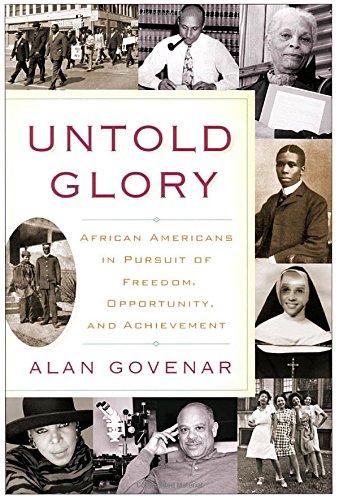
Untold Glory: African Americans in Pursuit of Freedom, Opportunity, and Achievement
$29.99
by Alan Govenar



Untold Glory offers a fresh perspective on one of the most fundamental elements of American history—the conquest of new frontiers. In twenty-seven fascinating first-person accounts, African Americans from different eras, backgrounds, and occupations explore and reflect on the meaning of frontier , both literally and metaphorically. This collection chronicles the search for freedom and opportunity and the achievement of success in a wide variety of fields. The contributors all pushed beyond self-imposed or culturally enforced boundaries to pursue their dreams and ambitions. They include Mark Dean, an IBM vice president and member of the Inventors Hall of Fame, who holds three of the original patents upon which the personal computer is based; the civil-rights attorney Oliver W. Hill, one of the architects of the Brown v. Board of Education Supreme Court case; the classical pianist and museum founder Josephine Love; and L. Douglas Wilder, the grandson of slaves who became the first African American governor of Virginia. Illustrated with black-and-white photographs and featuring an incisive introduction by Alan Govenar, Untold Glory is both an important addition to the field of African American history and an engaging, eye-opening look at some of the nation’s most daring, innovative, and influential pioneers. Exploring the beloved American concept of frontier from an African American perspective, Govenar offers portraits of 24 black achievers who forged paths for themselves in the arts, culture, business, religion, and politics. Each profile begins with a short biography followed by a first-person account of obstacles overcome and achievements earned in a cross section of professions and geography. The subjects recount the social and cultural contexts for their personal struggle and how they pushed beyond racial boundaries. The collection includes L. Douglass Wilder, the grandson of slaves who became Virginia's governor; attorney Oliver W. Hill, part of the legal team that argued the landmark Brown v. Board of Education case; Herb Jeffries, creator of the role of the black cowboy in western movies in the 1930s; Marvin Williams, a baseball player in the Negro Leagues who later tried out for the Boston Red Sox; and Frank Mark Dean, an IBM executive and holder of three of the nine patents involved in the personal computer. This is an inspiring collection of African American achievers, most not well known. Vanessa Bush Copyright © American Library Association. All rights reserved ALAN GOVENAR is the author of numerous books, including The Early Years of Rhythm and Blues , Stoney Knows How: Life as a Sideshow Tattoo Artist , Meeting the Blues: The Rise of the Texas Sound , Portraits of Community: African American Photography in Texas , Stompin’ at the Savoy: The Norma Miller Story , and Extraordinary Ordinary People: Five American Masters of Traditional Arts . He is the president and founder of Documentary Arts, a nonprofit organization that seeks to present new perspectives on diverse cultures. He lives in Dallas, Texas. Sidney Barthwell Jr. COURT MAGISTRATE Born September 1, 1947 Sidney Barthwell Jr. is a magistrate in Detroit, and in this capacity he is a judicial officer in a lower court whose jurisdiction is limited to the trial of misdemeanors, moving vehicular violations, and preliminary hearings on more serious charges. After attending what was then called Cranbrook School for Boys, he enrolled at Wayne State University, where he graduated in 1986. He taught second grade for half a year and was admitted to Harvard Law School in 1987. He received a law degree from Harvard in 1990 and was hired by Dickinson Wright, a major law firm that at the time employed 230 attorneys. After two years, Barthwell left Dickinson Wright and decided to focus his career on issues critical to the African American communities of Detroit. As one of the six magistrates appointed in the city, Barthwell works at the Thirty-sixth District Court and feels that through his efforts he can have an “impact directly on people’s lives every day.” ***** I grew up on the near west side of Detroit in an area known as the Boston Edison neighborhood. I think we moved into that house in 1949. My father was a pharmacist, and he lived in that house until the day he died, June 23, 2005. He owned a chain of drugstores. He also made his own ice cream. He had thirteen flavors. He used to make a half million gallons a year of ice cream. It was very popular at the time–Barthwell's Ice Cream. He was from Cordele, Georgia, originally. It’s the county seat of Crisp County, Georgia, and it’s about sixty–five miles south of Macon, Georgia, straight down I–75. His family migrated to Detroit around 1919. His father’s name was Jack Barthwell. I think my father had seven brothers and sisters. My grandfather’s work was agricultural in the South. But when he came up here, he worked at Ford for a lot of years in the foundry at the River Rouge