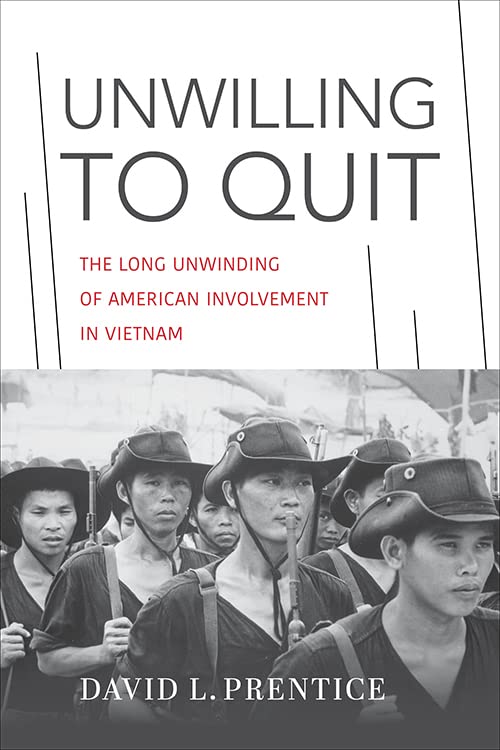
Unwilling to Quit: The Long Unwinding of American Involvement in Vietnam (Studies In Conflict Diplomacy Peace)
$35.00
by David L. Prentice



Although US involvement in the Vietnam conflict began long before 1965, Lyndon Johnson's large commitment of combat troops that year marked the official beginning of America's longest twentieth-century war. By 1969, after years of intense fighting and thousands of casualties, an increasing number of Americans wanted the United States out of Vietnam. Richard Nixon looked for a way to pull out while preserving the dignity of the United States at home and abroad, and at the same time, to support the anticommunist Republic of Vietnam. Ultimately, he settled on the strategy of Vietnamization―the gradual replacement of US soldiers with South Vietnamese forces. Drawing on newly declassified documents and international archives, Unwilling to Quit dissects the domestic and foreign contexts of America's withdrawal from the Vietnam War. David L. Prentice demonstrates how congressional and presidential politics were a critical factor in Nixon's decision to abandon his hawkish sensibilities in favor of de-escalation. Prentice reframes Nixon's choices, emphasizes Secretary of Defense Melvin Laird's outsized yet subtle role in the decision-making process, and considers how South Vietnam's Nguyen Van Thieu and North Vietnam's Le Duan decisively shaped the American exit. Prentice brings Vietnamese voices into the discussion and underscores the unprecedented influence of American civilians on US foreign policy during the Vietnamization era. "David Prentice splendidly advances an admirable historiographical trend by placing the American war in Vietnam into its proper Vietnamese context. Centering on two key characters―US Defense Secretary Melvin Laird and South Vietnamese president Nguyen Van Thieu―Prentice offers a bold new interpretation of how wartime allies approached the impending withdrawal of American troops from a long and brutal conflict. A stimulating, fresh approach to the war's final years."―Gregory A. Daddis, USS Midway Chair in Modern US Military History, San Diego State University and author of Pulp Vietnam: War and Gender in Cold War Men's Adventure Magazines "In Unwilling to Quit , David Prentice has written a brilliant and thoroughly researched history of the Nixon administration's Vietnamization policy, skillfully demonstrating what the president hoped to achieve as "peace with honor," yet revealing the frustrations and failures the policy ultimately entailed. This book is a must-read for Americans trying to understand why the Vietnam War ended as tragically as it did."―Thomas A. Schwartz, Distinguished Professor of History, Vanderbilt University, and author of Henry Kissinger and American Power: A Political Biography " Unwilling to Quit offers fresh and invaluable insights into the Vietnam War's de-Americanization. This is the first study of its kind to advance that the so-called process of Vietnamization underwritten by the Nixon administration to offset the phased withdrawal of U.S. combat forces was not only tolerated but actually embraced by South Vietnamese President Nguyen Van Thieu. In a field so marked by repetition of old, standard arguments, Prentice bravely and convincingly challenges the traditional consensus on a critical aspect of the Cold War's most consequential conflagration."―Pierre Asselin, author of Vietnam's American War: A History "Written in accessible prose, Unwilling to Quit offers a laudatory thesis that effectively re-centers America's Vietnam War policies. It is one of the first books to examine how the Thieu Administration in South Vietnam understood America's strategy....(an) important and thoughtful book."― The VVA Veteran "A splendid account of how the United States curtailed its long and bloody involvement in Vietnam. Understanding America's exit means grappling with the policy of Vietnamization and the domestic U.S. political context in which it was adopted, and Prentice does so with unprecedented power and insight. In the process, he brings needed attention to the vital role played by Secretary of Defense Melvin Laird."―Fredrik Logevall, Professor of International Affairs and History, Harvard University "A singularly impressive work of commendably detailed scholarship. . . .Exceptionally well written, organized and presented."― Midwest Book Review "The importance and originality of Prentice's contributions to our understanding of the Vietnam War cannot be overstated. . . . This is not just another book on the Vietnam War, but a crucial contribution to its historiography. To be sure, Prentice does countless things―big and small―right in his book. Fundamentally, he reminds us of the importance of considering the Vietnamese perspective in addressing the Vietnam War, and shows how rigorous research―a really deep dive into the archival record―can help us develop new understandings of old issues. Unwilling to Quit is model Vietnam War scholarship. While it goes without saying that the book is a must-read for those who are interested in the latter stages o