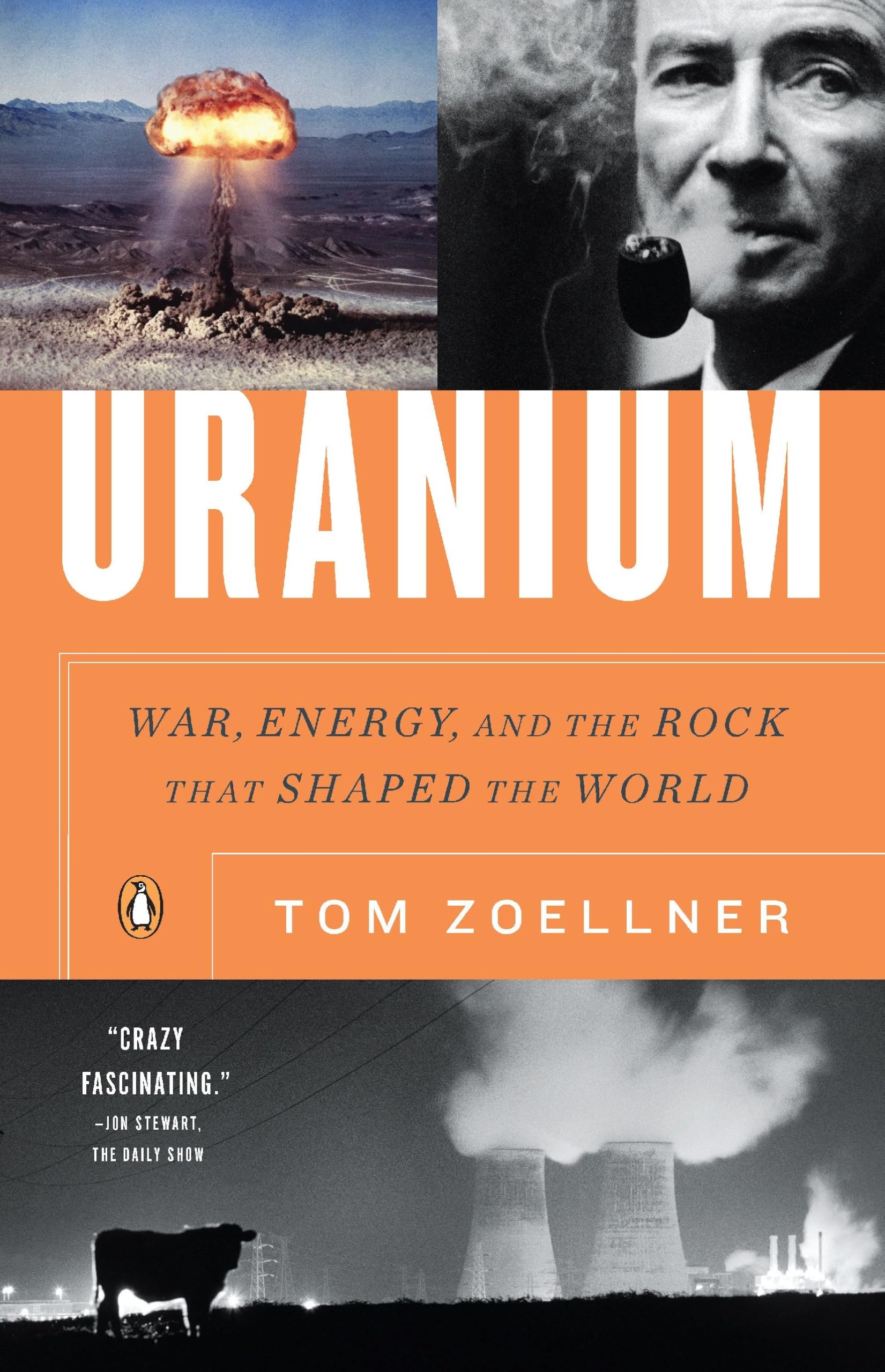



The astonishing biography of a mineral that can sustain our world- or destroy it Uranium occurs naturally in the earth's crust-yet holds the power to end all life on the planet. This is its fundamental paradox, and its story is a fascinating window into the valor, greed, genius, and folly of humanity. A problem for miners in the Middle Ages, an inspiration to novelists and a boon to medicine, a devastating weapon at the end of World War II, and eventually a polluter, killer, excuse for war with Iraq, potential deliverer of Armageddon and a possible last defense against global warming- Uranium is the riveting story of the most powerful element on earth, and one which will shape our future, for better or worse. "CRAZY, FASCINATING" - JOHN STEWART Tom Zoellner has worked as a contributing editor for Men’s Health magazine and as a reporter for the San Francisco Chronicle . His book The Heartless Stone: A Journey Through the World of Diamonds and Desire will be published in the summer of 2006. Table of Contents Title Page Copyright Page Introduction Chapter 1 - SCALDING FRUIT Chapter 2 - BEGINNINGS Chapter 3 - THE BARGAIN Chapter 4 - APOCALYPSE Chapter 5 - TWO RUSHES Chapter 6 - THE RAINBOW SERPENT Chapter 7 - INSTABILITY Chapter 8 - RENAISSANCE EPILOGUE Acknowledgements NOTES ON SOURCES INDEX VIKING Published by the Penguin Group Penguin Group (USA) Inc., 375 Hudson Street, New York, New York 10014, U.S.A. • Penguin Group (Canada), 90 Eglinton Avenue East, Suite 700, Toronto, Ontario, Canada M4P 2Y3 (a division of Pearson Penguin Canada Inc.) Penguin Books Ltd, 80 Strand, London WC2R 0RL, England Penguin Ireland, 25 St. Stephen’s Green, Dublin 2, Ireland (a division of Penguin Books Ltd) Penguin Books Australia Ltd, 250 Camberwell Road, Camberwell, Victoria 3124, Australia (a division of Pearson Australia Group Pty Ltd) • Penguin Books India Pvt Ltd, 11 Community Centre, Panchsheel Park, New Delhi-110 017, India Penguin Group (NZ), 67 Apollo Drive, Rosedale, North Shore 0632, New Zealand (a division of Pearson New Zealand Ltd) Penguin Books (South Africa) (Pty) Ltd, 24 Sturdee Avenue, Rosebank, Johannesburg 2196, South Africa Penguin Books Ltd, Registered Offices: 80 Strand, London WC2R 0RL, England First published in 2009 by Viking Penguin, a member of Penguin Group (USA) Inc. Copyright © Tom Zoellner, 2009 All rights reserved Portions of chapter 5 originally appeared in the article “The Uranium Rush,” by Tom Zoellner, in the Summer 2000 issue of The American Heritage of Invention and Technology. Library of Congress Cataloging-in-Publication Data Zoellner, Tom. Uranium : war, energy, and the rock that shaped the world / Tom Zoellner. p. cm. Includes bibliographical references and index. eISBN : 978-1-101-02452-2 1. Uranium. 2. Uranium—History. I. Title. QD181.U7Z’.431—dc22 2008029023 Without limiting the rights under copyright reserved above, no part of this publication may be reproduced, stored in or introduced into a retrieval system, or transmitted, in any form or by any means (electronic, mechanical, photocopying, recording, or otherwise), without the prior written permission of both the copyright owner and the above publisher of this book. The scanning, uploading, and distribution of this book via the Internet or via any other means without the permission of the publisher is illegal and punishable by law. Please purchase only authorized electronic editions and do not participate in or encourage electronic piracy of copyrightable materials. Your support of the author’s rights is appreciated. INTRODUCTION T his all began for me at a mesa in Utah called Temple Mountain, so named because its high-pitched walls and jagged spires had reminded early Mormon settlers of a house of worship. I had driven into the wide canyon at its base, pitched a tent among some junipers, and eaten a can of chili while sitting on a rock and watching the day’s last sunlight creeping upward on the salmon-colored walls to the east. A set of caves, their mouths agape, dotted the face of the cliff. Pyramid-shaped mounds of rock and talus were piled under them, and rotten wooden boards lay half drowned in this debris. I looked closer and saw that the caves were square, and one appeared to be propped with beams. These weren’t caves at all. They were mine entrances. It now made sense. The valley floor had that ragged and hard-used look common to many other pieces of wilderness in the American West that had been rich in gold or silver in the nineteenth century. A braiding of trails was etched into the dirt, and the slabs of an abandoned stone cabin and shattered lengths of metal pipe were down there, too, now almost obscured in the dusk. The place had been devoured quickly and then spat out, with a midden of antique garbage left behind. What kind of ore had been carted away from here? Curiosity got the better of me, and I wandered over to a spot down the trail where three other people had