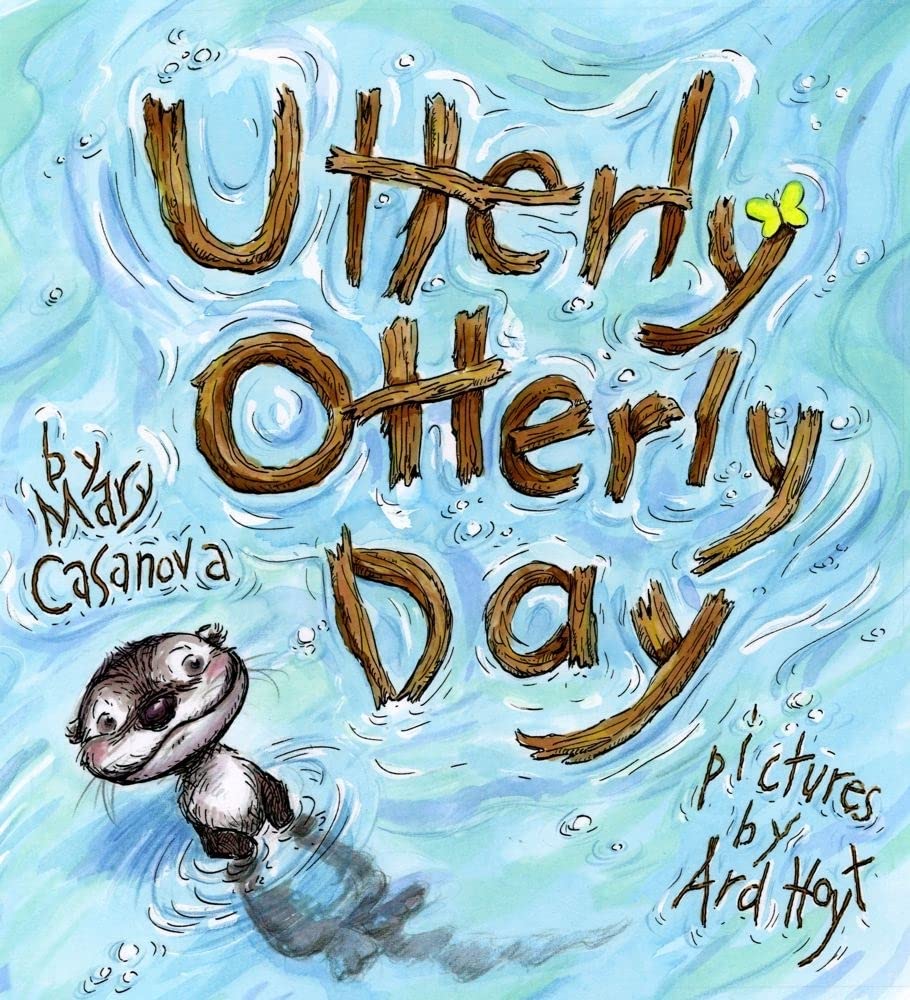



Little Otter likes to play in a carefree, unabashed, utterly otterly way. Mom warns Little Otter, "Be careful!" Dad says, "Stay close!" But does Little Otter listen? Oh, no! No. No. No. Little Otter thinks he's a big otter now, big enough to take care of himself. But watch out, Little Otter, because no matter how big you get, it's good to have loved ones looking out for you. PreS—Little Otter speeds through his day at breakneck pace, from the moment he wakes up and rouses his sleepy family to his spine-tingling sunset escape from a hungry cougar. In between, he eludes a falling tree, an eagle, a snapping turtle, and an angry fisherman. After each escape, he tells himself that "he's a big otter now," and swims away with typical preschooler bravado. His close call with the cougar leaves him shaken, however, and he retreats to the safety and comfort of the den. As he accepts some parental snuggles, he admits that "He needs his family—/no matter how big he grows." Alliteration and onomatopoeic phrases ("whippidy, slippiddy," "swishily swashily") combine to give a sense of the hustle and bustle of Little Otter's day. Sketchy watercolor drawings with multiple perspectives lend a feeling of constant movement, while the recurring image of a yellow butterfly ties the story together. As Little Otter falls asleep, he dreams of being carried away by a swarm of them, demonstrating that he is bold even in his sleep. Though a few of the illustrations are unclear, and the book is a bit too long to maintain its breathless pace, Little Otter is a likable hero with familiar childlike traits. Additionally, there is just enough information about otters to whet readers' appetite for further research.— Rachael Vilmar, Eastern Shore Regional Library, Salisbury, MD Copyright © Reed Business Information, a division of Reed Elsevier Inc. All rights reserved. In this story about the fun and the perils of independence, Little Otter bounds away from his den, encounters one dangerous creature after another, and then gets back home with the help of his family. The pen-ink-and-watercolor illustrations by Hoyt (who has illustrated two of Casanova’s previous books) emphasize the quick, exciting movement of the forest’s animals, while the text hops with made-up rhyming words meant to capture Little Otter’s frantic efforts to escape from such menaces as an eagle and a giant snapping turtle. There’s some fierce fur pulling and tail biting when Little Otter’s family rescues him from very a hungry cougar, but his survival is never really in doubt. The lesson isn’t subtle (“His paws stop trembling. He tucks tail to nose. He needs his family—no matter how big he grows”), and the lack of a coherent rhyme scheme makes for a sometimes frustrating read-aloud,. Even so, the adventurous otter and his caring family prove fairly irresistible, pictured snug and cuddly in their warm den. Preschool-Grade 1. --Abby Nolan Mary Casanova is an award-winning children's author of novels and picture books. Many of her books stem from her life on the Minnesota-Canadian border; yet some of her stories have taken her as far away as France, Norway, and Belize for research. Ard Hoyt has illustrated a number of books, including the New York Times bestsellers I’m a Manatee by John Lithgow and The Hair of Zoe Fleefenbacher Goes to School by Laurie Halse Anderson. Ard lives with his wife and five daughters in Bentonville, Arkansas. Used Book in Good Condition