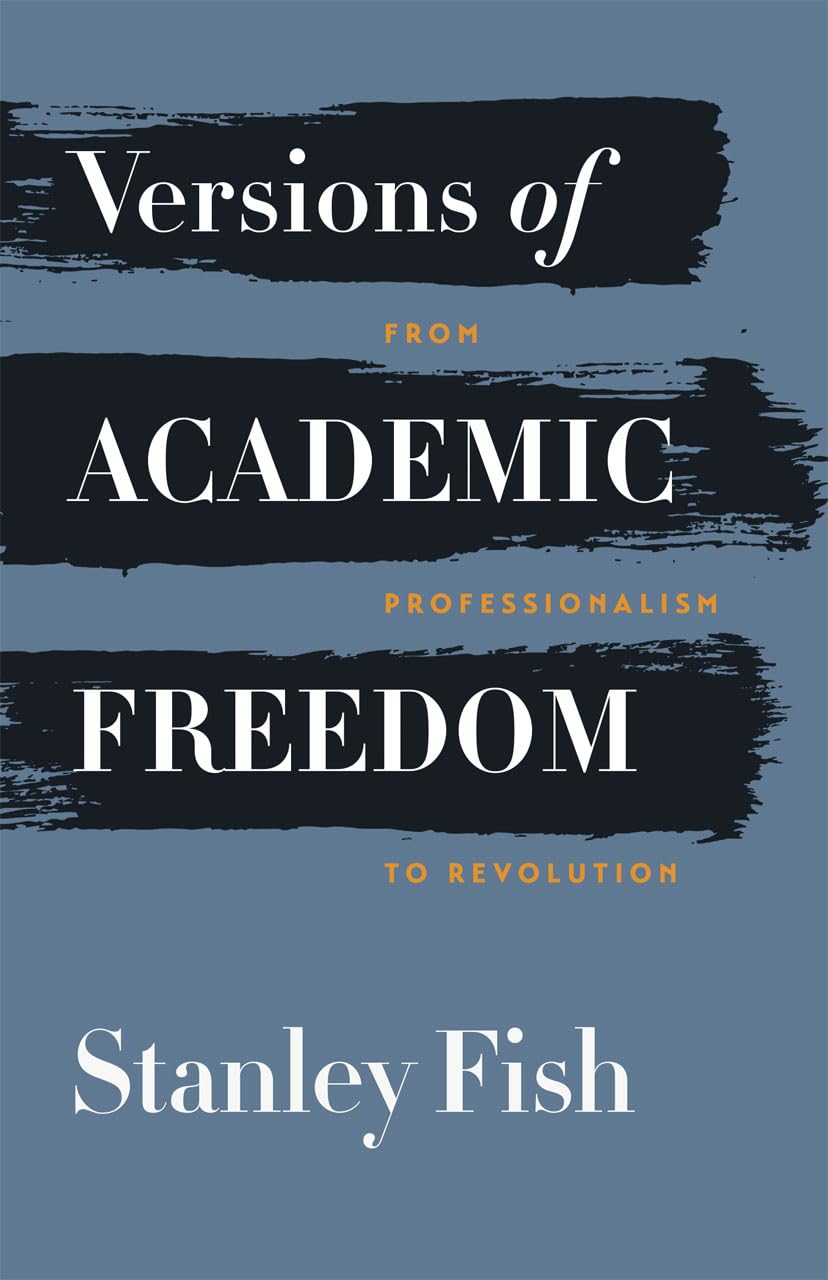
Versions of Academic Freedom: From Professionalism to Revolution (The Rice University Campbell Lectures)
$24.20
by Stanley Fish



Through his columns in the New York Times and his numerous best-selling books, Stanley Fish has established himself as our foremost public analyst of the fraught intersection of academia and politics. Here Fish for the first time turns his full attention to one of the core concepts of the contemporary academy: academic freedom. Depending on who’s talking, academic freedom is an essential bulwark of democracy, an absurd fig leaf disguising liberal agendas, or, most often, some in-between muddle that both exaggerates its own importance and misunderstands its actual value to scholarship. Fish enters the fray with his typical clear-eyed, no-nonsense analysis. The crucial question, he says, is located in the phrase “academic freedom” itself: Do you emphasize “academic” or “freedom”? The former, he shows, suggests a limited, professional freedom, while the conception of freedom implied by the latter could expand almost infinitely. Guided by that distinction, Fish analyzes various arguments for the value of academic freedom: Is academic freedom a contribution to society's common good? Does it authorize professors to critique the status quo, both inside and outside the university? Does it license and even require the overturning of all received ideas and policies? Is it an engine of revolution? Are academics inherently different from other professionals? Or is academia just a job, and academic freedom merely a tool for doing that job? No reader of Fish will be surprised by the deftness with which he dismantles weak arguments, corrects misconceptions, and clarifies muddy arguments. And while his conclusion―that academic freedom is simply a tool, an essential one, for doing a job―may surprise, it is unquestionably bracing. Stripping away the mystifications that obscure academic freedom allows its beneficiaries to concentrate on what they should be doing: following their intellectual interests and furthering scholarship. "With his customary flair and insight, Stanley Fish discusses essential contemporary issues of academic freedom. Fish’s views are consistently trenchant and illuminating. They should be required reading for anyone interested in these questions." -- Robert Post, Yale University "Stanley Fish makes a full-throated attack on conceptions of the academic’s role and academic freedom that depart from the job description 'teaching and research in accordance with the standards of the discipline in which I'm engaged.' Fish demurs to more grandiose alternative job descriptions, such as revolutionary, social critic, public servant, or exceptional human being. Once academics move beyond the standards of their discipline, then according to Fish, they no longer are functioning as academics or entitled to any freedom unique to academics. For academic freedom is nothing more than the freedom necessary to fulfill the academic's role, which is defined by the standards of his or her discipline. Fish's argument is one that every academic should confront and, in my opinion, should accept." -- Larry Alexander, University of San Diego "In this bracingly clarifying book, Stanley Fish shows why the concept of academic freedom, as it is widely invoked, is radically incoherent. He follows this unsettling revelation by convincingly demonstrating why academic freedom makes sense only if it is understood as the freedom of academics to do their distinctive jobs--intellectual analysis, research, and teaching. In the process he shows why academic freedom must not be confused with saving the world." -- Gerald Graff, University of Illinois at Chicago Stanley Fish is the Davidson-Kahn Distinguished University Professor of Law and the Humanities in the College of Law at Florida International University and the author of numerous books. Versions of Academic Freedom From Professionalism to Revolution By Stanley Fish The University of Chicago Press Copyright © 2014 Stanley Fish All rights reserved. ISBN: 978-0-226-06431-4 Contents Preface, Acknowledgments, 1 ACADEMIC FREEDOM STUDIES: The Five Schools, 2 THE "IT'S JUST A JOB" SCHOOL: Professionalism, Pure and Simple, 3 THE "FOR THE COMMON GOOD" SCHOOL: Academic Freedom, Shared Governance, and Democracy, 4 PROFESSIONALISM VS. CRITIQUE: The Post-Butler Debates, 5 ACADEMIC EXCEPTIONALISM AND PUBLIC EMPLOYEE LAW, 6 VIRTUE BEFORE PROFESSIONALISM: The Road to Revolution, Coda, APPENDIX, Works Cited, Index, CHAPTER 1 ACADEMIC FREEDOM STUDIES The Five Schools In 2009 Terrence Karran published an essay with the title "Academic Freedom: In Justification of a Universal Ideal." Although it may not seem so at first glance, the title is tendentious, for it answers in advance the question most often posed in the literature: How does one justify academic freedom? One justifies academic freedom, we are told before Karran's analysis even begins, by claiming for it the status of a universal ideal. The advantage of this claim is that it disposes of one of