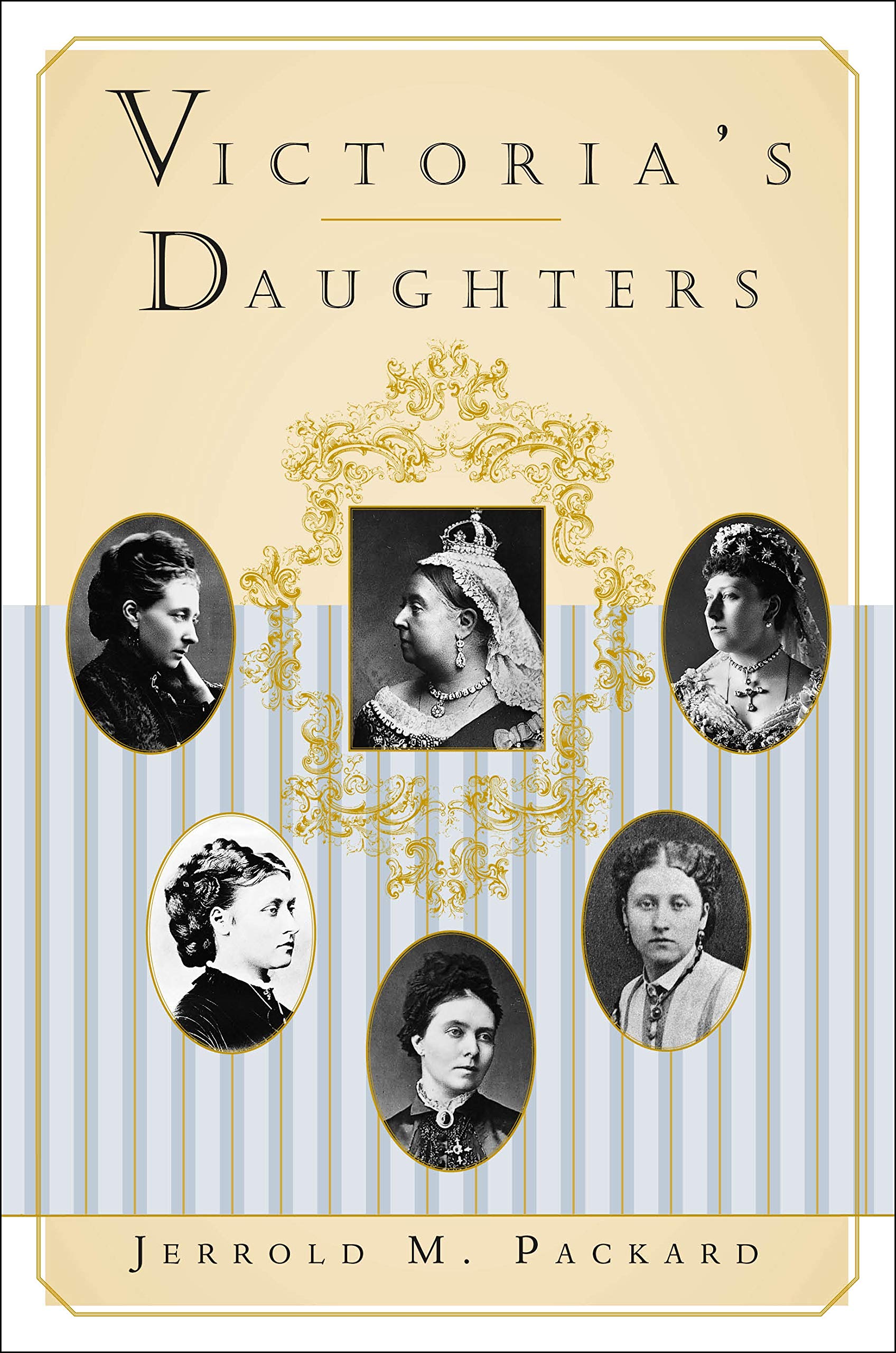



Five women who shared one of the most extraordinary and privileged sisterhoods of all time... Vicky, Alice, Helena, Louise, and Beatrice were historically unique sisters, born to a sovereign who ruled over a quarter of the earth's people and who gave her name to an era: Queen Victoria. Two of these princesses would themselves produce children of immense consequence. All five would face the social restrictions and familial machinations borne by ninetheenth-century women of far less exalted class. Researched at the houses and palaces of its five subjects-- in London, Scotland, Berlin, Darmstadt, and Ottawa-- Victoria's Daughters examines a generation of royal women who were dominated by their mother, married off as much for political advantage as for love, and passed over entirely when their brother Bertie ascended to the throne. Packard, an experienced biographer whose last book chronicled Victoria's final days, provides valuable insights into their complex, oft-tragic lives as scions of Europe's most influential dynasty, and daughters of their own very troubled times. “Packard's narrative is accessible, unpretentious, and solidly written....He manages to treat historical events succinctly while emphasizing the princesses' individual lives and family relationships, their talents in music and art, their patronage of schools and hospitals, and their pioneering advocacy of women's education and employment.” ― Publishers Weekly Jerrold Packard 's books include the best-selling Victoria's Daughters , the life stories of the five princesses born to Britain's longest-reigning monarch; Sons of Heaven , a chronicle of Japan's monarchy over fourteen centuries; and American Nightmare , the history of Jim Crow and the racial torment that America endured for more than a hundred years in the wake of the Civil War. Mr. Packard lives in Vermont. VICTORIA'S DAUGHTERS 1Foundations S ince neither the queen nor her new husband had the first idea how pregnancy might be avoided, only weeks after her wedding the amazed Victoria found herself, not particularly happily, with child. The expectant mother suppressed her horror of what she called the "shadow side" of marriage and resolved to look upon the approaching event with something like equanimity. Both parents were determined to give their kingdom a male heir, such production representing the most fundamental duty of sovereign mother and consort father. Thus it happened that in the early hours of November 21, 1840, a rainy day Victoria remembered most clearly for the smoking chimneys outside her bedroom windows, the young queen's labor pains began, a week or two earlier than her doctors had predicted.Because of the low state of medicine in the early nineteenth century, childbirth was still a largely primitive undertaking. Though royal deliveries were conducted with a degree of care far exceeding that received by most of her kingdom's mothers, the effort had, in truth, killed the queen's aunt, a tragedy most responsible for putting Victoria on the throne. This unique position she nowfilled with a prideful mix of noblesse oblige and the assuredness that it had been God's own plan. Indeed, it did appear that divine facilitation had led some three and a half years earlier to the accession of the eighteen-year-old princess to Britain's throne. To understand how Victoria became queen of England, it is necessary to look back a few decades, to the reign of her grandfather, King George III, and his queen, Charlotte. George, the prince of Wales, the couple's eldest child, had to the surprise of many fulfilled his dynastic duty by contracting for a lawful marriage, relatively late in life--he was already in his thirties when he went to the altar. Others, however, accurately foresaw the failure of that enterprise, since his bride-to-be was a woman whose tastes differed in almost every particular from those of her reluctant fiancé.To complicate the situation, the royal groom had already been married--although his first marriage, to the Roman Catholic widow Maria Fitzherbert, was officially kept secret: marriage between any heir to the British throne and a Catholic was impermissible under the law as it then stood, and to this day continues so. Because of its illegality, George's marriage to Mrs. Fitzherbert had been contracted in an essentially morganatic state (though Britain didn't and still legally doesn't recognize this either),1 which meant that his wife could not assume rank as princess of Wales, nor could any children of that union have inherited rank, titles, or rights to the throne from their father. Though on becoming king George could have made Mrs. Fitzherbert his queen--she was already widely called "Princess Fitz"--such an act would have brought disapprobation from every European court, as well as grave constitutional questions as to the legitimacy of Britain's crown, a matter taken by royalty of the early nineteenth century with massive seriousness, and therefore not