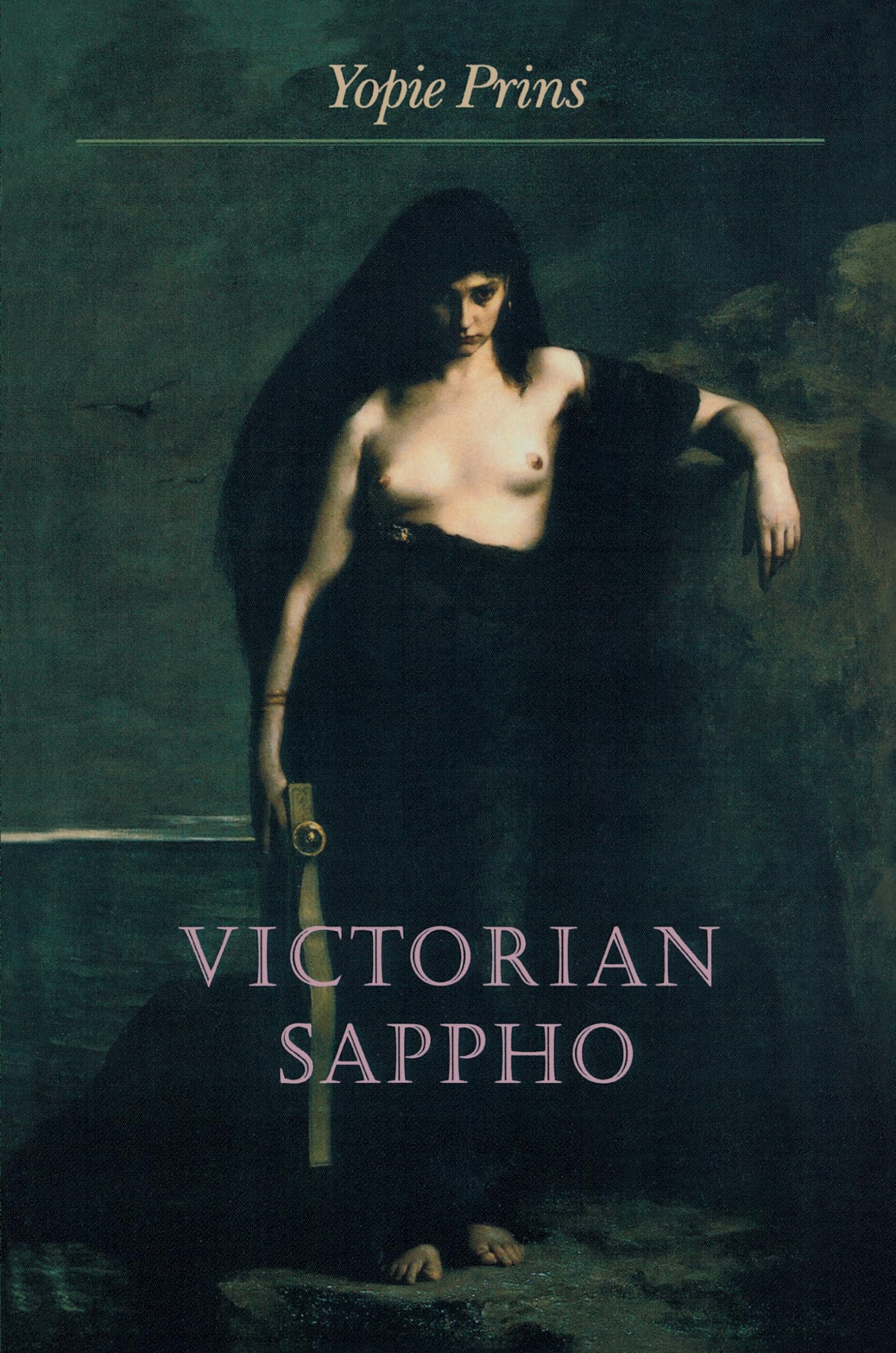



What is Sappho, except a name? Although the Greek archaic lyrics attributed to Sappho of Lesbos survive only in fragments, she has been invoked for many centuries as the original woman poet, singing at the origins of a Western lyric tradition. Victorian Sappho traces the emergence of this idealized feminine figure through reconstructions of the Sapphic fragments in late-nineteenth-century England. Yopie Prins argues that the Victorian period is a critical turning point in the history of Sappho's reception; what we now call "Sappho" is in many ways an artifact of Victorian poetics. Prins reads the Sapphic fragments in Greek alongside various English translations and imitations, considering a wide range of Victorian poets--male and female, famous and forgotten--who signed their poetry in the name of Sappho. By "declining" the name in each chapter, the book presents a theoretical argument about the Sapphic signature, as well as a historical account of its implications in Victorian England. Prins explores the relations between classical philology and Victorian poetics, the tropes of lesbian writing, the aesthetics of meter, and nineteenth-century personifications of the "Poetess." as current scholarship on Sappho and her afterlife. Offering a history and theory of lyric as a gendered literary form, the book is an exciting and original contribution to Victorian studies, classical studies, comparative literature, and women's studies. A remarkable new addition to the fields of gender studies, classical studies, and modern poetics, Yopie Prins's Victorian Sappho sends off many casually brilliant sparks, with a broad appeal that easily transcends disciplines. "Invoked as a lyric muse in antiquity and mythologized for posterity by Ovid," Sappho has always been "a figment of the literary imagination." Prins traces the 19th-century recovery of new fragments of Sappho's poems and the allure they held for classical philologists, who attempted to piece together not only her lyrics but her absent, impossible self--the feminine voice and the female body. In scholarly writing, as well as the work of Swinburne and countless popular poets like Felicia Hemans, Sappho eventually came to embody the Victorian definition of the lyric. The era's fascination with the "incomplete" Sappho carried over to this century in the modernist idealization of the fragment. The book features engaging scholarship--the introduction alone establishes Prins as a strong and subtle thinker--and is gorgeously written. --Regina Marler "Winner of the 2001 Sonya Rudikoff First Book Prize, Northeast Victorian Studies Association" "Honorable Mention for the 2000 First Book Prize of the Modern Language Association" "Prins' immersion in the Victorian art and literature of Sappho is deep; the sophistication of her approach is formidable. . . . By any measure this book is a debut of major ambition and considerable achievement." ― London Review of Books "Yopie Prins elegantly unravels the complex Victorian reception of Sappho. Notable above all for what it reveals about the theory and practice of translation, her book offers brilliant close readings of the translation, interpretation, imitation or adaption of Sappho's notoriously ambigious and fragmentary poetry." ―Helene Foley, Barnard College, Columbia University "Few readers of Victorian poetry display Yopie Prins's remarkable erudition, theoritical subtlety, and interpretive acuity. Her brilliant discussion illuminates how and why Sappho took many distinctive lyric shapes in Victorian culture. Further, Prins reveals how a searching, deconstructive critique of lyric can produce an innovative literary history." ―Joseph Bristow, University of California, Los Angeles "Yopie Prins elegantly unravels the complex Victorian reception of Sappho. Notable above all for what it reveals about the theory and practice of translation, her book offers brilliant close readings of the translation, interpretation, imitation or adaption of Sappho's notoriously ambigious and fragmentary poetry." --Helene Foley, Barnard College, Columbia University "Few readers of Victorian poetry display Yopie Prins's remarkable erudition, theoritical subtlety, and interpretive acuity. Her brilliant discussion illuminates how and why Sappho took many distinctive lyric shapes in Victorian culture. Further, Prins reveals how a searching, deconstructive critique of lyric can produce an innovative literary history." --Joseph Bristow, University of California, Los Angeles Yopie Prins is Associate Professor of English and Comparative Literature at the University of Michigan. Used Book in Good Condition