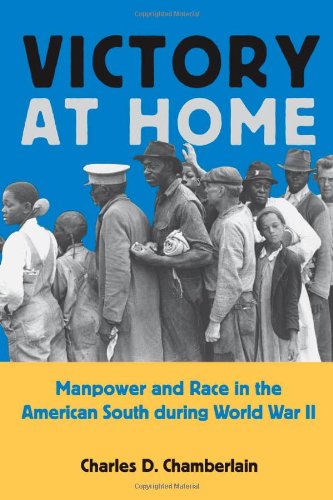
Victory at Home: Manpower and Race in the American South During World War II (Economy and Society in the Modern South)
$69.95
by Charles D. Chamberlain



Describes the trend, emerging during World War II, of the South's poor population using the war's industrialization to acquire employment and social stature, a trend that extended into the civil rights era to fight segregation. "Chamberlain's work opens a window on a chaotic, explosive South, a region in which wartime labor shortages reshuffled the population and placed unprecedented strains on the social and economic workings of Jim Crow segregation. The research is deep, the information fresh, and the writing clear. By focusing on one critical issue—labor power for wartime production—Chamberlain's work sheds new light on the complex dynamics of the southern (and national) economy of the 1940s."—Douglas Flamming "An important account of the impact of World War II on southern African American workers. Chamberlain describes how they used the economic opportunities the war provided to press their own demands for political and economic justice, and how the wartime experiences of black labor shaped the postwar civil rights struggle."--Nan Elizabeth Woodruff, author of The American Congo: The African American Freedom Struggle in the Arkansas and Mississippi Delta, 1900–1950 " Victory at Home deserves to be on every short list of indispensable books on World War II and race. Researched both broadly and deeply, and persuasively argued, Chamberlain's nuanced account of wartime mobilization and federal manpower policies at both the regional and local levels provides fresh and revealing insights into the war's transformative impact upon the South, as well as penetrating explanations for the region's continuities and retractions. His revisionist view of southern African American goals and strategies during war helps to illuminate both the struggle against white supremacy to come as well as the subsequent massive resistance to that movement."--Harvard Sitkoff, University of New Hampshire "Whiteness ideology may be fashionable, but Charles D. Chamberlain's Victory at Home reveals the virtues of research in government archives, black newspapers, and labor union records. Chamberlain focuses on the way World War II altered conditions for African American southern workers in the South and in other regions. . . . Chamberlain has produced an important story of migration and economic mobility."-- Journal of American History "Historians interested in the South, race, and economic history will find Victory at Home very useful in rethinking the World War II era."-- History: Reviews of New Books Charles D. Chamberlain is the museum historian at the Louisiana State Museum and an adjunct professor of history at Tulane University.