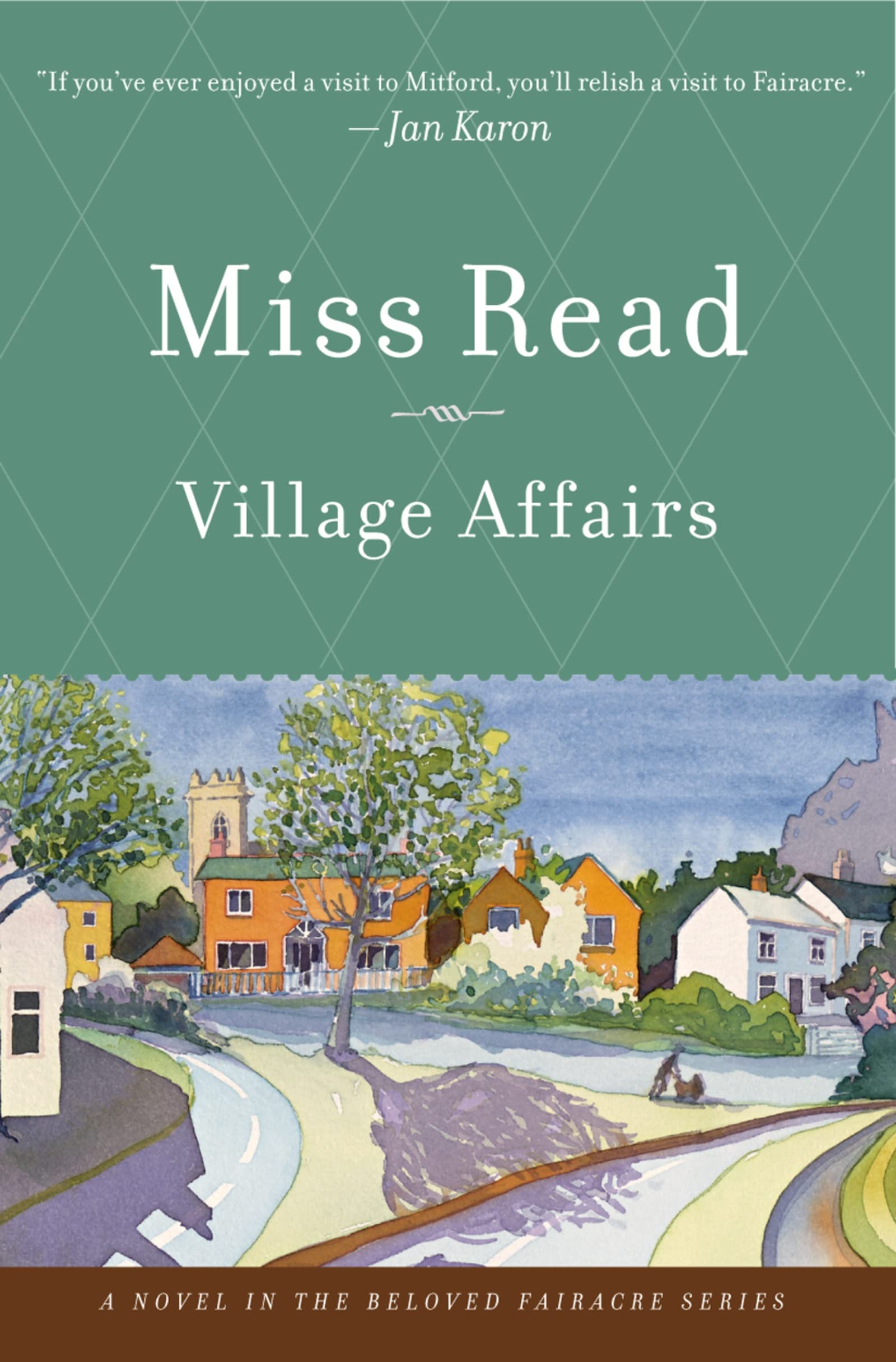



Open the gate to Fairacre, America’s favorite English village. The English village of Fairacre may appear idyllically peaceful to passersby, but those who live among its shady lanes always have problems to untangle. When a terrible rumor emerges — that the Fairacre School is to be closed and the children bused to nearby Beech Green — the village is up in arms at once. The schoolmistress, Miss Read, suffers agonizing indecision at the prospect, and her situation is made worse when her infants’ room teacher decides to leave and the short-tempered Mrs. Pringle becomes more contrary than ever. Miss Read (1913-2012) was the pseudonym of Mrs. Dora Saint, a former schoolteacher beloved for her novels of English rural life, especially those set in the fictional villages of Thrush Green and Fairacre. The first of these, Village School , was published in 1955, and Miss Read continued to write until her retirement in 1996. In the 1998, she was awarded an MBE, or Member of the Order of the British Empire, for her services to literature. Village Affairs By Miss Read, J. S. Goodall Houghton Mifflin Harcourt Publishing Company Copyright © 1977 Miss Read All rights reserved. ISBN: 978-0-618-96242-6 Contents Title Page, Contents, Copyright, Dedication, The Rumours Fly, Forebodings, News of Minnie Pringle, Could It Be Arthur Coggs?, Mrs Pringle Has Problems, Hazards Ahead, The Managers' Meeting, Troubles Never Come Singly, Fairacre Hears the News, A Welcome Diversion, Mrs Pringle Goes to War, Who Shall It Be?, Problems, Militant Managers, Other People's Homes, The Summer Holiday, Fate Lends a Hand, Two Ladies in Trouble, Snow, Renewed Fears, A Battle in Caxley, Doctor Martin Meets His Match, Relief on Two Fronts, About the Author, Connect with HMH, CHAPTER 1 Forebodings IT is an undisputed fact that people who choose to live in the country must expect to be caught up, willy-nilly, in the cycle of the seasons. Spring-cleaning is done to the accompaniment of the rattle of tractors as they drill up and down the bare fields outside. Lambs bleat, cuckoos cry, blackbirds scold inquisitive cats, while upstairs the sufferers from spring influenza call hoarsely for cold drinks. Summer brings its own background of sights and sounds and the pace of village life quickens as fêtes follow cricket matches, and outings, tennis parties and picnics crowd the calendar. There is not quite so much junketing in the autumn, for harvest takes pride of place, and both men and women are busy storing and preserving, filling the barns and the pantry shelves. It is almost a relief to get to winter, to put away the lawn mower, to burn the garden rubbish, and to watch the ploughs at work turning the bright corn stubble into dark chocolate ribs ready for winter planting, while the rooks and peewits flutter behind, sometimes joined by sea-gulls when the weather is cruel elsewhere. For each of us in the country our own particular pattern of life forms but a small part against the general background of the seasons. If you are a schoolmistress, as I am, then the three terms echo in miniature the rural world outside. The Christmas term brings the arrival of new children to the school, harvest festival and, of course, the excitement of Christmas itself. The Spring term is usually the coldest and the most germ-ridden, but catkins and primroses bring hope of better times, and summer itself is the crown of the year. It is good to have this recurring rhythm, this familiar shape of the year. We know — to some extent — what to expect, what to welcome, what to avoid. But there is another aspect of country life which is not so steady. There are certain topics which crop up again and again. Not, to be sure, as rhythmically as primroses and harvest, but often enough over the years to give us a little jolt of recognition. There is the matter of the village hall, for instance. Is it needed or not needed? And then there is the parlous state of the church organ and its eternal fund. And Mrs So-and-so is expecting again for the twelfth — or is it the thirteenth? — time, and something must be done about her house, or her husband, or both. It is rather like watching a roundabout at a Fair. The galloping horses whirl by, nostrils flaring, tails streaming, and then suddenly there is an ostrich, strange and exotic in its plumage among the everyday beasts. The merry-go-round twirls onward and we begin to sink back again into our pleasant lethargy when, yet again, the ostrich appears and our interest is quickened once more. So it is with these topics which disappear for a time whilst we are engrossed with everyday living, and then reappear to become the chief matters of importance, our talking points, things which have startled us from our normal apathy and quickened our senses. Just such a recurring topic is the possible closure of Fairacre School. I have been headmistress here for a number of years, and talk of closin