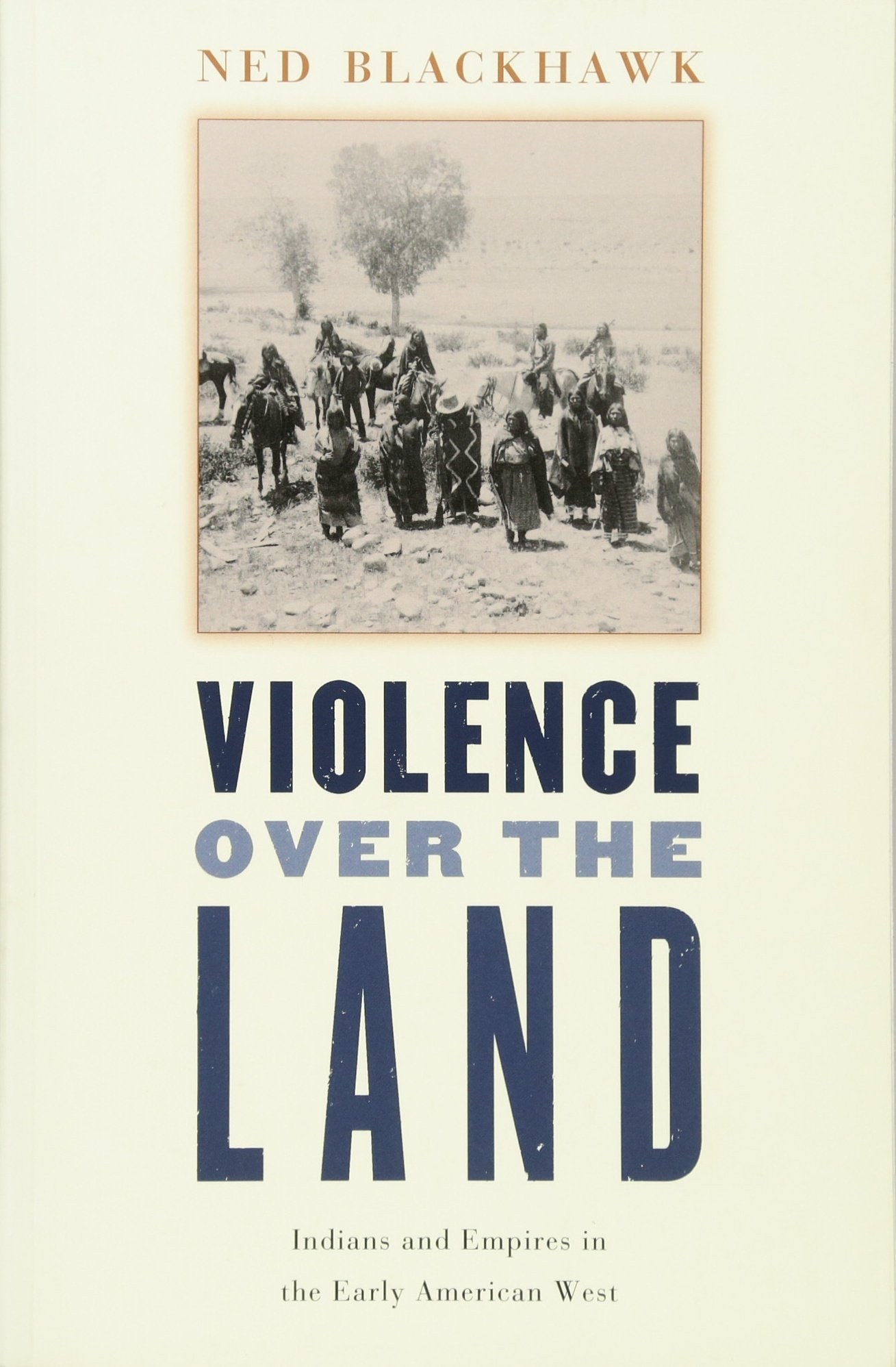
Violence over the Land: Indians and Empires in the Early American West
$29.34
by Ned Blackhawk



American Indians remain familiar as icons, yet poorly understood as historical agents. In this ambitious book that ranges across Utah, Nevada, New Mexico, Colorado, and eastern California (a region known as the Great Basin), Ned Blackhawk places Native peoples squarely at the center of a dynamic and complex story as he chronicles two centuries of Indian and imperial history that profoundly shaped the American West. On the distant margins of empire, Great Basin Indians increasingly found themselves engulfed in the chaotic storms of European expansion and responded in ways that refashioned themselves and those around them. Focusing on Ute, Paiute, and Shoshone Indians, Blackhawk illuminates this history through a lens of violence, excavating the myriad impacts of colonial expansion. Brutal networks of trade and slavery forged the Spanish borderlands, and the use of violence became for many Indians a necessary survival strategy, particularly after Mexican Independence when many became raiders and slave traffickers. Throughout such violent processes, these Native communities struggled to adapt to their changing environments, sometimes scoring remarkable political ends while suffering immense reprisals. Violence over the Land is a passionate reminder of the high costs that the making of American history occasioned for many indigenous peoples, written from the vantage point of an Indian scholar whose own family history is intimately bound up in its enduring legacies. “Blackhawk’s achievement…is not just rephrasing what is already known, but actually filling a void in historical knowledge by restoring previously overlooked peoples to the record… Blackhawk claims that American history has ‘failed to reckon with the violence upon which the continent was built’… No other Western historian has exposed that violence as starkly as he has.” ― David Wishart , Times Literary Supplement “Ned Blackhawk’s Violence over the Land provides much more than a few missing pages of what came to be the northern frontier of the Spanish colonial empire―or the early American West. More than that, it is a contribution to the living narrative of this continent…one that begins not with the arrival of three European ships in 1492, not with conquistadors or soldiers and missionaries―but rather far back to a time before recorded history on this continent… Violence over the Land is complex, layered history that covers what is nowadays referred to as the Great Basin… It is a region and a history that is normally ignored by U.S. historians.” ― Roberto Rodriguez and Patrisia Gonzales , Column of the Americas “This book fills large gaps―both geographical and historical―in the narratives of the intermountain West. Blackhawk demonstrates the prominent role of violence, albeit with occasional respires, in shaping native–settler relations. Furthermore, he shows how violence, and especially the attempts by native peoples to adjust to it, shaped their histories and social organizations. Violence over the Land is a significant addition to the history of the U.S. West. It sets a high standard on how to use colonizers’ accounts to present native views of history.” ― Thomas D. Hall , Journal of American History “This book takes an academic approach but reads well and reveals an interesting aspect of Southwestern history from a new perspective. It will probably be recognized as a ground-breaking advance in Native American history.” ― Charles Bennett , New Mexico Magazine “Ned Blackhawk’s Violence over the Land presents the empirical record from the Spanish West, the areas of New Mexico, Arizona, Colorado, and the Great Basin country of Utah and Nevada where the various Ute, Pauite, and Shoshone tribes lived. The age of modern empire brought first the Spanish empire and its clashes with the British and French empires, followed by the Spanish and American clashes that resulted in American supremacy across the continent. It is a perspective of an expanding American empire overtaking a weakened Spanish empire (after 1824, the Republic of Mexico), based on the view that American continental expansion was as much more about empire and empirical control of property, wealth, and resources, as any other civilizing drive… Blackhawk effectively weaves a story beginning with the Spanish, involving the rise of equestrian nations from captured and stolen horses, the effects of disease, the changes in tribal economies brought about by settlements and trade for products increasingly in demand as they became necessary for survival and accommodation to the newcomers, rifles and ammunition. Slavery played a large role in the economies of the area… The violence that is the subject of this book, of ‘Indians and Empires,’ carries itself forward today with American imperial ambitions around the globe. It is both the predominant military violence and its inter-woven cultural aspects, with the changing manner of accommodation by the groups that encounter and r