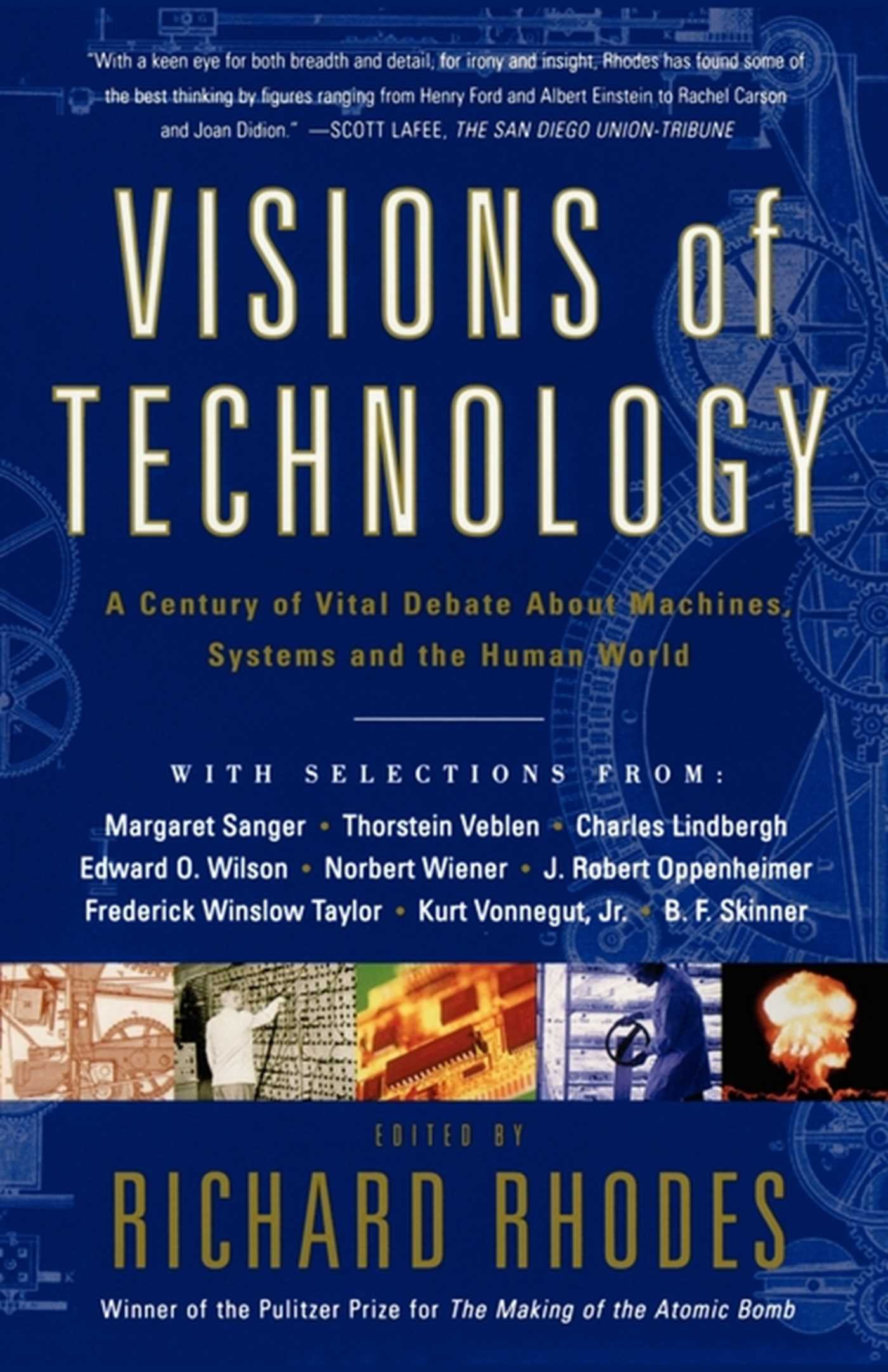
Visions Of Technology: A Century Of Vital Debate About Machines Systems And The Human World
$12.79
by Richard Rhodes



Technology was the blessing and the bane of the twentieth century. Human life span nearly doubled in the West, but in no century were more human beings killed by new technologies of war. Improvements in agriculture now feed increasing billions, but pesticides and chemicals threaten to poison the earth. Does technology improve us or diminish us? Enslave us or make us free? With this first-ever collection of the essential twentieth-century writings on technology, Pulitzer Prize-winning historian Richard Rhodes explores the optimism, ambivalence, and wrongheaded judgments with which Americans have faced an ever-shifting world. Visions of Technology collects writings on events from the Great Exposition of 1900 and the invention of the telegraph to the advent of genetic counseling and the defeat of Garry Kasparov by IBM's chess-playing computer, Deep Blue. Its gems of opinion and history include Henry Ford on the horseless carriage, Robert Caro on the transformation of New York City, J. Robert Oppenheimer on science and war, Loretta Lynn on the Pill and much more. Together, they chronicle an unprecedented century of change. "With a keen eye for both breadth and detail, for irony and insight, Rhodes has found some of the best thinking by figures ranging from Henry Ford and Albert Einstein to Rachel Carson and Joan Didion."– Scott LaFee, The San Diego Union-Tribune "A captivating encapsulation of our dissonant feelings about technology."– Gilbert Taylor, Booklist "The book reads like a condensed history of technology, told through the strained voices of those who marvel -- or cower -- at its impact."– Jeff Pooley, Brill's Content Richard Rhodes is the author of numerous books and the winner of the Pulitzer Prize, the National Book Award, and the National Book Critics Circle Award. He graduated from Yale University and has received fellowships from the Ford Foundation, the National Endowment for the Arts, the John Simon Guggenheim Memorial Foundation, and the Alfred P. Sloan Foundation. Appearing as host and correspondent for documentaries on public television’s Frontline and American Experience series, he has also been a visiting scholar at Harvard and MIT and is an affiliate of the Center for International Security and Cooperation at Stanford University. Visit his website RichardRhodes.com. Visions Of Technology A Century Of Vital Debate About Machines Systems And The Human World By Richard Rhodes Simon & Schuster Copyright © 2000 Richard Rhodes All right reserved. ISBN: 0684863111 Introduction Richard Rhodes The Western world has argued passionately about technology -- what it is, where it's going, whether it's good or bad for us -- throughout the twentieth century, even while inventing it at a ferocious and accelerating rate. This anthology samples that vital debate, drawing primarily on American sources. It's an impressionistic sampling. It had to be, given the sheer volume of statements, articles, books and documents generated across a hundred years. I sorted for variety, for felicity and succinctness of expression, for range not only of subject but also of mood. I looked for humor to balance solemnity, prediction to balance explication, recollection to balance abstraction. I included a share of the canonical texts all of us have heard (or, sometimes, misheard) -- H. G. Wells's prediction of atomic bombs, Arthur C. Clarke's vision of geosynchrony, Murphy's Law, Moore's Law, the silent spring of Rachel Carson. I left out most commentary on medicine, which is regularly attended because of its mortal impact on our lives. Something you think should be here is probably missing; but I hope you will also be surprised by what you find. If my witching methods work, drinking from this particular Pierian spring may at least leave you thirsty to explore the original texts, a mighty river of discourse. Those texts are referenced in the bibliography that begins on page 381. I could pretend innocence of America's environmental and cultural wars and say that technology is human making. At first inspection, it is that -- from lemon pie to computer chips, from plowshares to gene sequencers. Along with language, it's what distinguishes us from the other species with which we share the planet. People used to speak of craft or "practical arts"; in that guise, technology has been around for a good two million years. The Pleistocene spearpoint flaked from pink flint that I display on my coffee table was the high technology of its day, as sophisticated and effective as a samurai sword or a fighter jet. But for many of us, "technology" means something more specific (and problematic) than craft or practical art; hearing the word applied to cooking or gardening might surprise us, at least initially. In this more recent sense, the term came into use only about 150 years ago, adapted from a classical Greek noun meaning a systematic treatment, as of grammar or philosophy. Ask a friend today to define