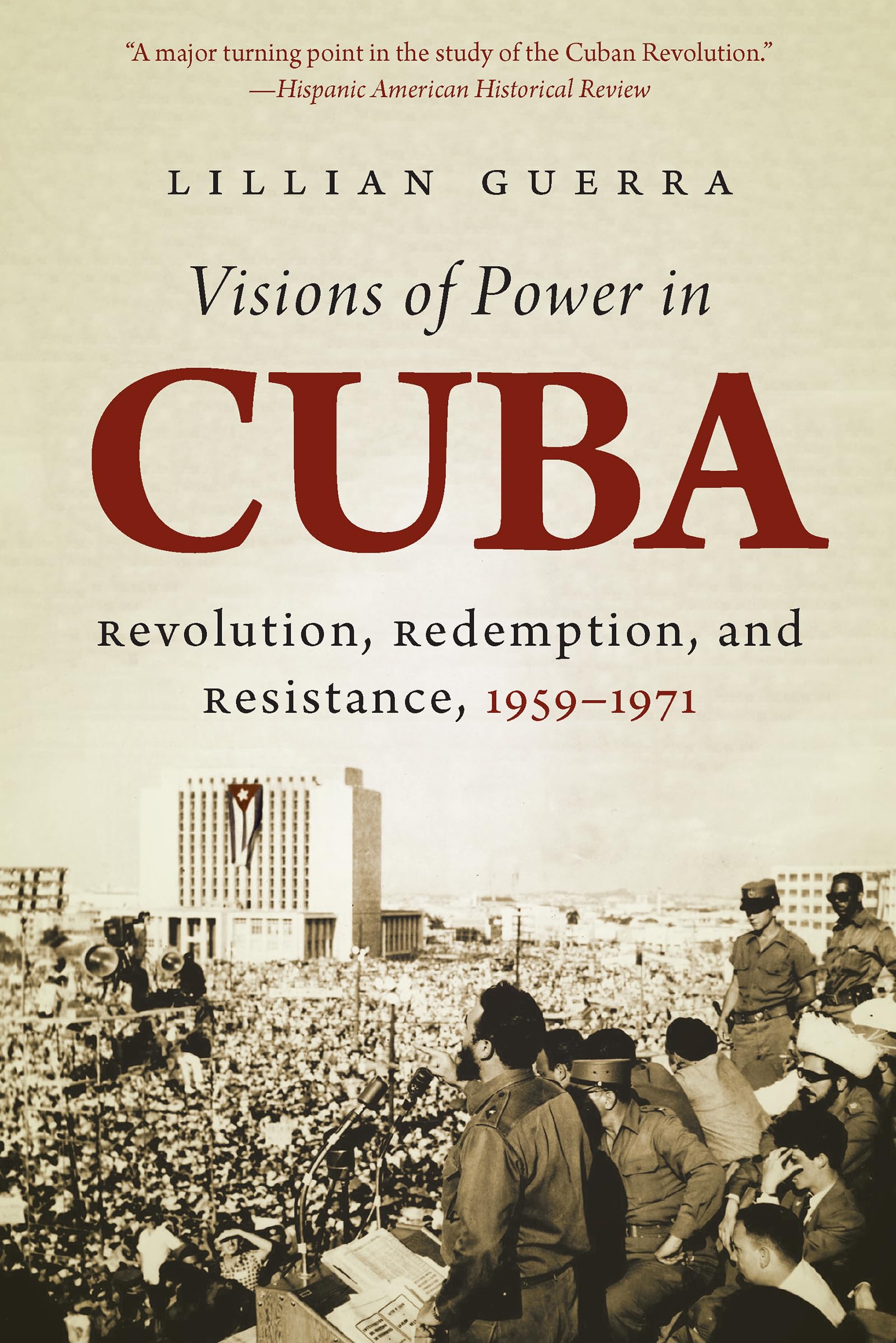
Visions of Power in Cuba: Revolution, Redemption, and Resistance, 1959-1971 (Envisioning Cuba)
$36.18
by Lillian Guerra



In the tumultuous first decade of the Cuban Revolution, Fidel Castro and other leaders saturated the media with altruistic images of themselves in a campaign to win the hearts of Cuba’s six million citizens. In Visions of Power in Cuba , Lillian Guerra argues that these visual representations explained rapidly occurring events and encouraged radical change and mutual self-sacrifice. Mass rallies and labor mobilizations of unprecedented scale produced tangible evidence of what Fidel Castro called “unanimous support” for a revolution whose “moral power” defied U.S. control. Yet participation in state-orchestrated spectacles quickly became a requirement for political inclusion in a new Cuba that policed most forms of dissent. Devoted revolutionaries who resisted disastrous economic policies, exposed post-1959 racism, and challenged gender norms set by Cuba’s one-party state increasingly found themselves marginalized, silenced, or jailed. Using previously unexplored sources, Guerra focuses on the lived experiences of citizens, including peasants, intellectuals, former prostitutes, black activists, and filmmakers, as they struggled to author their own scripts of revolution by resisting repression, defying state-imposed boundaries, and working for anti-imperial redemption in a truly free Cuba. “Should be a required (and saddening) assignment. . . . Guerra reconstructs how Fidel Castro went about narrowing the range of civil liberties, autonomous institutions, and finally the society itself, until he completely dominated them.”— New York Review of Books “A stimulating, original—and in some circles, provocative—contribution to the historiography of the Cuban revolution.”— International Affairs “Combines a captivating narrative style, academic rigor and an invitation to rethink the very basics of the history and political culture of the Cuban revolution. . . . A unique and masterful piece of historical and sociological prose. . . . Captures you and does not let go. . . . Possibly one of the most significant of recent contributions to the historiography of the Cuban revolution.”— Havana Times “Guerra’s efforts to develop [her] thesis are carefully constructed, thought-provoking, and persuasively presented.”— The Americas “A major turning point in the study of the Cuban Revolution.”— Hispanic American Historical Review “Guerra’s pathbreaking book pushes the historiography beyond simplistic and dogmatic generalizations and is an outstanding example of where new and innovative research should go.”— American Historical Review “A creative and extraordinary book that dares to criticize the Cuban Revolution and its leadership.”— New West Indian Guide “A unique book in the historiography of the Cuban Revolution.... Avoiding approaches common to [scholars] inside and outside the island, Guerra places herself in that rare space defined by a commitment to truth, at a time of generalized skepticism reinforced by post-structuralist unbelief. Writing against the grain, this book intervenes in a profound and impeccable manner in the debate over how to remember, read and give voice to those subjects who have been buried by the great undertakings of the State and those ”heroic figures“ of a certain monumental historiography.”— Diario de Cuba “Essential for students of 20th-century Cuban and Latin American history. . . . Highly recommended. Upper-division undergraduates and above.”— CHOICE “An outstanding work ― skillfully organized, effectively presented, and fully substantiated. Guerra’s fascinating analysis of the revolutionary process in Cuba should be a standard reference work within a short time.” ―Franklin W. Knight, The Johns Hopkins University “An outstanding work — skillfully organized, effectively presented, and fully substantiated. Guerra’s fascinating analysis of the revolutionary process in Cuba should be a standard reference work within a short time.” —Franklin W. Knight, The Johns Hopkins University Image, script, and spectacle in the Cuban Revolution Lillian Guerra is professor of Cuban and Caribbean history at the University of Florida and author of The Myth of José Martí: Conflicting Nationalisms in Early Twentieth-Century Cuba and Popular Expression and National Identity in Puerto Rico .