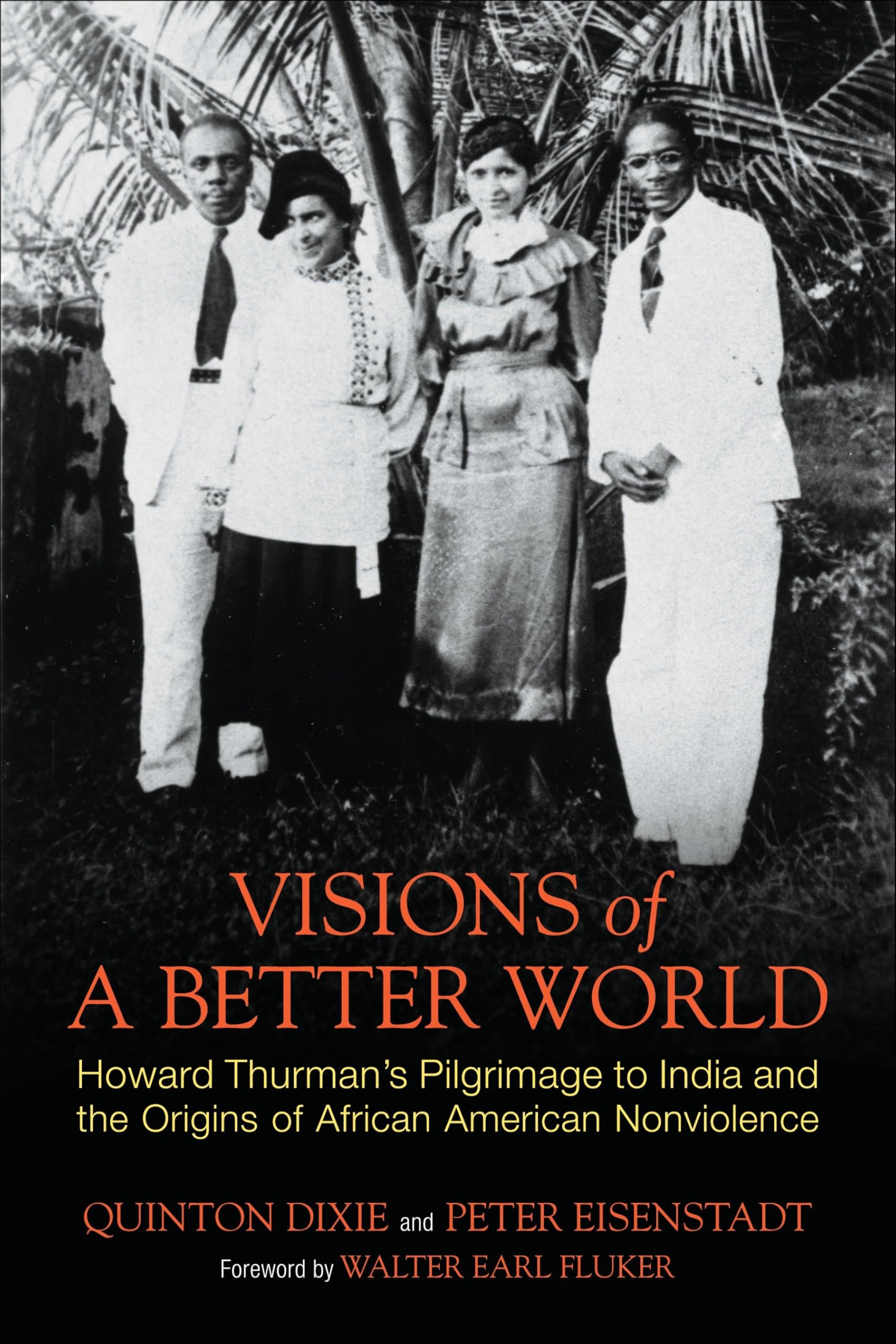
Visions of a Better World: Howard Thurman's Pilgrimage to India and the Origins of African American Nonviolence
$21.00
by Quinton Dixie



In 1935, at the height of his powers, Howard Thurman, one of the most influential African American religious thinkers of the twentieth century, took a pivotal trip to India that would forever change him—and that would ultimately shape the course of the civil rights movement in the United States. When Thurman (1899–1981) became the first African American to meet with Mahatma Gandhi, he found himself called upon to create a new version of American Christianity, one that eschewed self-imposed racial and religious boundaries, and equipped itself to confront the enormous social injustices that plagued the United States during this period. Gandhi’s philosophy and practice of satyagraha , or “soul force,” would have a momentous impact on Thurman, showing him the effectiveness of nonviolent resistance. After the journey to India, Thurman’s distinctly American translation of satyagraha into a Black Christian context became one of the key inspirations for the civil rights movement, fulfilling Gandhi’s prescient words that “it may be through the Negroes that the unadulterated message of nonviolence will be delivered to the world.” Thurman went on to found one of the first explicitly interracial congregations in the United States and to deeply influence an entire generation of black ministers—among them Martin Luther King Jr. Visions of a Better World depicts a visionary leader at a transformative moment in his life. Drawing from previously untapped archival material and obscurely published works, Quinton Dixie and Peter Eisenstadt explore, for the first time, Thurman’s development into a towering theologian who would profoundly affect American Christianity—and American history. “Highly recommended.”— Choice Quinton Dixie and Peter Eisenstadt are two of the country's leading experts on Howard Thurman. They are both senior volume editors of the Howard Thurman Papers Project and have extensive backgrounds in African American history and religious history. Dixie is assistant professor of religious studies at Indiana University-Purdue University at Fort Wayne. He holds MA and PhD degrees in religious studies and American church history, respectively, from Union Theological Seminary. He is coauthor, with Juan Williams, of This Far by Faith , and is coeditor, with Cornel West, of The Courage to Hope . Eisenstadt is an independent historian with a PhD in history from New York University. He is the author or editor of six books, including Rochdale Village, Encyclopedia of African American Culture and History , and Black Conservatism . He is also the associate editor of T he Papers of Howard Washington Thurman, Vols. I-III . Introduction Long before the two men met, long before he had any inkling that a meeting would ever be possible, Howard Thurman had been preparing for an encounter with Mohandas K. (Mahatma) Gandhi. When the meeting took place, in early 1936, Thurman and his colleagues would be the first African Americans to meet with the famous leader of the Indian independence movement. Thurman’s time in India was less a transformation than a confirmation of what had long been his core belief: Christianity, as it had been traditionally practiced, was incapable of taking on the greatest challenge of the day, social and racial inequality. Howard Thurman was never a firebrand, and to some, who did not pay close attention to his message, he seemed to be an otherworldly mystic with little time to spare for any down-to-earth realities, including the practical politics of American minorities fighting for their civil rights. But for those who listened carefully, including many in the rising generation of African American leaders in the 1930s and 1940s, among them James Farmer, Pauli Murray, and Martin Luther King Jr., they heard a call for a new Christianity—one without dogmas, dedicated to the principles of pacifism and nonviolence, and utterly committed to the task of eradicating Jim Crow in all its varieties and manifestations. It is true that Thurman was never primarily a writer or speaker on political topics. But in his public appearances, articles, and teaching in the 1930s and 1940s, and both in his own right and through his broader contagion, he was one of the creators of a distinctly African American path to radical Christian nonviolence. On October 21, 1935, Howard Thurman reached Ceylon’s major port and capital city, Colombo. When Thurman arrived in Colombo he had been traveling by rail and boat for a month, since he and his party had left New York Harbor. He was in Ceylon as chair of the four-person Negro Delegation, undertaking a “Pilgrimage of Friendship” to South Asia on the behest of the Student Christian Movement in the United States (basically an alliance between the YMCA and the YWCA), and its Asian counterpart, the Student Christian Movement of India, Ceylon, and Burma. He was accompanied by the other members of the delegation: his wife, Sue Bailey Thurman, and another co