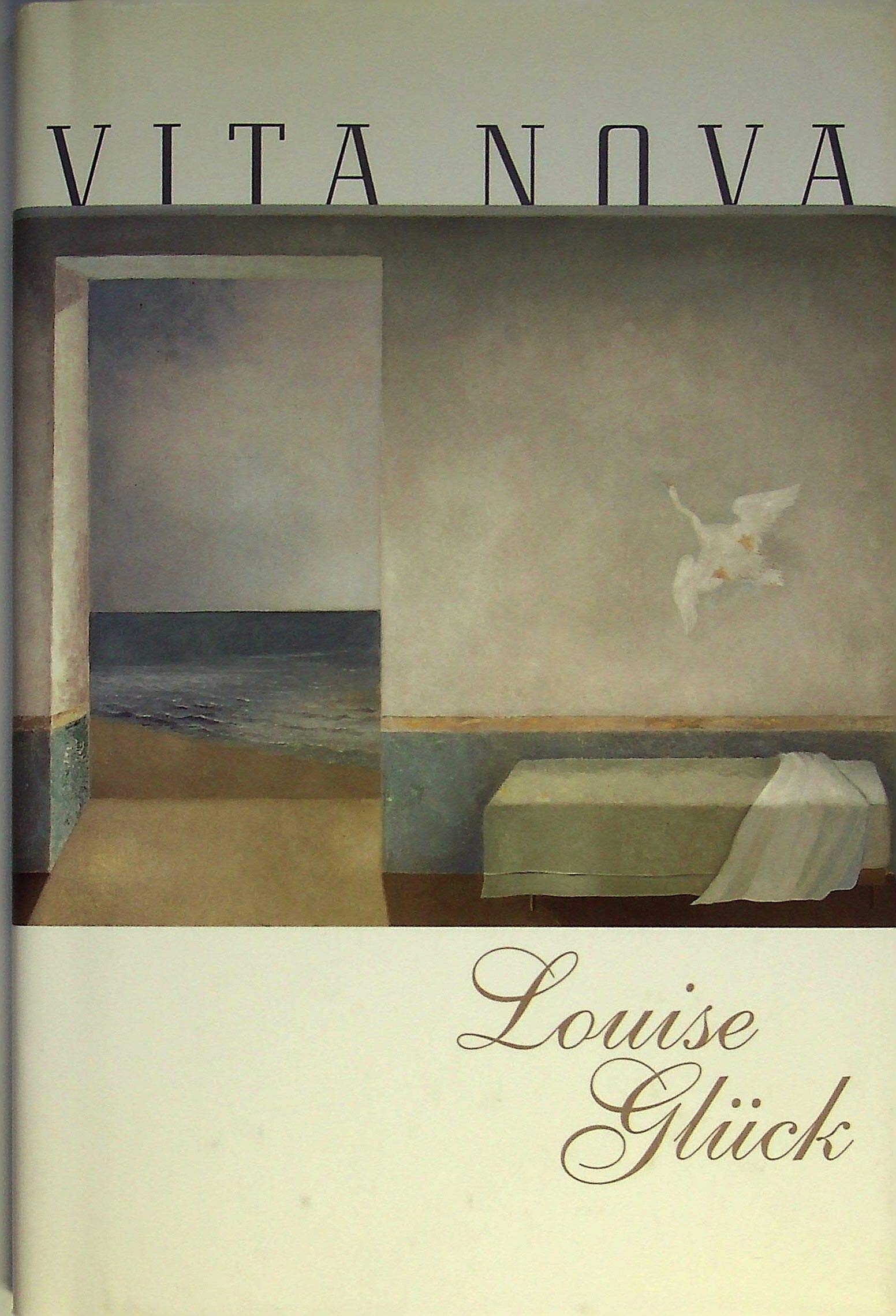



Winner of the Nobel Prize in Literature In Vita Nova , Pulitzer-Prize winning poet Louise Glück manages the apparently impossible: a terrifying act of perspective that brings into resolution the smallest human hope and the vast forces that shape and thwart it Since Ararat in 1990, Louise Glück has been exploring a form that is, according to the poet, Robert Hass, her invention. Vita Nova-- like its immediate predecessors, a booklength sequence--combines the ecstatic utterance of The Wild Iris with the worldly dramas elaborated in Meadowlands. Vita Nova is a book that exists in the long moment of spring: a book of deaths and beginnings, resignation and hope; brutal, luminous, and far-seeing. Like late Yeats, Vita Nova dares large statement. By turns stern interlocutor and ardent novitiate, Glück compasses the essential human paradox. In Vita Nova, Louise Glück manages the apparently impossible: a terrifying act of perspective that brings into resolution the smallest human hope and the vast forces that thwart and shape it. No poet has grafted her life more stubbornly to myth than Louise Glück. In Meadowlands , this meant voyaging simultaneously through the Odyssey and the disintegration of her marriage; in Vita Nova , the legend of Orpheus and Eurydice provides a backdrop to the bitter aftermath of divorce. "No one wants to be the muse; / in the end, everyone wants to be Orpheus," Glück pithily notes, but here, she assumes both voices--the grieving artist and his doubly silenced love. "How would you like to die / while Orpheus was singing? / A long death; all the way to Dis / I heard him," the nymph complains in "Relic," while in "Orfeo," the bard dwells almost lovingly on both his loss and his art: I have lost my Eurydice, I have lost my lover, and suddenly I am speaking French and it seems to me I have never been in better voice; it seems these songs are songs of a high order. In the end, of course, it's not Eurydice but his own pain that Orpheus immortalizes. "I made a harp of disaster / to perpetuate the beauty of my last love," Glück admits, but this is less a matter of personal glory than it is of sheer survival. And besides, she reminds us, "sometimes / our consolations are the costliest thing." Glück is an excruciatingly honest poet, but not, exactly, a confessional one. Vita Nova holds her life at arm's length, examining its particulars with almost Olympian detachment. Several of these poems include a self-interrogation, rendered in a voice equal parts prosecutor and witness for the defense: "Ask her how he touched her." "Ask her what she remembers." "Ask her if the fire hurts," demands a speaker in "The Burning Heart." Is this Eurydice's story as accident report? Séance? Cross-examination? Elsewhere, her troubles come rendered in a piercing gallows wit. In the volume's final poem, "Vita Nova" (the second of two with that same title), she dreams a dog, then dreams a custody fight with her ex. Be brave, she tells her hypothetical pet--"this is / all material; you'll wake up / in a different world, / you will eat again, you will grow up into a poet!" One senses that for Glück, it's all material--marriage, divorce, life, death, even and especially the ancient drama of myth. These are poems of rebirth, but of a particular kind--not of hope, and certainly not of youth, but of something far more important: poetry itself. In "The Nest," as Glück emerges from her grief, she feels her mind once again engage with the world, thinking "first, I love it. / Then, I can use it. " --Mary Park Gl?ck's ninth collection flips between the mythic utterances of her earlier work and the tragicomic personal realism of her most recent book, Meadowlands (LJ 3/15/96). A literal point of departure, Vita Nova picks up where Meadowlands left off: after a marital breakup, when single life in a new locale eerily recalls life before marriage. It is framed by two poems of the same name ("Vita Nova," of course)Aone spoken by Persephone, the other an ironic address concerning a dream, a divorce, and a dog named Blizzard: "Blizzard/ Daddy needs you/...the kind of love he wants Mommy/ doesn't have, Mommy's/ too ironicAMommy wouldn't do/ the rhumba in the driveway." Gl?ck's probing, intimate voice takes the reader hostage, and her quiet, bitter humor penetrates to the bone: "In the bathtub, I examine my body./ We're supposed to do that./...I was vigilant: when I touched myself/ I didn't feel anything." Abstract without being vague, personal without being maudlin, Gl?ck's exquisitely crafted work continues to astound. For all poetry collections.AEllen Kaufman, Dewey Ballantine Law Lib., New York Copyright 1999 Reed Business Information, Inc. "The book exists at the vanishing point of light. What's left is not darkness, but the amniotic of soul, and hence the title, Vita Nova , new life." - BookForum Since Ararat in 1990, Louise Gluck has been exploring a form that is, according to poet Robert Hass, he