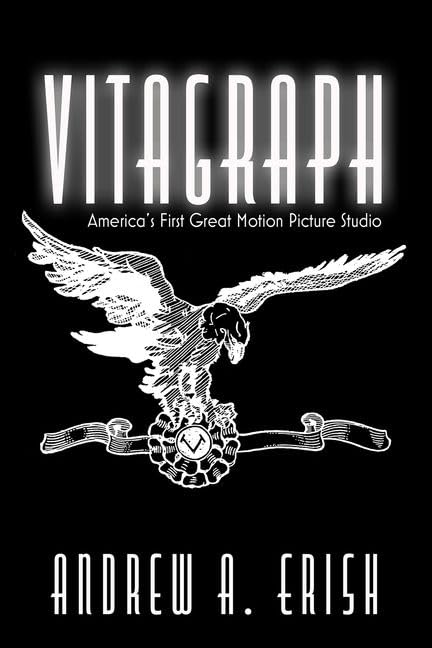
Vitagraph: America's First Great Motion Picture Studio (Screen Classics)
$34.95
by Andrew A. Erish



In Vitagraph: America's First Great Motion Picture Studio , Andrew A. Erish provides a comprehensive examination and reassessment of the company most responsible for defining and popularizing the American movie. This history challenges long-accepted Hollywood mythology that Paramount and Fox invented the feature film, that Universal created the star system, and that these companies, along with MGM and Warner Bros., developed motion pictures into a multimillion-dollar business. In fact, the truth about Vitagraph is far more interesting than the myths that later moguls propagated about themselves. Established in 1897 by J. Stuart Blackton and Albert E. Smith, Vitagraph was the leading producer of motion pictures for much of the silent era. Vitagraph established America's studio system, a division of labor utilizing specialized craftspeople and artists and developed fundamental aspects of American movies, from framing, lighting, and performance style to emphasizing character-driven comedy and drama in stories that respected and sometimes poked fun at every demographic of Vitagraph's vast audience. For most of its existence America's most influential studio was headquartered in Brooklyn, New York, before relocating to Hollywood. A historically rigorous and thorough account of the most influential producer of American motion pictures during the silent era, Erish draws on valuable primary material long overlooked by other historians to introduce readers to the fascinating, forgotten pioneers of Vitagraph. "This is a well-researched, exhaustively documented study of a film company that at one time was better known than any other. The author has drawn extensively on archival material and especially the trade publications of the period to enrich his study. He separates fact from fiction, particularly in the accounts of the two founders of the company who tended to mythologize and fabricate to enhance their reputations. A commendable book―I learned much from it."―Bernard F. Dick, author of Engulfed: The Death of Paramount Pictures and the Birth of Corporate Hollywood "This straightforward, richly documented work is a credit to film history . Vitagraph fills a significant gap, as there is no existing volume that dispassionately recounts the full history of this studio using such a range of sources."―Stephen Bottomore, editorial board member of Film History journal "A handsome book with well-chosen, highly evocative photographs."― Stage and Cinema "What is evident on almost every page is the deep knowledge that Erish possesses about early cinema and his overwhelming enthusiasm for it. . . . A fine piece of historical research as well as a testament to a largely unsung part of American cinema."―Kevin Brianton, adjunct senior research fellow at La Trobe University and author of Hollywood Divided , Cinema History Online "With a deft combination of thorough research and page-turning storytelling, Erish makes the Vitagraph story flicker to life over [304] thrilling pages. He succeeds not only in laying out the journey of the Vitagraph boys and their importance in film history, but also in separating fact from layers of tale tales spun by the Blackton and Smith themselves."― Hollywood North Magazine "A mixture of good gossip and heavy, important research."― A Person in the Dark Blog "Erish's new book, Vitagraph: America's First Great Motion Picture Studio , is a valuable history of filmmaking in its earliest days. . . . Erish is an honest researcher, willing to set aside his enthusiasm for Vitagraph in pursuit of the truth."― Shepherd Express "A fascinating look at the history and influence of Vitagraph. . . . This book is a wonderful read focused upon the importance and impact of Vitagraph."― Hometowns to Hollywood "Erish backs up his claims with scholarship that calls into question many years of cinematic history assumptions. Readers can feel his satisfaction at righting this decades-long wrong, and putting Vitagraph back in it's place as one of the most important founders of the modern day movie business. The fall of Vitagraph is also well-detailed, in this writer's view, explaining how the names behind the company faded into obscurity, while names like Warner, Lasky, and Zukor remain. Though this book may be most enjoyed by movie historians and lovers of the silent age, it neatly fits into the genre of eye-opening revisionist history that is beloved by many. It also serves as an overarching history of the early days of the movie business, so could easily serve as a jumping off point for readers who want to get it right from the start. Long live Vitagraph!"― Picture This Post Andrew A. Erish is the author of Col. William N. Selig, the Man Who Invented Hollywood. Andrew A. Erish is an independent scholar of cinema and the author of Col. William N. Selig, the Man Who Invented Hollywood.