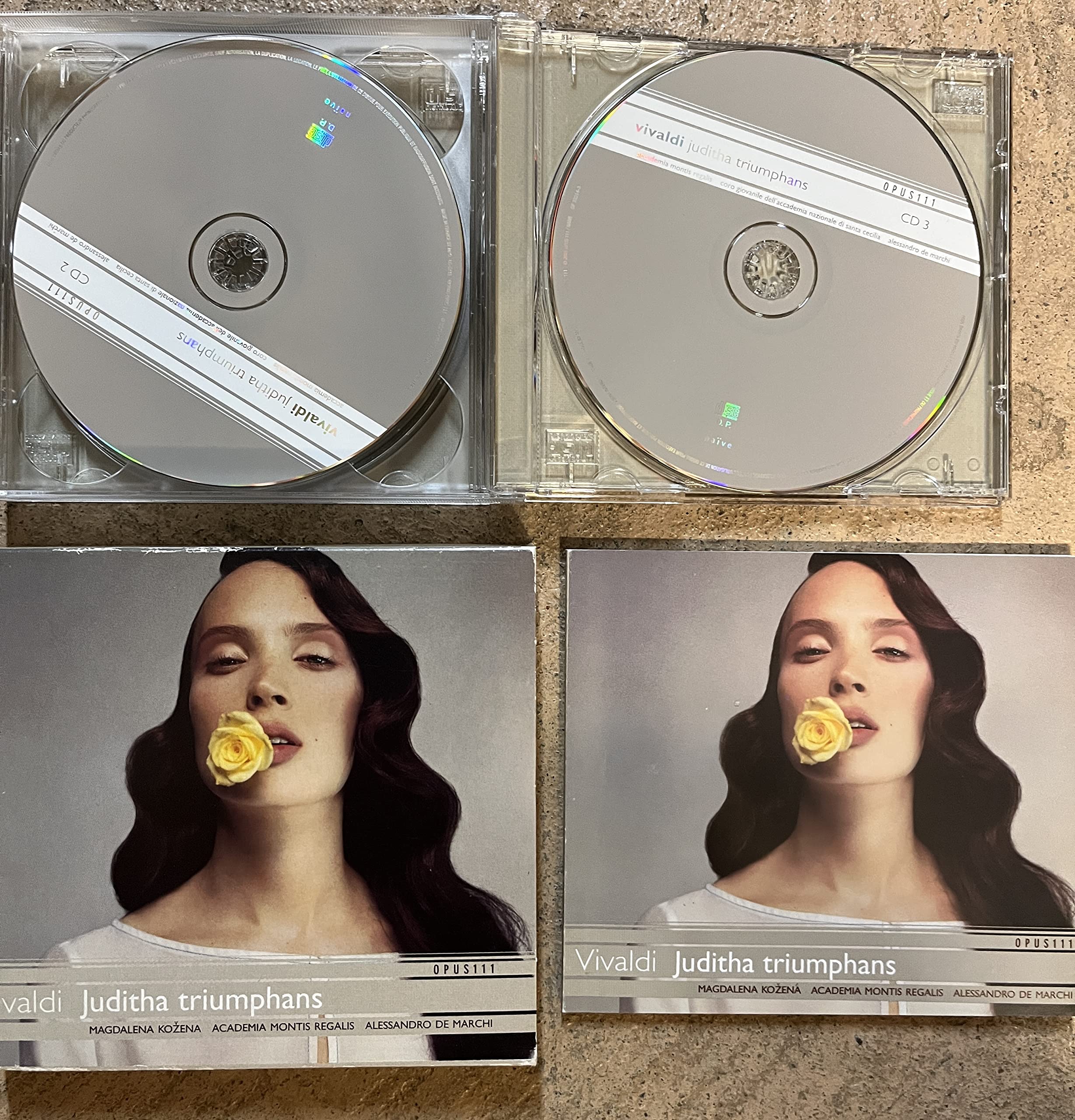



Vivaldi may be best remembered for his virtuosic concertos but, as anyone familiar with his famous D major Gloria will know, he also had a real ear for vocal sonorities. His only surviving oratorio, Juditha Triumphans, has until recently been a well-kept secret. The biblical story of Judith overcoming Holofernes and his army (beheading him herself--no shrinking violet she) was popular with both librettists and composers, offering plenty of opportunities for exuberant tub-thumping. And these Vivaldi seizes eagerly, the opening rabble-rousing chorus (here preceded by a sinfonia reconstructed by Vivaldi scholar Michael Talbot) setting the tone in truly martial fashion. (on-line review) Vivaldi may be best remembered for his virtuosic concertos but, as anyone familiar with his famous D major Gloria will know, he also had a real ear for vocal sonorities. His only surviving oratorio, Juditha Triumphans , has until recently been a well-kept secret. The biblical story of Judith overcoming Holofernes and his army (beheading him herself--no shrinking violet she) was popular with both librettists and composers, offering plenty of opportunities for exuberant tub-thumping. And these Vivaldi seizes eagerly, the opening rabble-rousing chorus (here preceded by a sinfonia reconstructed by Vivaldi scholar Michael Talbot) setting the tone in truly martial fashion. However, Juditha also abounds in reflective numbers, something at which Vivaldi excels. Perhaps the most striking examples are the ethereal "turtle dove" aria ("Veni sequere fida"), with our heroine beautifully accompanied by a chalumeau (a precursor of the clarinet), the tranquil "Vivat in pace," and the sublime "Umbrae carae", here lyrically sung by Marina Comparato. The all-female lineup (five solo characters plus, on this particular recording, an all-female chorus) is a strong one. And, vitally, the soloists are well-differentiated, each with immediately recognizable timbres. Magdalena Kozena is fruity in the title role: not the kind of voice you'd necessarily associate with this repertoire, but it does turn a potentially smug heroine into one of real flesh and blood. Maria José Trullu is an opulent Holofernes, while Anke Herrmann's Abra is attractively mellow voiced. Downers? Just one--the recorded sound, which is too echoey. Overall, though, this is a fine performance of a great work and one that deserves a place on the shelves of every lover of Baroque music. --Harriet Smith The tenth volume of Opus 111's Vivaldi edition, which aims to record all 450 works from the Foà and Giordano manuscript collections now in Turin, is the 1716 oratorio Juditha Triumphans. This is Vivaldi's best-known large-scale choral work today (and his only extant oratorio) and has been recorded quite a few times in the last half-century: by Angelo Ephrikian, Alberto Zedda, Ferenc Szekeres, Vittorio Negri, Nicholas McGegan and Robert King; these last two are on period instruments.The work is emphatically patriotic in content, and retells the Apocrypha story of Judith and Holofernes in terms of Venice's then-current war with the Ottomans. Giacomo Cassetti's Latin libretto explicitly assigns equivalent roles, with heroine Judith as the Adriatic, the tyrant Holofernes as the Emperor of the Turks and so on, the victory of Judith presaging the triumph of the Venetian fleet. With a theme of such direct contemporary relevance, Vivaldi gives rein to a sequence of imaginatively scored arias of an operatic nature. Even if the result is somewhat stagey, with not much actual drama evident between the protagonists, the music is often of very high quality.As Juditha Triumphans was written for his pupils at the Venetian orphanage of the Ospedale della Pietà, all the solo roles are for high voices ('tenors' and 'basses' are found in the chorus only, but were probably as here sung by women also). As if to make up for this limited vocal palette, Vivaldi drew on the variety and talent of the celebrated Ospedale instrumentalists, and scored the work for recorders, oboes, chalumeaux, trumpets, drums, mandolin, theorbos, viola d'amore, solo organ, strings and continuo. There is no surviving sinfonia, so Alessandro De Marchi has used the Sinfonia, RV562, to preface the work. He has also taken advantage of the very latest research on pitch, harpsichord continuo style, instrumentation and performing practice; all this is explained in detail in the comprehensive booklet notes.Previous recordings of the work have usually stood or fallen by their approach to the dramatic content; it is here that the older 1974 Negri recording scores over McGegan, and King is better still, with the advantage of a consistently excellent cast and band plus a fine modern recording. Alessandro De Marchi's Coro da Camera dell'Accademia di Santa Cecilia and Academia Montis Regalis, too, are on excellent form, and his five soloists spare no effort in characterizing their roles. Judith's lamenting aria 'Veni, me sequere fida', with i