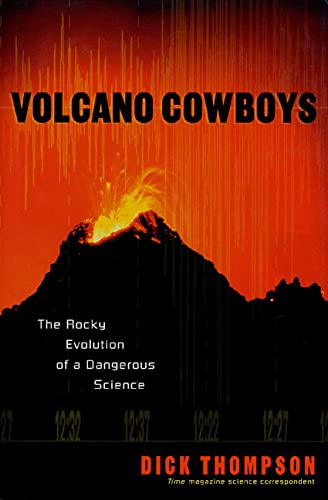



Twenty years ago, Mt. St. Helens, in Washington State, "blew." It was the volcano's first eruption in recorded time, although as early as 1978 a team of scientists from the US Geological Survey had labeled it "the most dangerous volcano in the Cascade Range." In June 1991, Mt. Pinatubo in the Philippines spewed forth its own mix of ash, gases, mud, lava, and all the other debris that had been building within the mountain for centuries. Between those two events, USGS scientists had been working at warp speed to learn more about predicting violent eruptions. Data from the nation's only Volcano Center was not helpful. Work there centered on volcanoes that responded to interior pressure by quietly releasing a slow-moving flow of lava, rather than spewing its entrails out in a blast. Survey members were presented with a rare opportunity when Mt. St. Helens showed signs of activity. Camped on the mountains flanks, daring the crater itself, they dug out rocks, tended recorders, began to learn how to use newly developed instruments. Here was an active volcano, believed to be on the verge of eruption by some, if not all, experts. Along with new instruments they had computer programs that saved them days and weeks of work. They learned techniques that revealed the dates of previous major eruptions and provided patterns for future predictions. After the eruption, studying Mt. St. Helens and other volcanoes, they learned more and more. By the time a newly-active Pinatubo threatened tens of thousands of villagers and the U.S. military's Clark Air Force Base, the men of the USGS were far better able to feel secure in urging local authorities and the Air Force brass to evacuate. It was still a gamble, but the odds were far better. And the work goes on. Thompson, a veteran science reporter for Time Magazine, spent many hours with the relative handful of scientists whom he calls "volcano cowboys." (Considering their lifestyle and their rugged "laboratories" - the volcanoes themselves -- the sobriquet is earned.) They have loaned him their field notes, and one geologist gave him his as yet unpublished autobiography. The vivid material and Thompson's skill in bringing a good story to life has resulted in a book that celebrates these "cowboys" their tough and hazardous lives and the often harrowing decisions they must make. Vulcanology is not the sexiest of sciences, despite Hollywood movies in which clenched-jawed heroes tame ferocious floods of lava that are busily swallowing up some crowded metropolis or another, racing against the clock to save humankind from the elements. It turns out that those movies aren't really so far-fetched, though, and in the pages of Volcano Cowboys the world's small corps of magma hunters acquire well-deserved élan. The study of volcanoes, Time magazine writer Dick Thompson notes, is largely an observational and not theoretical science; where the vital memory of a molecular biologist "generally drops off after a decade," a vulcanologist will carry reams of data about the behavior of the earth gleaned from reports stretching back to the time of Plato and Pliny the Elder, those amateur volcano-watchers of antiquity. They've had plenty more to do in recent years, though, than to quote the ancients. Thompson's vigorous narrative begins with the eruption of Mount St. Helens on May 18, 1980, an event that U.S. Geological Survey scientists had been able to predict with some accuracy. They lacked, however, a coordinated means to effect an evacuation of the area, and 57 people died. Battling institutional inertia and struggling for funding, teams of these scientists, the "volcano cowboys" of Thompson's title, set about trying to develop methods to predict more accurately dangerous volcanic events and to trim the body count when such events took place. His story recounts their eventual victory when, in 1991, the Philippine volcano Pinatubo exploded--but, thanks to the work of these dedicated field scientists, "less than one quarter of one percent of those at risk had died during the eruption." Tens of millions of people around the world live within the reach of volcanoes. Thompson's narrative reveals that the "volcano cowboys" have made their lives safer--and it's much better than the movies. --Gregory McNamee "Volcano cowboys"-that is what the U.S. Geological Survey geologists at the Hawaii Volcano Observatory call themselves, and not without reason. Studying an active volcano is like riding a bucking bronco. Researchers work around deadly hazards such as poisonous gas, hot lava, flying rocks called "pyroclastics," and landslides, and they don't always get out alive. Thompson, a staff reporter for Time magazine, has written a truly exciting account of the evolution of volcanology from a rough-and-tumble science to a more accurate discipline. In 1979, when Mount St. Helens began to rumble, the Volcano cowbows were called in to monitor the situation. Used to dealing with data sets and long