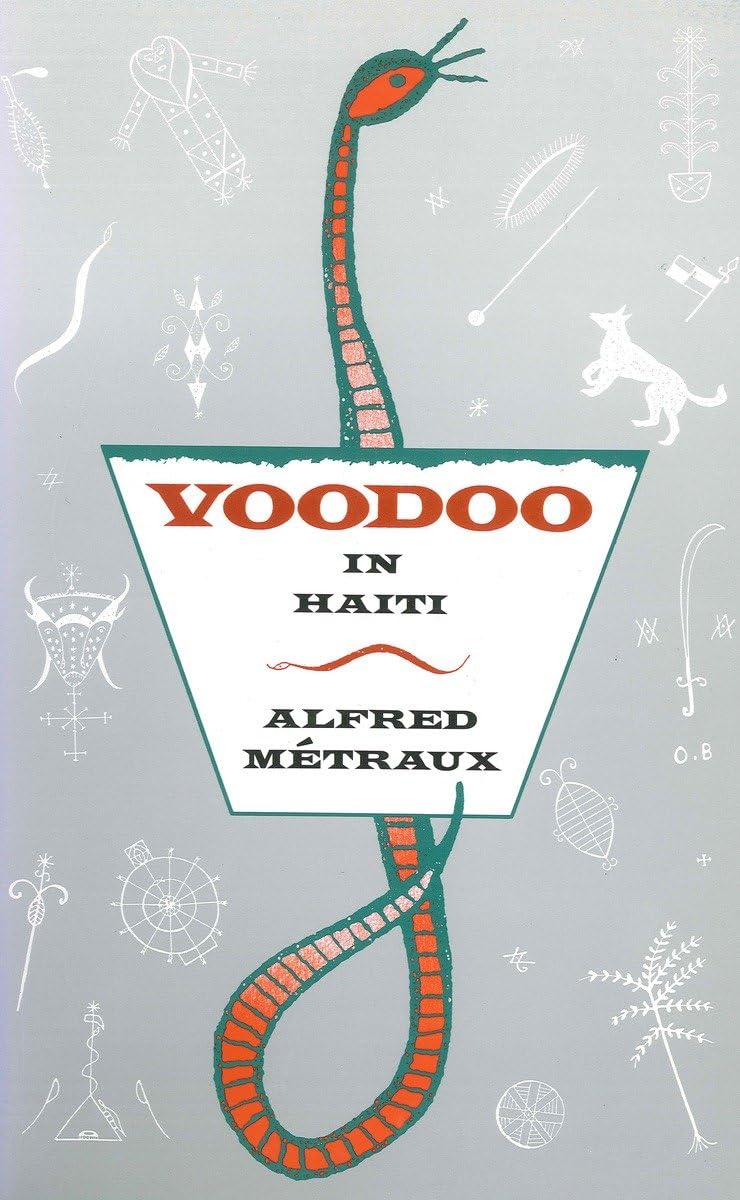



Voodoo in Haiti is a masterwork of observation and description by one of the most distinguished anthropologists of the twentieth century. Alfred Métraux (1902–1963) has written a rich and lasting study of the lives and rituals of the Haitian mambos and adepts, and of the history and origins of their religion. It is an accurate and engaging account of one of the most fascinating and misunderstood cultures in the world. Translated by Hugo Charteris Introduction by Sidney W. Mintz “Métraux’s book is a landmark in the serious study of Afro-Atlantic religion. The breadth and subtlety of its approach is such that it remains an essential classic of Afro-American ethnology.” —Robert Farris Thompson, professor of art history, Yale University, author of Flash of the Spirit “This is a work deserving of wide-readership, and assured of it by its understanding and appeal.” — Library Journal “This book gives what is surely the most authoritative general account of that complex of belief and practice called vaudoo available in literature. . . . No other observer of vaudoo has contributed to its study the exquisite documentation of detail that marks the work of Alfred Métraux.” —Sidney W. Mintz, professor of anthropology, Johns Hopkins University A master work of observation and description about the lives and rituals of the Haitian mambos and adepts, and of the history and origins of their religion. A master work of observation and description about the lives and rituals of the Haitian mambos and adepts, and of the history and origins of their religion. ALFRED MÉTRAUX was a Swiss anthropologist, ethnologist and human rights leader. A dedicated humanitarian, he brought the brilliance of South American Indian cultures to light, solved the mysteries of Easter Island, taught the world about voodoo , and defined the United Nations' stand against racism. Winner of the Guggenheim Fellowship for Natural Sciences, his books include Voodoo in Haiti, The History of the Incas and Easter Island . At the time of his death, he was Professor of South American Anthropology at the École Pratique des Hautes Etudes, Paris. From the Foreword : Voodoo today is less frightening than it was. The Haitians look upon it more and more as ‘folklore’—which seems to dispel the harm those practices do to the reputation of their country. Has not every country its ‘folklore’? It is therefore normal and desirable that Haiti should also have its own. People in other countries who say to their friends ‘Don’t go to Haiti: Voodoo is something diabolic, it is the worship of snakes and black magic’ are becoming rare. Distrust and disgust are giving way to curiosity which itself is gradually turning into indulgent sympathy. But prejudice is prejudice. Only anthropology, in explaining the true nature of Voodoo and in throwing cold light on the facts, can make this religion emerge from its cloaking shadows and free it of the nightmares which it still inspires in many honest but misinformed people. Certain Haitians will no doubt be saddened that a foreigner whom they welcomed so warmly has, like so many before him, felt the need to write a book on Voodoo which they look upon as one of the most embarrassing aspects of their national culture. Let them understand that I have not given way to a wish to exploit a subject of which the mere mention is sufficient to stimulate the curiosity of the public; nor have I wished to obtain personal notoriety at the expense of their country. Throughout the vast domain of anthropology I have always been interested by religious phenomena and in the formation of syncretic cults. Voodoo in this respect proved a particularly fertile field. I am no its apologist and I know that sooner or later it must disappear. My purpose has been to describe Voodoo as it appeared to me. It remains for other anthropologists to decide if I was mistaken or not. I shall feel satisfied if, in approaching the study of Voodoo seriously and with patience, I have helped to make known the ordinary people of the Haitian towns and countryside, whom I learnt to love and respect. LANGUAGE The language of Voodoo is Creole which in Haiti is spoken by everyone except the haute bourgeoisie. It is not a coarse patois, as had often been said, but a comparatively recent language derived from French, just as French is derived from Latin. It has preserved phonetic habits and grammatical structures which, in origin, are clearly African. Most writers who have concerned themselves with Voodoo transcribe Creole according to French spelling. In so doing they make it easier to understand terms which are not too remote from the original, or which, intrinsically, have even maintained their French form. The disadvantage of this system is that it conveys the sound of Creole only very imperfectly and it tyrannizes over the language wherever it has in fact evolved to a state of independence from the parent stem. It might, therefore, have been