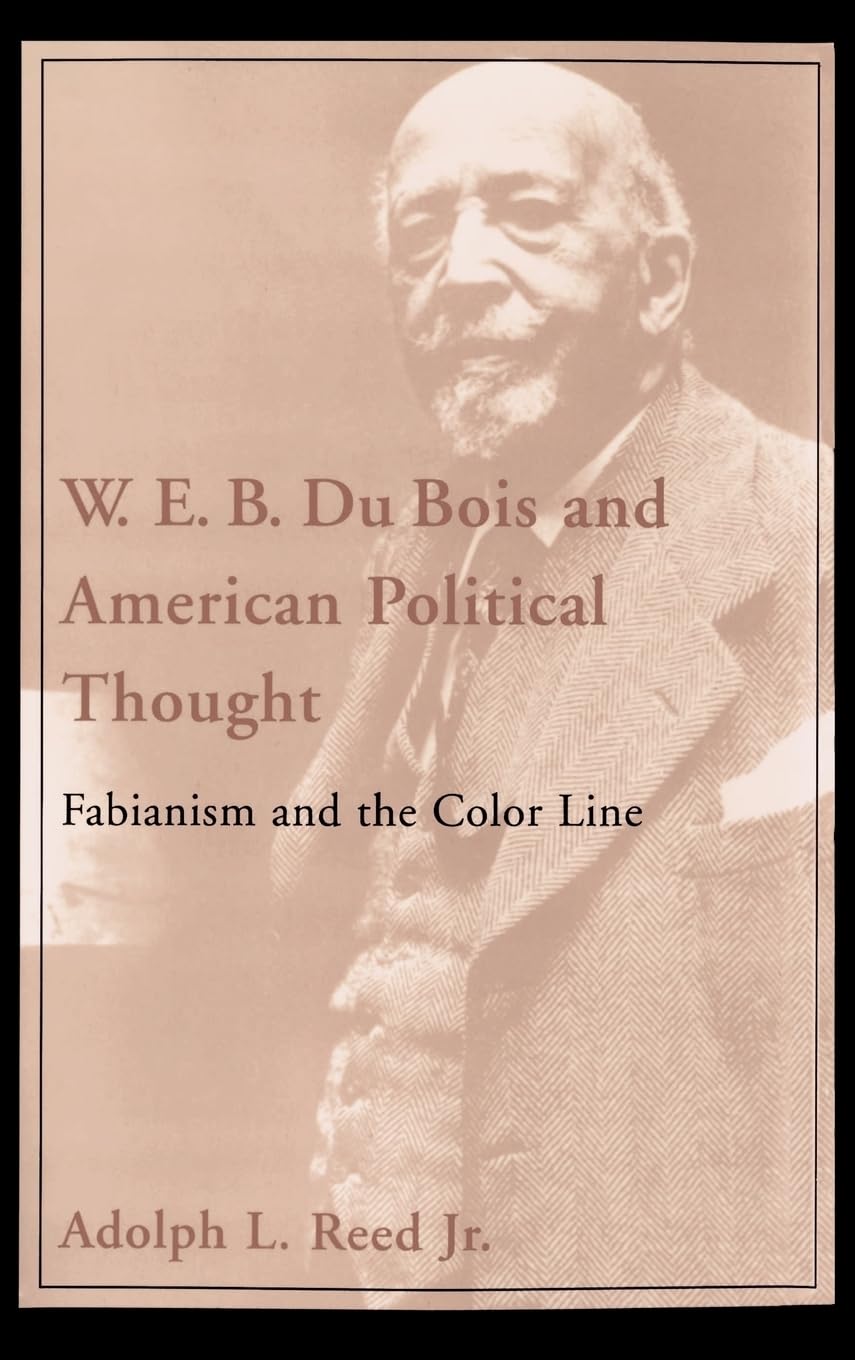
W. E. B. Du Bois and American Political Thought: Fabianism and the Color Line
$49.96
by Adolph L. Reed Jr



In this pathbreaking book, Adolph Reed, Jr. covers for the first time the sweep and totality of W. E. B. Du Bois's political thought. Departing from existing scholarship, Reed locates the sources of Du Bois's thought in the cauldron of reform-minded intellectual life at the turn of the century, demonstrating that a commitment to liberal collectivism, an essentially Fabian socialism, remained pivotal in Du Bois's thought even as he embraced a range of political programs over time, including radical Marxism. Exploring the segregation-era political discourse which informed Du Bois's texts, and identifying the imperatives which triggered Du Bois's strategic political thinking, Reed reveals that Du Bois's core beliefs concerning such `ssues as the relationship between knowledge and progress, social stratification among blacks, and proper social organization, endured with little change from their early formulation in The Philadelphia Negro (1899). Reed's discussion, in addition to demonstrating the theoretical rigor and integrity of Du Bois's work over nearly six decades, involves a suggestive remapping of the history of progressive thought in this span, bringing clearly into view previously unexamined continuities and tensions between fin de siecle and later twentieth-century socialist and Marxist discourses. Illuminating the foundations and course of Du Bois's political thought, Reed also considers the way this thought has been interpreted. Exposing recent vindicationist, de-politicizing, and transhistorical trends in Du Bois studies, Reed devotes special attention to recent misreadings of Du Bois's concept of "double- consciousness." Tracking the source of these trends to troubling currents in contemporary Afro-American, literary, and cultural studies, Reed offers a compelling alternative approach to the writing of the history of political thought, one that anchors inquiry to contemporary concerns while requiring the kind of thick historical grounding too often missing in recent scholarship. American intellectuals and activists of this century, Eloquent and far-reaching, W. E. B. Du Bois and American Political Thought is an indispensable study of Du Bois's thought and holds clear implications for Americanists, African- Americanists, and those doing theory-inflected work in the humanities. In his own time, W.E.B. Du Bois was a controversial figure, and now, more than 30 years after his death, he continues to be so. Born in 1868, Du Bois was a central figure in African American intellectual life during the late 19th and early 20th centuries, yet many of his positions are difficult to reconcile with current African American thought. Du Bois, for example, was an elitist who believed that black society was divided between "the talented tenth" and everybody else. Yet in his later years, he joined the communist party and moved to Africa, where he lived out the remainder of his life. Since his death in 1963, a generation of African American intellectuals have tried to interpret, explain, or revise him according to their own beliefs; now Adolph Reed Jr. weighs in with W.E.B. Du Bois and American Political Thought. Reed's approach to Du Bois is simple: he believes that what you read is what you get. When, for example, Du Bois wrote movingly in The Souls of Black Folk of a feeling of "twoness," a sense of warring natures, Reed suggests that, far from embracing a notion of double consciousness, Du Bois was actually following precepts of early 20th-century social theory which described the split between primitive and civilized societies. In addition to his discussion about Du Bois, Reed comments on many other African American critics at work today, from Houston Baker to Henry Louis Gates, making the author of W.E.B. Du Bois and American Political Thought as controversial as his subject. "W. E. B. Du Bois is a towering figure of central importance in American political thought, and so he has been annexed to many positions alien to his own. Reed provides the most informed, insightful, and balanced account of Du Bois's thinking yet written, one that is profoundly illuminating for progressive thought and action on issues of racial, political, and economic equality today."--Rogers M. Smith, Yale University "Adolph Reed's book is quite simply brilliant. It liberates Du Bois scholarship from a host of disfiguring anachronisms. By persuasively establishing the specific intellectual context within which Du Bois worked, Reed systematically reinterprets the meaning and significance of Du Bois's most influential writings. The logic is searing, the scholarship is impeccable, and, as always with Reed, there's a bristling polemical punchline as well. Anyone who takes Du Bois seriously must come to terms with this book."--James Oakes, Northwestern University "An extremely important contribution. Not only does Reed critically reclaim Du Bois as part of the traditions of both African American and American political thought,