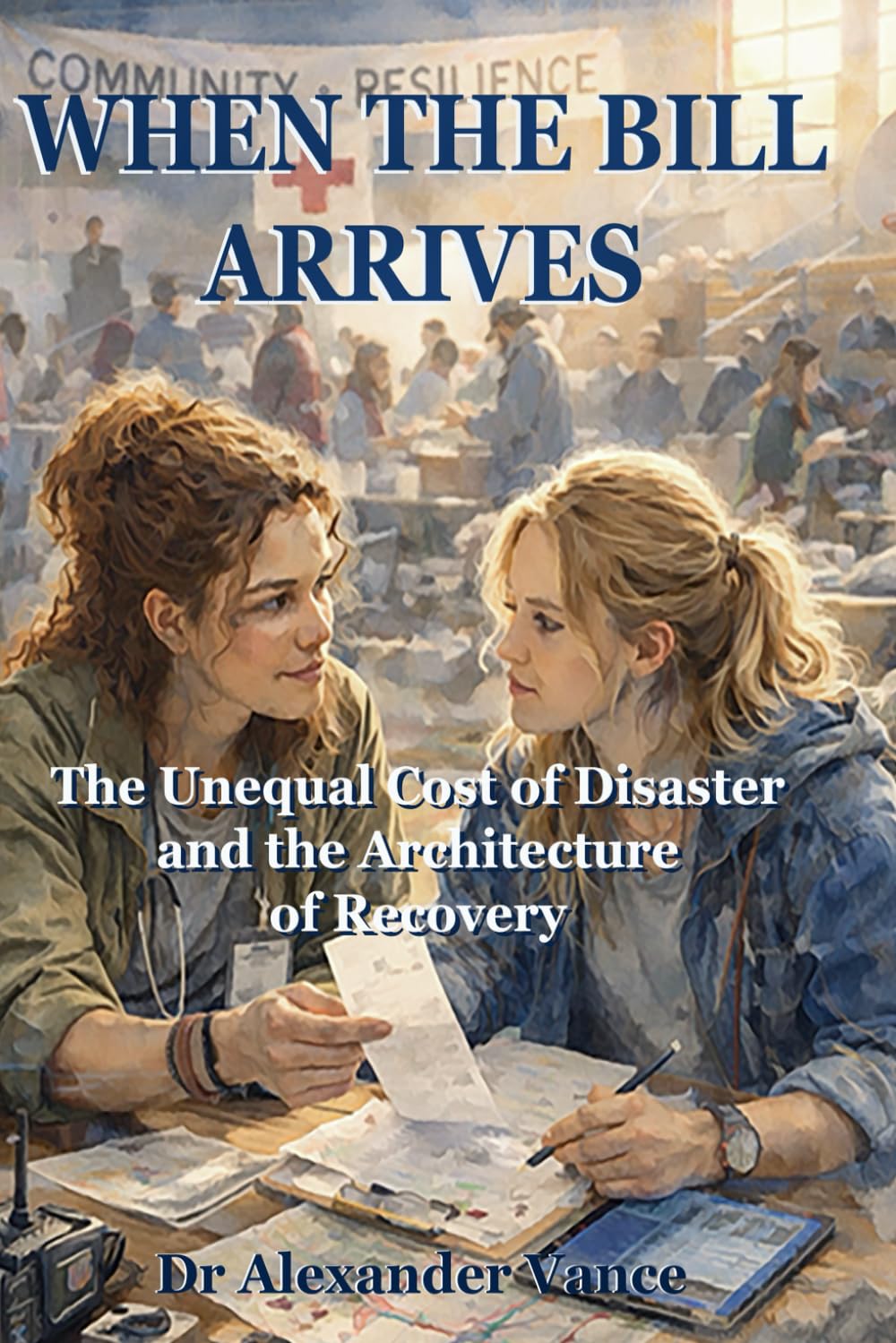
WHEN THE BILL ARRIVES: The Unequal Cost of Disaster and the Architecture of Recovery
$12.99
by Dr Alexander Vance



When the Bill Arrives: The Unequal Cost of Disaster and the Architecture of Recovery is not a disaster book in the usual sense. It is not chiefly about wind speed, flood maps, or the cinematic violence of storms—though it understands all of those. It is about what happens after the weather leaves: the quiet accounting, the paperwork that becomes a second catastrophe, the invisible architecture that determines who is restored and who is merely relocated into a slower ruin. The book’s great strength is its insistence that recovery is not a neutral process. It is a system with defaults—legal, financial, bureaucratic, psychological—and those defaults are not evenly distributed. Some households recover because the system recognizes them: they have clear title, adequate insurance, flexible work, savings, transportation, a lawyer in the family, and a zip code that makes agencies and contractors return their calls. Others are asked to prove their existence again and again: to document losses they never had the privilege to catalogue, to meet deadlines while living in temporary housing, to navigate forms in English they may not speak, to front money they do not have, to wait for reimbursement that arrives late enough to be meaningless. In this telling, “resilience” is revealed as a word that often means: the ability to endure what should never have been asked of you. What makes the narrative compelling is the author’s refusal to indulge in either sentimental pity or technocratic coldness. The book is both humane and structurally exact. It shows how inequality is not simply exposed by disasters—it is amplified by the machinery designed to respond to them. Aid is portrayed not as a moral gesture but as an engineered pipeline that can clog, divert, and leak, often without malice and sometimes precisely because “rules are rules.” The reader begins to see recovery as a sorting algorithm: forms, eligibility criteria, documentation thresholds, reimbursement schedules, procurement contracts, and political optics—all quietly deciding whose lives will be rebuilt in place and whose will be displaced by delay. The most haunting idea in the book is also the simplest: the bill always arrives, but it arrives unevenly. Some pay immediately—through lost wages, asthma, mold, missed dialysis, ruptured routines, trauma compounded by bureaucracy. Others pay later, indirectly, and often invisibly—through federal borrowing, insurance premiums, higher rents, depleted municipal budgets. The author makes the case that this temporal mismatch is not accidental; it is the core injustice. Disaster is an event. Recovery is a long exposure. Time becomes a tax, and the poor pay interest. There is also a rare practicality here. The book does not merely lament. It proposes an architecture of recovery that can be redesigned: simpler benefit pathways, better data systems that do not punish the undocumented, pre-positioned contracts, equity-weighted triage, community-led rebuilding, and accountability that is measured in outcomes rather than press conferences. Even when the author’s tone turns elegiac, the work remains anchored in policy reality—an argument that compassion must be translated into systems, or it will remain a speech.