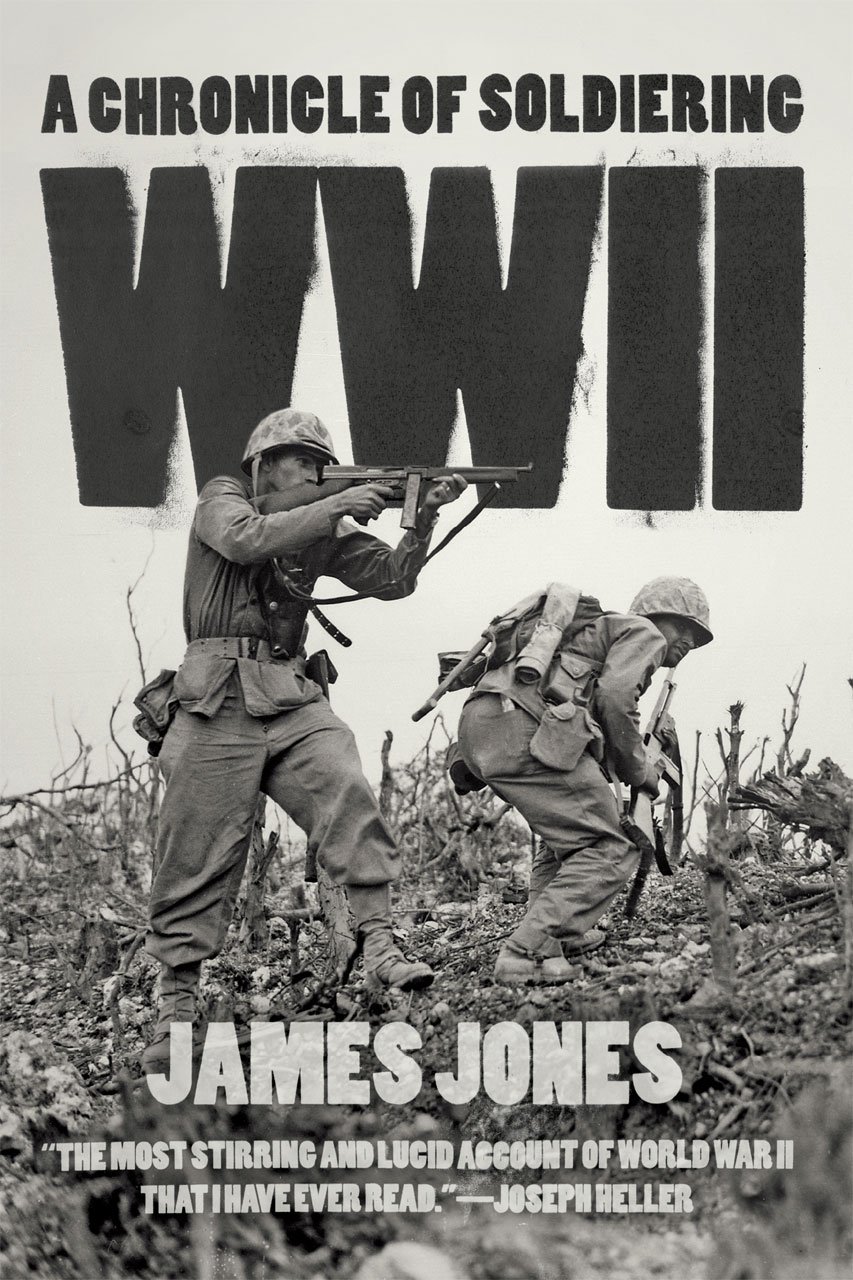



In 1975, James Jones—the American author whose novels From Here to Eternity and The Thin Red Line had made him the preeminent voice of the enlisted man in World War II—was chosen to write the text for an oversized coffee table book edited by former Yank magazine art director Art Weithas and featuring visual art from World War II. The book was a best seller, praised for both its images and for Jones’s text, but in subsequent decades the artwork made it impossible for the book to be reproduced in its original form, and it fell out of print and was forgotten. This edition of WWII makes available for the first time in more than twenty years Jones’s stunning text, his only extended nonfiction writing on the war that defined his generation. Moving chronologically and thematically through the complex history of the conflict, Jones interweaves his own vivid memories of soldiering in the Pacific—from the look on a Japanese fighter pilot’s face as he bombed Pearl Harbor, so close that Jones could see him smile and wave, to hitting the beach under fire in Guadalcanal—while always returning to resounding larger themes. Much of WWII can be read as a tribute to the commitment of American soldiers, but Jones also pulls no punches, bluntly chronicling resentment at the privilege of the officers, questionable strategic choices, wartime suffering, disorganization, the needless loss of life, and the brutal realization that a single soldier is ultimately nothing but a replaceable cog in a heartless machine. As the generation that fought and won World War II leaves the stage, James Jones’s book reminds us of what they accomplished—and what they sacrificed to do so. “This account is brutally honest, scathingly critical and even funny at times. Jones’s vivid, vulnerable memoir cuts through a veil of nostalgia that often surrounds the war. Instances of horror and levity punctuate his evolution as a soldier and the eventual begrudging acceptance of his own insignificant role in the American war machine. He also fiercely condemns the wasting of lives by careless or politically motivated strategists. Jones’s insightful mix of memoir and military history is engrossing.” ― Shelf Awareness “Jones does some remarkably sharp reflecting on the art and practice of history-writing itself—this is an entirely, refreshingly earnest book for all its gruff jadedness. . . . ‘In my old age I have about come to believe that the whole of written history is miscreated and flawed by these discrepancies in the two ideals systems,’ Jones (who was 52 at the time) writes, ‘the one of how we would all like to believe humanity to be, but only the privileged can afford to believe is; and the one of how we all really know humanity in fact is, but none of us wants to believe it.’ In a way that’s both slightly ironic and slightly saddening, Jones’ book manages to proceed equally in both those systems simultaneously, and the end effect, mesmerizing in its own way, is that of a smart, hot-hearted man trying to grapple with the epic thing that happened to him in his youth. Jones died far too young, only a couple of years after he wrote this book, and it’s a powerful, curious testimony. The good folks at University of Chicago Press are to be congratulated for salvaging it and putting it in front of the bookshopping crowds this winter.” -- Steve Donoghue ― Open Letters Monthly “A classic of its type. . . . Many eerie details . . . make [Jones’s] chronicle ring with authenticity, such as the look on the face of the wounded who have ‘entered some realm where the others, the unwounded, cannot follow.’ . . . The Pacific and Europe, war art, the home front and much more are depicted with memorable immediacy.” -- Steven Carroll ― The Age (Australia) “A unique and fascinating volume. Even now, after a perpetually surging Noah’s flood of ‘Good War’ literature, WWII stands out as one of the most vivid documents ever produced on how the war looked and felt to those who experienced it firsthand. . . . A too-little-known piece of work by a great American writer, and readers will discover unexpected, alarming, dazzling or horrifying observations on every page.” -- Lee Sandlin ― Wall Street Journal “The most stirring and lucid account of World War II that I have ever read.” -- Joseph Heller “Anytime he writes of war you can smell the gunsmoke. A book like this was needed to remind us what it was like. . . . A remarkable achievement.” -- James Michener “[Jones] overcomes the vastness of the event by emphasizing his personal experience of it, thus giving the reader a foothold in the text that is far more satisfying than gliding across a glossy overview. He overcomes his limited viewpoint of the war by symbolizing it in the experience of the common infantryman and locating in that experience a unique significance.” -- Christopher Lehmann-Haupt ― New York Times “A remarkable history. . . .This was a substantial effort—[Jones] had both the long view and