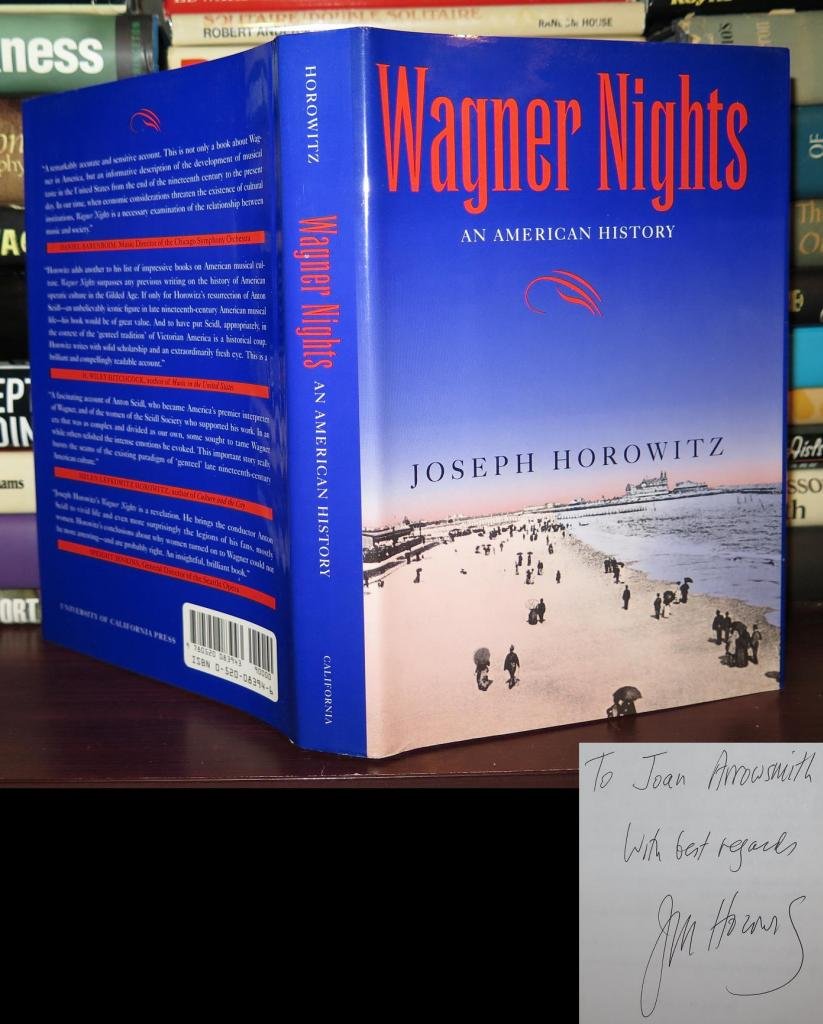
Wagner Nights: An American History (Volume 9) (California Studies in 19th-Century Music)
$16.00
by Joseph Horowitz



As never before or since, Richard Wagner's name dominated American music-making at the close of the nineteenth century. Europe, too, was obsessed with Wagner, but―as Joseph Horowitz shows in this first history of Wagnerism in the United States―the American obsession was unique. The central figure in Wagner Nights is conductor Anton Seidl (1850-1898), a priestly and enigmatic personage in New York musical life. Seidl's own admirers included the women of the Brooklyn-based Seidl Society, who wore the letter "S" on their dresses. In the summers, Seidl conducted fourteen times a week at Brighton Beach, filling the three-thousand-seat music pavilion to capacity. The fact that most Wagnerites were women was a distinguishing feature of American Wagnerism and constituted a vital aspect of the fin-de-siècle ferment that anticipated the New American Woman. Drawing on the work of such cultural historians as T. Jackson Lears and Lawrence Levine, Horowitz's lively history reveals an "Americanized" Wagner never documented before. An entertaining and startling read, a treasury of operatic lore, Wagner Nights offers an unprecedented revisionist history of American culture a century ago. This delightful recounting of America's early reception of Richard Wagner's music deftly reviews foundations laid by others, then settles into Horowitz's real subject: the intense 12-year American career of Budapest-born conductor Anton Seidl and the all-female Seidl Society that supported his work. Horowitz argues that the Gilded Age had substance behind the glitter, that Wagner's music provided a veritable soundtrack for "protofeminist" experience in America, and that further investigation of American "high culture" at the turn of the last century will yield fascinating insights. As laid out here, American Wagnerism alone invites more studies into the history of its public reception. With his customary fresh approach to his subject and lively prose style, Horowitz (Understanding Toscanini, Univ. of Minnesota Pr., 1987) sets a high standard to be followed. Recommended for academic music and social history collections. Bonnie Jo Dopp, formerly with Dist. of Columbia P.L. Copyright 1994 Reed Business Information, Inc. An expert blend of musical and social history, illuminating one of the cultural cores of America's ``Gilded Age.'' In the 1880s, as accurately depicted in Edith Wharton's Age of Innocence, the upper echelons of New York society flocked to Faust (a scene carefully retained in Martin Scorsese's recent film version). But by the 1890s, Wagner fever had overtaken America's most ardent opera patrons, and not in New York alone. This is the world that Horowitz (The Ivory Trade, 1990, etc.) reveals in his fascinating, gracefully written study of American Wagnerism. Currently executive director of the Brooklyn Philharmonic, formerly a New York Times music critic, and a long-time student of the interplay between musical art and national culture, Horowitz orders his narrative around the parallel careers of the conductor Anton Seidl and the New York Tribune critic Henry Krehbiel. He evokes an era when issues of aesthetics and musical philosophy were the common currency of middle-class discussion. From the viewpoint of today's world, in which the column inches devoted to serious arts criticism in the daily papers have shrunk to virtually nothing, fin-de-sicle America was, musically and intellectually, an enviably lively place. Wagner's works dominated the stage, and his music and ``ideas'' were the subject of passionate debate. To this extent, Horowitz proves his thesis that the ``Gay '90s'' were not the crass, lowbrow scene its detractors have claimed. One fascinating recurrent theme in this study is the positive impact of Wagnerism on emerging feminism at the turn of the century. It appears that a majority of American Wagnerites were women, and the idea of Brunnhilde (as well as the regal dramatic sopranos who portrayed her) fit neatly with the notion of the ``New Woman'' then sweeping the nation. A work of engrossing scholarship about an important, unjustly ignored slice of our artistic past. -- Copyright ©1994, Kirkus Associates, LP. All rights reserved. "A beautifully realized and moving portrait. . . . Wagner Nights is a richly informative and considered study of cultural history. An exciting invitation to rethink the period and, at last, to dispense with the meritricious 'Gilded Age'." -- John Dizikes, New York Times Book Review "Remarkably accurate and sensitive. . . . not only a book about Wagner in America, but an informative description of the development of musical taste in the United States from the end of the nineteenth century to the present day."Daniel Barenboim, Music Director, Chicago Symphony Orchestra "Horowitz adds another to his list of impressive books on American musical culture. Wagner Nights surpasses any previous writing on the history of American operatic culture in the Gilded Age. If only for Horow