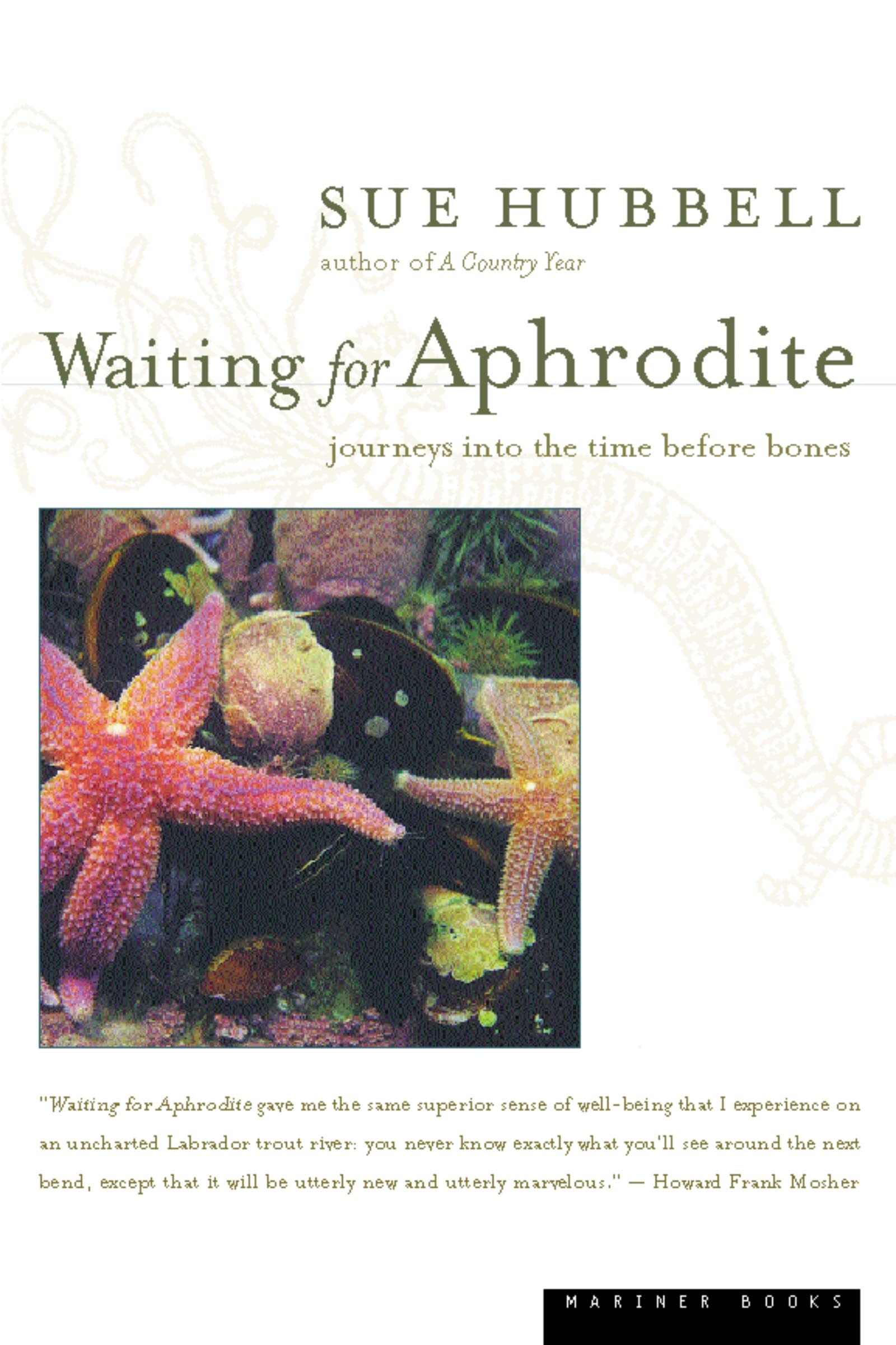



"We humans are a minority of giants, stumbling around in the world of little things," Sue Hubbell writes in this marvelous book. Each of these little things "has a complicated and special way of getting on in the world, different from ours and different from one another's." In Waiting for Aphrodite she explores the ways of sponges and sea urchins, horseshoe crabs and the sea mouse known as Aphrodite -- as well as our ways. She takes us on a journey through the mysteries of time -- geological, biological, and personal -- as she writes of the evolution of life on this planet and the evolution of her own life: her childhood next to a Michigan graveyard; the three colleges where she "learned three things"; her twenty-five years keeping bees on a farm in the Ozarks; her move to a "strange little house" in a small Maine town, "the place I wanted to grow old in." And in the tide pools and ocean waters there she discovered a whole new world, the world of little things that inspired this book. "In her new book, Hubbell becomes a Shakespeare of advocacy for some of the more ignored denizens of our complicated planet. For, she says, hath not a (millipede, earthworm, cricket, etc.) its own life, beaty, rightness and place in the scheme of things? Can't we see them, admire them, appreciate their simplicities and their complexities, marvel at their durability?- remembering, meanwhile, that we humans are, compared with many of them, the most insolent upstarts of evolution? Along the way in this engaging tribute, you find that you are being educated-by Hubbell of course, and by the array of dedicated scientists and partisans of each invertebrate she seeks out." Newsday "Hubbell makes life more interesting." Nature "From a tidal pool in Maine and rainforest treetops in Belize to the Missouri Ozarks, [Sue Hubbell] sees everything and speaks of it in words that blend passion and insight and wit and charm." Kansas City Star Sue Hubbell was the author of eight books, including A Country Year and New York Times Notable Book A Book of Bees . She wrote for the New Yorker , the St. Louis Post-Dispatch , Smithsonian , and Time , and was a frequent contributor to the “Hers” column of the New York Times . Waiting for Aphrodite Journeys Into the Time Before Bones By Sue Hubbell Mariner Books Copyright © 2000 Sue Hubbell All right reserved. ISBN: 061805684X Chapter One I went to three different colleges before I managed to snagan undergraduate degree, and considering how callow I was inthose days, it is a wonder I learned anything at all. But lookingback, I believe I learned three things. Two are irrelevant to ourpurposes here, but one has some bearing. A professor at the firstof those colleges penetrated my attention sufficiently to impressupon me that there was no such thing as objective writing, that everyinscription, every traveler's tale, every news account, everypiece of technical writing, tells more about the author and histimes than it does about the ostensible subject. The best that can behoped is that the writer will lay out his bias up front. I'm nearly half a century away from my college days, but everythingI've ever read, including the scientific papers on biologicalsubjects that I mine for my own writing, has convinced me that theprofessor was right. The writers of those papers, men and women Ihave interviewed and have come to know and admire, have selectedtheir subjects because they have a passion for them. Theyhave observed phenomena with an eye shaped by their experiencesin particular places and times and have found interest andsignificance according to their own gifts, limitations, sadnesses, andsociabilities; their understandings have been shaped by their ownpeculiar and quirky worlds. One of the better achievements of Western thought is thescientific method, which, when it works well, makes allowances forall those passions, limitations, and quirks. A good field biologistgoes out and looks at the real world, sees something no one else hasnoticed, writes it down as accurately as he can, and reports it toothers through publication. On the basis of his observation, he orsomeone else may spin a theory that explains it. Other observerswith other passions, later observers with other biases, check it out,supplement, amplify, disagree, revise. Science is a process, not abody of received wisdom. My own interests run to small animals that creep and jump andslither and flutter, the invertebrates ? "the little things that runthe world," as E. O. Wilson has said. What I hope to do when Iwrite, keeping my old professor in mind, is to tell about the worldof invertebrates, which appears to me an interesting and engagingone. I try to lay out my biases up front. I am grateful but astonishedthat over my writing life ? one of the several lives I've had ? sober,serious, responsible grownup editors have let me loose in thatparticular world to satisfy my own curiosity and amuse myself,in re