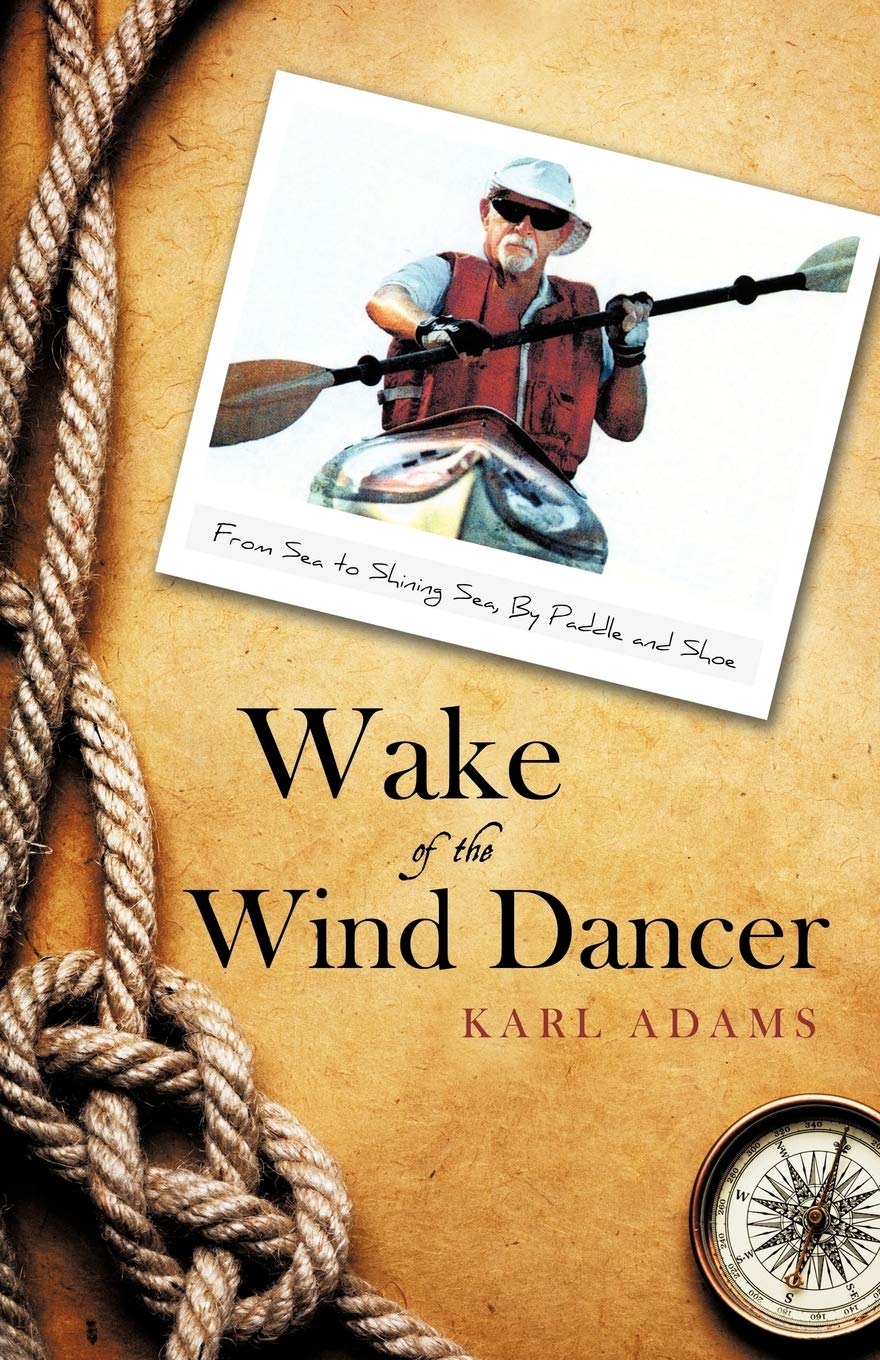



Wake of the Wind Dancer was written from a daily accounting of the journey that Karl Adams took across America in his kayak, the Wind Dancer, and on foot. He followed or closely paralleled the path of seven of America's early explorers; Lewis and Clark among them. He is the only person known to have covered this entire route by boat and on foot, with no support team or power other than the energy supplied by his own body. Each stroke of his paddles brought an ever changing, panoramic view and a different and challenging adventure; at times humorous and at other times perilous, sometimes even life threatening. When he ran out of waterways he walked, pulling the kayak behind him for three hundred and fifty miles. He took pictures of the interesting and beautiful sights along the way which he used to create a travelogue of his journey to show to his family and friends at the end of his year of travels. Wake of the Wind Dancer is a stimulating, photographic narrative that provides a valuable historical record of his exciting and sometimes harrowing year-long adventure from Oregon to Florida on foot and by kayak! Karl Adams was born in Idaho, but now lives in Oregon. He served five years in the U.S. Navy during WWII and eighteen years in the U.S. Army during the Korean War. At eighty-three, his travels and this unique life-long adventure still continues, often with his wife of forty-seven years by his side. Wake of the Wind Dancer From Sea to Shining Sea, By Paddle and Shoe By Karl Adams iUniverse, Inc. Copyright © 2009 Karl Adams All right reserved. ISBN: 978-1-4401-6077-6 Contents Chapter 1 Planning...........................................................1Chapter 2 The Columbia River 1987............................................15Chapter 3 The Snake River....................................................51Chapter 4 The Long March.....................................................59Chapter 5 Missouri River-Montana.............................................92Chapter 6 Missouri River-North Dakota........................................137Chapter 7 Missouri River-South Dakota........................................146Chapter 8 Missouri River-Nebraska & Kansas...................................167Chapter 9 Missouri River-Missouri............................................179Chapter 10 Mississippi and Ohio rivers.......................................187Chapter 11 Tennessee River...................................................202Chapter 12 Florida Intracoastal Waterways North and West.....................226Chapter 13 Florida Intracoastal Waterway-East................................250Chapter 14 The Ripples on the Pond...........................................261 Chapter One Planning When I was launched into this world I brought with me certain characteristics: a passion for adventure, a desire to see what was over the horizon, and a love of travel by water. A car or motorboat couldn't take me where I wanted to go, but a paddle, a sail, and a strong pair of legs could take me anywhere in the world. In my youth, whenever I was unable to participate in an adventure of my own, I would resort to reading books of the early explorers. I would have liked to have lived in that era. The migration of humans was the greatest adventure of all times. Early man drifted out of Africa and went north across Europe and Asia until they came to Northeast Siberia. Then, twenty to forty thousand years ago, they crossed over into what is now North America. After early man reached what is now Alaska, they started moving south and east. How long it took them to reach Florida, I have not been able to learn, but the Seminole Native Americans were there to greet the first Europeans. In 1513, Ponce de Leon landed on the east coast of what is now Florida. Thinking he was exploring another island, he sailed around the tip of Florida to the west coast. His exploration of Florida was cut short by a Seminole arrow. Spain's next two candidates for the conquest of North America were Narvez and Nez Cabeza de Vaca. In 1528, they landed on the west coast of Florida and moved north. After eight years, only Vaca and three others still survived. That set the stage for Desoto. In 1539, Hernando de Soto landed on the north coast of Florida near what is now Tallahassee. Once on shore he moved inland and looped around west to the Mississippi River, fighting Native Americans all the way. Hernando de Soto was the first European to reach the river. Unfortunately, he contracted a fever and died. His body was deposited in the Mississippi ... Europe's first contribution to its pollution. Things remained static for a few years while the whole eastern seaboard filled up with Europeans. Then the new Americans got into the act. Captain Robert Gray sailed around the horn of South America and up the west coast to where he found a mighty river. In May 1792, he sailed his vessel the Columbia Rediviva across the bar