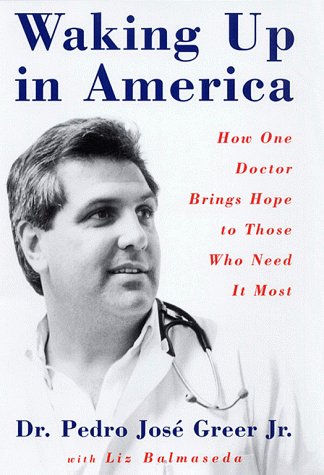
Waking Up in America: How One Doctor Brings Hope To Those Who Need It Most
$32.00
by Dr. Pedro Jose Greer



An internationally acclaimed advocate for the homeless and vocal critic of current health care and welfare reforms, Miami's "Dr. Joe" presents an inspirational portrait of his life work and his compassionate philosophy, demanding a change in attitudes toward the poor. 20,000 first printing. Inspiring memoirs of a remarkable physician whose dedication to helping the homeless has changed the face of health care in Miami. Winner of a MacArthur Foundation genius award, Greer, aided here by a Pulitzer-winning journalist at the Miami Herald, tells of his pledge, made on the sudden death of his young sister, never to let any one die or suffer alone. A Cuban who was born in the US by chance, he seems to moves easily between the worlds of Anglo and Spanish, rich and poor, powerful and helpless. In 1984, the lonely death of a local homeless man sent Greer, then an intern at Miamis Jackson Memorial Hospital, looking for the mans family. The search led him to Camillus House, a shelter for the homeless, where he soon set up a tiny free walk-in clinic. At risk to his own safety, Greer scoured the mudflats under the bridges and highways to tell alcoholics, drug addicts, and other down-and-outers living there in crates and boxes about his free clinic and persuade them to come in for treatment. With furnishings and supplies and medicines scavenged by the resourceful Greer and care provided by fellow volunteers, the Camillus House clinic thrived and eventually grew to a multistory center named after Greers dead sister. Greer acquired an education in raising funds and applying for grants, and he soon opened other clinics in Little Havana and in South Dade migrant labor camps. By 1991, the intrepid Greer had become the first assistant dean of homeless education at the University of Miami School of Medicine, with rotations of medical students staffing the clinics. Sharp in its indictment of profit-hungry HMOs that sign up homeless patients for their Medicaid-paid fees but dont serve them, hospital administrators who refuse admission to the under- or uninsured, and out-of-touch Washington policymakers, Greers text offers spirited testimony to the difference one committed individual can make -- Copyright ©1999, Kirkus Associates, LP. All rights reserved. Gloria Estefan I am proud to call Joe Greer my friend and not just because he calls me to tell me jokes that I may have heard a few (hundred) times before. Joe is the kind of man who will go out of his way to help not only his family and friends but anyone in need that comes to his attention. He has made a commitment to making this world a belier place and lives each day making sure that he follows through. His story is inspirational and makes us feel that there's always something we can contribute and even have a lot of laughs along the way! I'm sure his book will touch countless minds and hearts the way his friendship enriches my life. -- Review Pedro José Greer Jr., M.D., is the award-winning founder and volunteer medical director of Miami's Camillus Health Concern, a health care clinic for the poor and homeless, which serves more than ten thousand men, women, and children annually. The winner of numerous honors, including a MacArthur Foundation "Genius" grant and the President's Service Award in 1997, Dr. Greer has served as an adviser to both the Bush and the Clinton administrations on health care issues. He holds a diverse number of appointments, ranging from serving as a trustee for the RAND corporation to sitting on the board of directors of Comic Relief. In addition, Dr. Greer is a professor of medicine, a gastroenterologist and hepatologist in private practice, and the former Chief of Gastroenterology at Mercy Hospital, a full-Service hospital in Miami. The son of Cuban immigrants, he grew up in the Caribbean and in Miami. Introduction I started writing this book in a hotel room in San Juan, Puerto Rico, six years ago. I had just finished giving a lecture entitled "A Physician's Responsibility to the Poor" at an annual medical-student convention. That lecture had opened up some old, painful memories and sent me back to files I had not read in a long while. Over the years, I had kept cryptic notes of my journey into the world of medicine and the sick, the homeless and the poor, the world of politics, HMOs, and other horrors. I wanted to write in a language that would reach the students. I wanted to convey my sense of mission. I wanted to tell them about passion. I wanted to tell them about the things I had learned, the things they would never learn in the lab. I wanted to tell about the joy I found in my profession, particularly when it involved my patients. I'm a hepatologist and gastroenterologist by formal training. But I have never had a liver or a colon walk into my office alone. They always came attached to a person. That person had a family, friends, a history, dreams. As physicians, I told the students, we treat people, not organs or diseases. So, in the