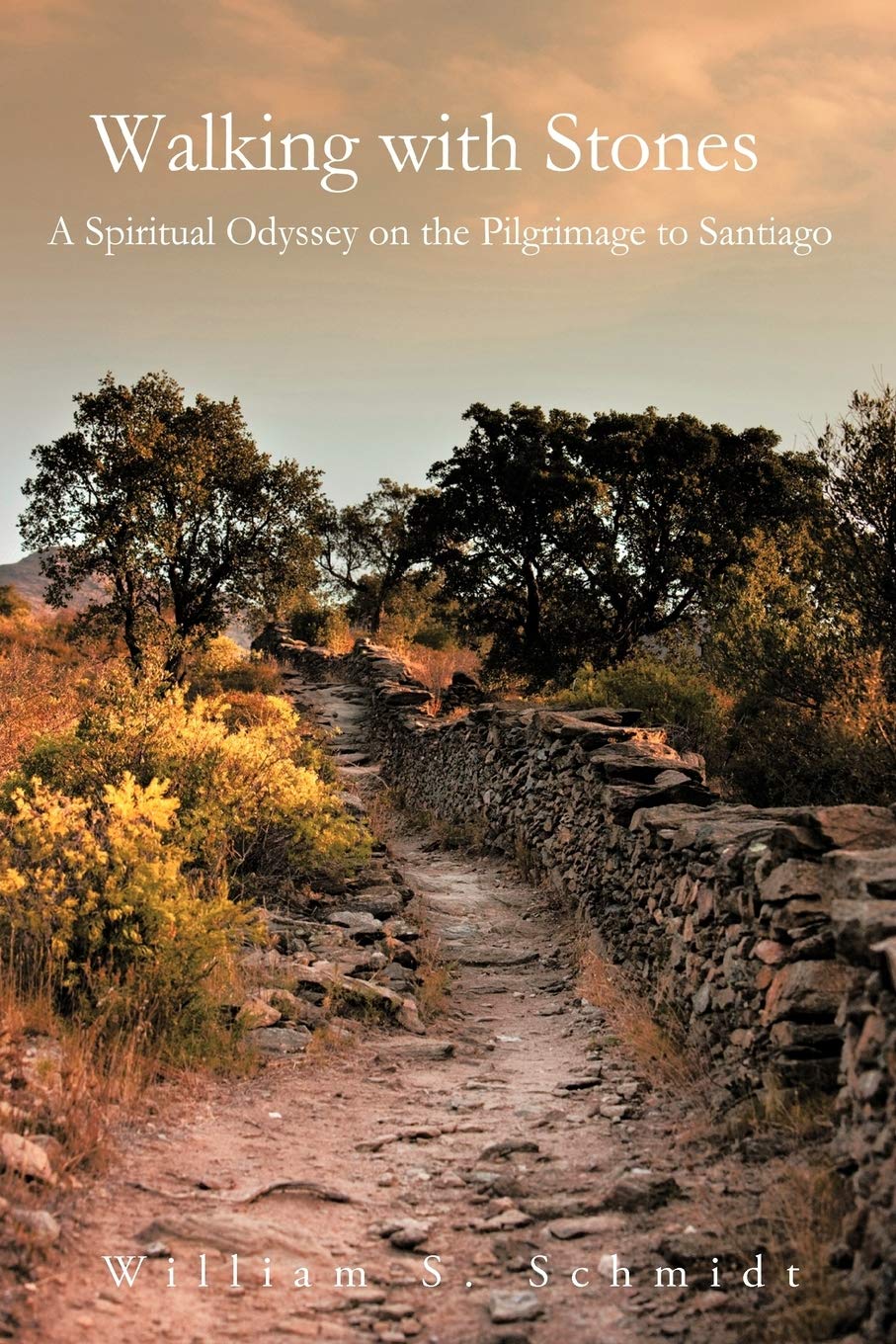
Walking With Stones: A Spiritual Odyssey on the Pilgrimage to Santiago
$13.04
by William S. Schmidt



Sometimes life throws us onto paths so raw and unexpected, that one enters an uncharted personal wilderness. In these pages we find a story of profound spiritual renewal, forged from the very depths of our hearts. The very stones themselves become a witness to our quest. Walking with Stones: A SPIRITUAL ODYSSEY ON THE PILGRIMAGE TO SANTIAGO By William S. Schmidt Trafford Publishing Copyright © 2012 William S. Schmidt All right reserved. ISBN: 978-1-4669-0934-2 Contents Chapter 1 The Way of the Scallop Shell........................1Chapter 2 Prayer Stones.......................................12Chapter 3 Hitting Walls.......................................28Chapter 4 A Wholeness Stone...................................47Chapter 5 A Wedding Anniversary...............................61Chapter 6 The Chicken Oracle..................................73Chapter 7 Angels in the Wilderness............................86Chapter 8 Resisting Grace.....................................101Chapter 9 The Temptation of Leonard Cohen.....................116Chapter 10 The Cross of Ferro.................................126Chapter 11 Reflections on Loving..............................138Chapter 12 No Room at the Inn.................................150Chapter 13 Camino Variations..................................165Chapter 14 A Visit With St James..............................186Chapter 15 The End of the Earth...............................195A Meditation on Stones........................................209About the Author..............................................217 Chapter One The Way of the Scallop Shell "Pilgrims are poets who create by taking journeys." Traveling With Pomegranates, Sue Monk Kidd, 2010, p. 143 "So, why are you walking the Camino?" Such is the question that enters most any pilgrim conversation. Why, in our modern era, do well over one hundred thousand of us on an annual basis walk hundreds of miles/kilometers, in all seasons, under all possible conditions, with all manner of challenges: physical, emotional, or spiritual, to reach this relatively obscure northern Spanish city of Santiago, there to hug the statue of this saint called James? Why do we cry the tears and laugh the gut-splitting laughter the path seems to squeeze out of us? Why did I walk over 500 miles/800 kilometers (mostly) from St. Jean Pied de Port in southern France, through all of northern Spain, across three mountain ranges, to reach Santiago, finishing in Finisterre, the so-called "end of the earth," all in thirty five days? I believe I share with most pilgrims a combination of pain and hope that leaves us with an inner yearning. For what? Perhaps some healing, a resolution of some dilemma, possibly renewal of some sort, or perhaps finding our way again in the midst of the storms and confusion that life churns up for us. For me, there were very specific burdens I was carrying on my pilgrimage, the most intense of which was the collapse of my 35 year marriage, and my yearning to find healing and perhaps some closure of the wound that this loss generated. But an even deeper struggle I was less aware of, even as it touched more of me, was a disconnect from my own true center, and with that a disconnect from God. These revelations come with some embarrassment because I of all people should not be in such a predicament. After all, I have been a counselor and psychotherapist for the same number of years as my marriage. I have worked with well over 100 couples in that time span, and supposedly helped a good number of them. So what gives? Others he can help, himself he cannot? It feels even worse when it comes to the God question. I was an ordained minister for a quarter of a century. I teach counseling and spirituality at a Jesuit University, and directed two Master's degree programs in Counseling and Spirituality for over a decade. I should know how to find my way to God and be able to stay there. How can my head and heart be so disconnected? A glimmer of why the Camino might be a partial remedy for my problems is seen in its supreme symbol, the scallop shell. The scallop has represented a deep truth about the Camino going back even into pre-Christian eras when the town of Finisterre on the Atlantic shore was the final goal, the furthest point of land known to persons in the Western Hemisphere. There, at this final shore, the scallop shells on the beach were used by pilgrims as a ritual object to symbolize the completion of their journey. But perhaps the shell also reveals something about the path itself. A close look at a scallop shell reveals its truth. Its many grooves all point to the center and every groove reaches the center, but the spiritual mystery of the scallop is that the grooves at the center of the shell are longer and thus further from its end, therefore covering more distance than those grooves at the perimeter. But how does this relate to the Camino or any spiritual truths? Just because