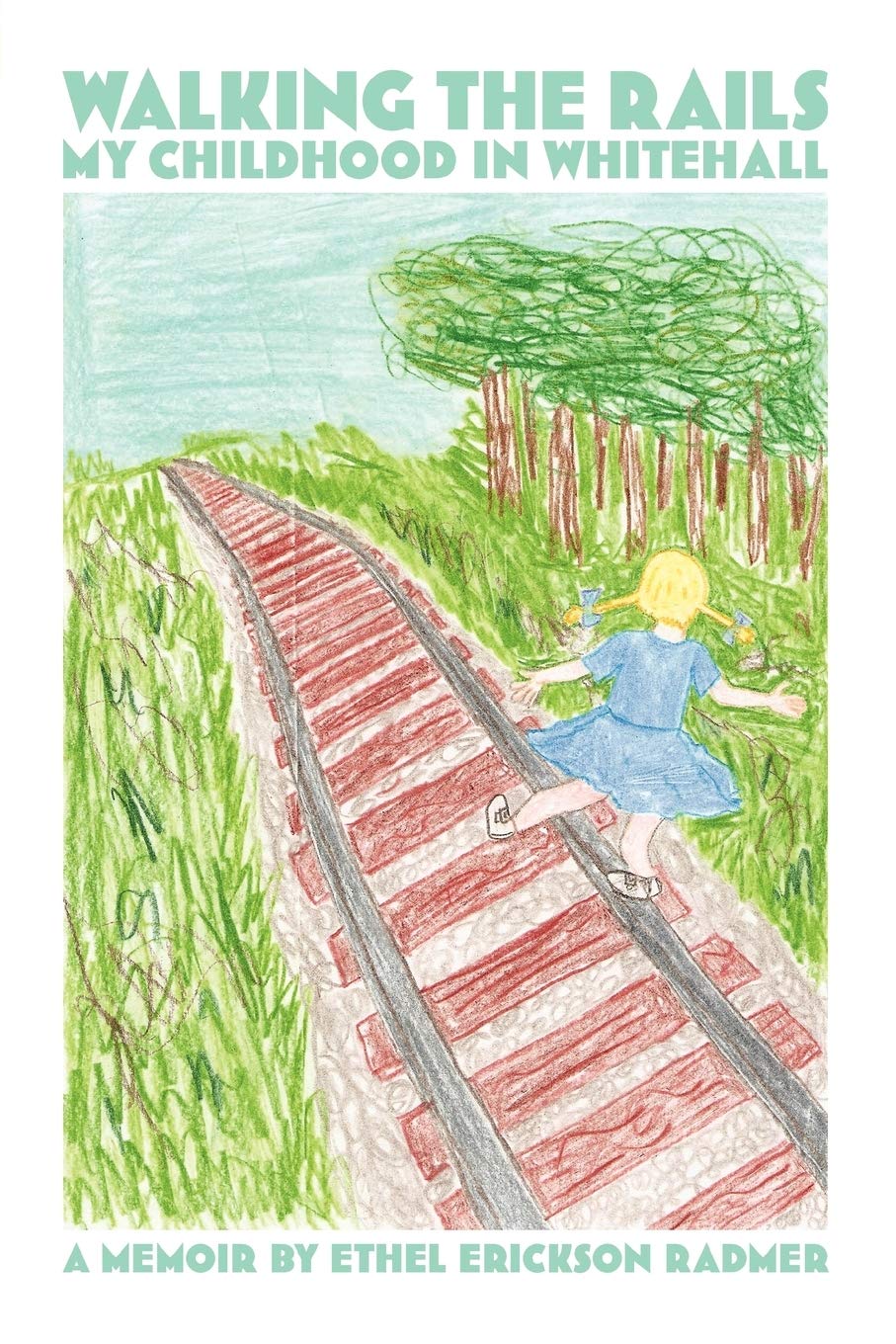



For Ethel Erickson Radmer, a child of the 1930s, life in Wisconsin was an adventure filled with imagination, fun, and curiosity. Hers was a simple life, without computers and cell phones. It was a time when people in a small town dropped in on each other to visit and paid their bills in person. It was a time when folks honored courtesy and neighborly affection. If you knew someone was in the hospital, you brought them flowers-from your own garden. Ethel grew up in a railroad town that bustled with supplies and troops for World War II. To a small girl from a small town, a Green Bay & Western Railroad passenger car represented nothing short of freedom. But Ethel found joy in the simple things-a playground for roller skating . . . a golf course made just for picnics and sled-ding (and swinging clubs) . . . nearby farmland and barns to explore . . . and a meandering river to quiet her heart. It was a simpler time, but Ethel Erickson Radmer was no simple girl. "Walking the Rails is everything a good memoir should be-generously detailed, disarmingly frank, and emotionally moving. With wit, irony, and generosity of spirit, Ethel Radmer has woven a heartwarming and lush tapestry of growing up in a loving American family during the difficult days of the Great Depression, World War II, and its aftermath". -Dave Wood, past vice-president of the National Book Critics Circle, former book review editor of the Minneapolis Star Tribune, and memoirist Walking the Rails My Childhood in Whitehall By Ethel Erickson Radmer iUniverse, Inc. Copyright © 2012 Ethel Erickson Radmer All right reserved. ISBN: 978-1-4759-1008-7 Contents Preface.........................................ixA Girl Was Born.................................1Walking, Climbing, Falling......................11Arvid and Sarah's Courtship.....................24O! Segari!......................................35The Depot.......................................58Early School Days...............................71Dr Tyvand......................................90Moving Up.......................................97The Coulees.....................................108High School.....................................113 Chapter One A Girl Was Born "In the fall of 1935, when `the frost was on the pumpkin, and the fodder was in the shock;' when the green leaves were changing their colors to the many golden hues of Autumn; when Mother Nature was singing her lullaby to her brood in preparation for a long winter's slumber of hibernation in accordance with her Cyclic Laws, an event of great importance took place on November 6th 1935 at 12:30 High Noon; an individual in a small physical body was born into our world of storm and strife, albeit a world of beauty and order and system; born as a female in our house and we called her Ethel Mae. What a name! What a girl!" This was my dad's welcome for my arrival, written in his autobiography. I came on a Wednesday and weighed in at 9½ pounds on the "fisherman's scale" that the doctor brought to my parents' home. I was laid onto a blanket with rings on a hook and a weight measure needle at the top. Dr. J. C. Tyvand, the physician who held me as I came out of my mother Sarah's womb, was assisted by nurse Mrs. J. C. Tyvand. It was a normal, natural birth, with my mother lying in her own bed, gently pushing me out the birth canal to introduce me to life outside my nourishing cocoon of nine months. I came to rest in my mother's arms against her breast. Ah! What peace and love and adventure I felt from birth on through all my years growing up in Whitehall, Wisconsin. What good fortune I had to have caring, nurturing parents in a very manageable town of 1,035 to know and explore with ease and safety, filled with people who knew and cared about me and whom I in turn could trust and churches to inspire some morals and ethics. In the center of my town of birth and in the center of our lives was the Green Bay and Western Railway Depot. The continuous ribbon of two parallel railroad tracks ran straight through the middle of the town and right through the middle of the state of Wisconsin, cutting it in half horizontally as it connected town to town east and west. We rode the trains across the state and walked those rails into the countryside surrounding my hometown, where we could roam freely and with abandon. My mother was forty-six years old when she had me, and I was fortunate to not be a statistic for higher birth defects in children born to mothers over forty, higher still among first-time mothers. But I was not her first! My mother had at least ten pregnancies in her fertile life—seven survived through adulthood, two died young, and one miscarried. I was the last that I knew of of her conceptions. What a relief that must have been! And she seemed to show it with a grateful ease about life. She could sit back in her Mission Style, oak-stained wood and brown leather rocking chair and relax with me, enjoying th