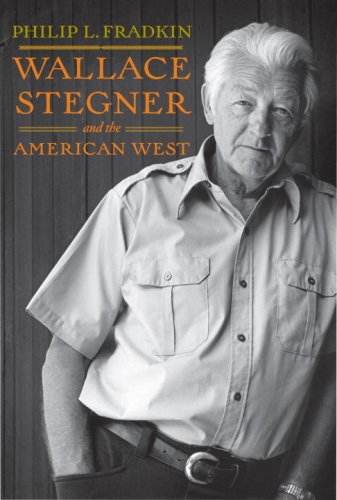



Wallace Stegner was the premier chronicler of the twentieth-century western American experience, and his novels, the Pulitzer Prize–winning Angle of Repose and the National Book Award–winning The Spectator Bird, brought the life and landscapes of the West to national and international attention. Now, in this illuminating biography, Philip L. Fradkin goes beyond Stegner’s iconic literary status to give us, as well, the influential teacher and visionary conservationist, the man for whom the preservation and integrity of place was as important as his ability to render its qualities and character in his brilliantly crafted fiction and nonfiction. From his birth in 1909 until his death in 1993, Stegner witnessed nearly a century of change in the land that he loved and fought so hard to preserve. We learn of his hardscrabble youth on the Canadian frontier and in Utah, and of his painful relationship with his father, a bootlegger and gambler. We follow his intellectual awakening as a young man and his years as a Depression-era graduate student at the University of Iowa, during its earliest days as a literary center. We watch as he finds his home, with his wife, Mary, in the foothills above Palo Alto, which provided him with a long-awaited sense of belonging and a refuge in which he would write his most treasured works. And here are his years as the legendary founder of the Stanford Creative Writing Program, where his students included Ken Kesey, Edward Abbey, Robert Stone, and Wendell Berry. But the changes wrought by developers and industrialists were too much for Stegner, and he tirelessly fought the transformation of his Garden of Eden into Silicon Valley. His writings on the importance of establishing national parks and wilderness areas—not only for the preservation of untouched landscape but also for the enrichment of the human spirit—played a key role in the passage of historic legislation and comprise some of the most beautiful words ever written about the natural world. Here, too, is the story—told in full for the first time—of the accusations of plagiarism that followed the publication of Angle of Repose, and of the shadow they have cast on his greatest work. Rich in personal and literary detail, and in the sensual description of the country that shaped his work and his life—this is the definitive account of one of the most acclaimed and admired writers, teachers, and conservationists of our time. Stegner, born in Iowa in 1909 and brought up on a Saskatchewan dirt farm, may have been our last frontier writer. As Fradkin notes in this astute biography, it was a miracle that he didnt write pulp Westerns. Instead, Stegner took as his subject the failure of his fathers homestead, built on denial of the most fundamental Western reality: drought. Stegners fiction stalked the slow disintegration of the family as closely as previous potboilers tracked cattle; and he transformed his fathers subsequent ramblesbootlegging the family from the dry northern plains to drier Mormon countiesinto a founding narrative stronger than any ultra-violent "revisionist" Western. Whether as novelist, conservationist, or teacher, Stegner showed how the West has "a way of warping well-carpentered habits, and raising the grain on exposed dreams." Copyright © 2008 Click here to subscribe to The New Yorker Environmental historian Fradkin’s previous books about the West focus on sagebrush and stagecoaches, earthquakes and rivers. He now portrays a western writer who mapped the paradoxes of the New West. Fradkin has a deep affinity for Wallace Stegner (1909–93) and makes superb use of Stegner’s evocative writing, including passages never before published. Adept at seeding every scene with myriad details, he follows Stegner from the Saskatchewan prairie, where nature was his narrative, to Utah, where he became a “public library addict.” Stegner’s prizewinning fiction comes under close scrutiny as Fradkin explicates Stegner’s profound insights into the way nature shapes the human condition. Fradkin writes with particular zest about Stegner’s conservation work with Secretary of the Interior Stewart Udall and the Sierra Club, and assesses the enormous influence of Stegner’s “environmental classic” Beyond the Hundredth Meridian (1954). Fradkin’s dynamic and probing portrait of Stegner brilliantly combines literary and environmental history, and provides a fresh and telling perspective on the rampant development of the arid West, and Stegner’s prophetic warnings of the complex consequences. --Donna Seaman "Clear-eyed . . . skillful . . . Reveals a canny, forthright, major figure in 20th century American letters." --Peter Richardson, Los Angeles Times Book Review "An ideal match between biographer and subject . . . You get the whole man . . . A true original as a person, as a writer and as a critic." --Martin Rubin, San Francisco Chronicle "[An] astute biography . . . Stegner may have been our last frontier writer." --