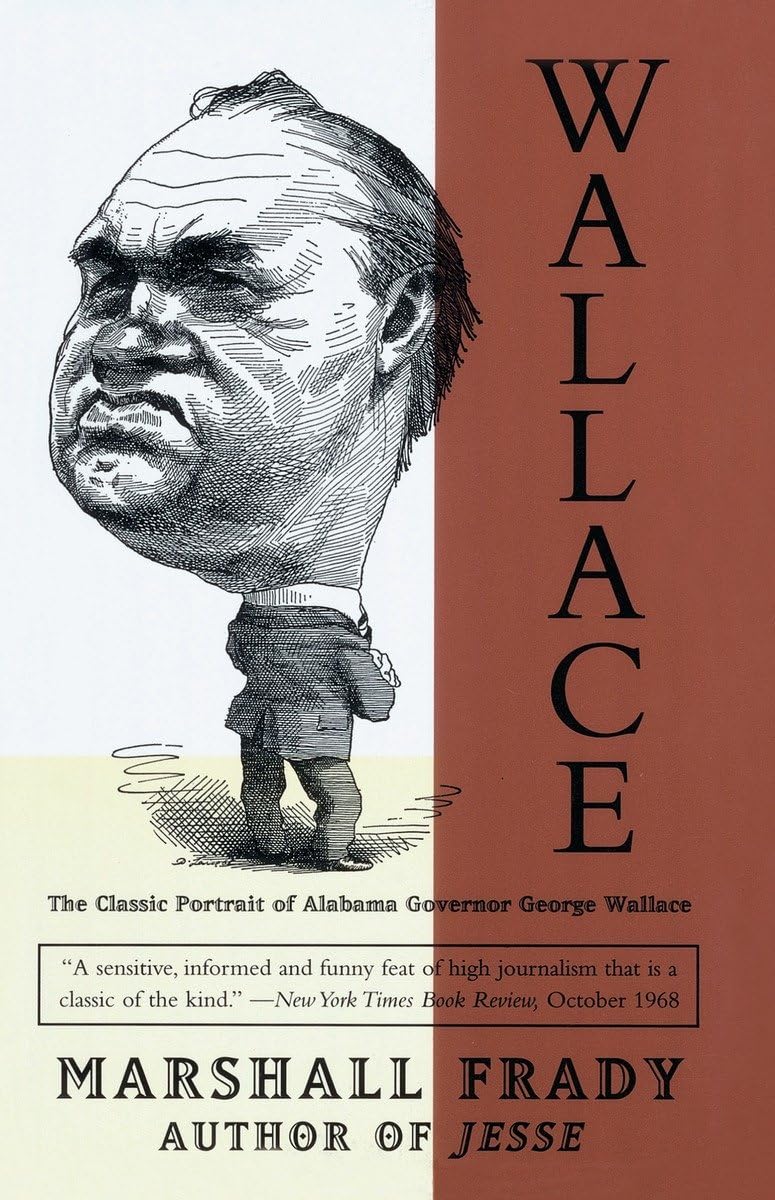



“A sensitive, informed and funny feat of high journalism that is a classic of the kind.”— The New York Times Book Review Wallace is a classic portrait of one of the century’s most fiery and controversial political figures. Initially conceived as a novel, Marshall Frady’s biography of George Wallace retains the narrative force and descriptive powers of fiction. Elizabeth Hardwick noted on Wallace ’s first publication in 1968, “There is a palpable Faulknerian mood to the reporting,” and The New Republic observed, “Frady has established new standards in political biography.” This is a wonderfully crafted depiction of a seminal figure whose influence altered the course of national politics. George Wallace is the most important failed American presidential candidate of the 20th century. He rose to national prominence during the first of his four official terms as governor of Alabama (there was also the term served by his first wife, Lurleen, when state law prohibited him from a third consecutive run at the office) by fulfilling a promise made to a group of state senators: "I'm going to make race the basis of politics in this state, and I'm going to make it the basis of politics in this country." His commitment to the racial segregation he believed the people of Alabama wanted, when taken to the national level, led to the articulation of a conservative working-class voter demographic that was eventually harnessed by Ronald Reagan in the 1980 elections and without which the candidacies of Ross Perot and Patrick Buchanan would seem much less plausible. Marshall Frady's Wallace is more than a political biography; it is a portrait in words. It crackles with the liveliness of Wallace on the Alabama campaign trail, capturing the feel of an era in which Southern politicians could still publicly refer to black Americans with a certain word without the slightest trace of self-consciousness. There are some remarkable passages within, including a conversation in which Governor Wallace tries to put Attorney General Robert F. Kennedy on the spot as to the potential deployment of federal troops to enforce the integration of the University of Alabama. Readers will also learn that, for all his racial demagoguery--of which he would repent late in life--Wallace was in many ways a rather liberal statesman, launching massive social programs, and in every way a canny politician despite appearances. --Ron Hogan Wallace is the classic portrait of one of the century's most fiery and controversial political figures. Initially conceived as a novel, Marshall Frady's biography retains the narrative force and descriptive powers of fiction. This is a depiction of George Wallace, a seminal figure of the second half of the twentieth century whose influence has altered the course of national politics. A native South Carolinian, Marshall Frady has been a journalist for more than 25 years, writing principally on political figures and racial and social tensions in the American culture, first as a correspondent for Newsweek , then for Life , Harper's, Esquire , The New York Review of Books , The Sunday Times (London), The Atlantic Monthly , and most recently The New Yorker . In the 1980s, he was chief writer and correspondent for ABC News Closeup and a correspondent for Nightline . He is the author of the acclaimed biographies Wallace and Billy Graham: A Parable of American Righteousness. On a cold, rain-flicked night in 1967 a rickety twin-engine Convair 240 began a blind and uncertain descent through low clouds, abruptly breaking out over the scattered watery lights of Concord, New Hampshire. It came in headlong, less by instruments and calculation than with a precipitous lurching optimism. A damp huddle of greeters was waiting in the dark, and they waggled dime-store Confederate flags when he emerged from the plane—a stumpy little man with heavy black eyebrows and bright black darting eyes and a puglike bulb of a nose who looked as if he might have stepped out of an eighteenth-century London street scene by Hogarth. Wrapped in a black raincoat, he bobbed spryly down the steps as flashbulbs stammered in the rain. Someone held an umbrella over his head while he said a few words to the newsmen. Asked if he were offended because no local officials were there to welcome him, he answered jauntily, “Naw”—his voice rising just a bit—“Naw, ’cause it’s the workin’ folks all over this country who’re gettin’ fed up and are gonna turn this country around, and a whole heap of politicians are gonna get run over when they do.” With that, he was bundled into a car at the head of the waiting cavalcade, and, with a swift surge, everyone—he, his entourage, the reporters, his local supporters—vanished into the night. One had the peculiar fleeting impression that a squad of commandos or guerrillas, irregulars at any rate, had just landed in the dark and was now loose in the New England countryside. At a press conference that eveni