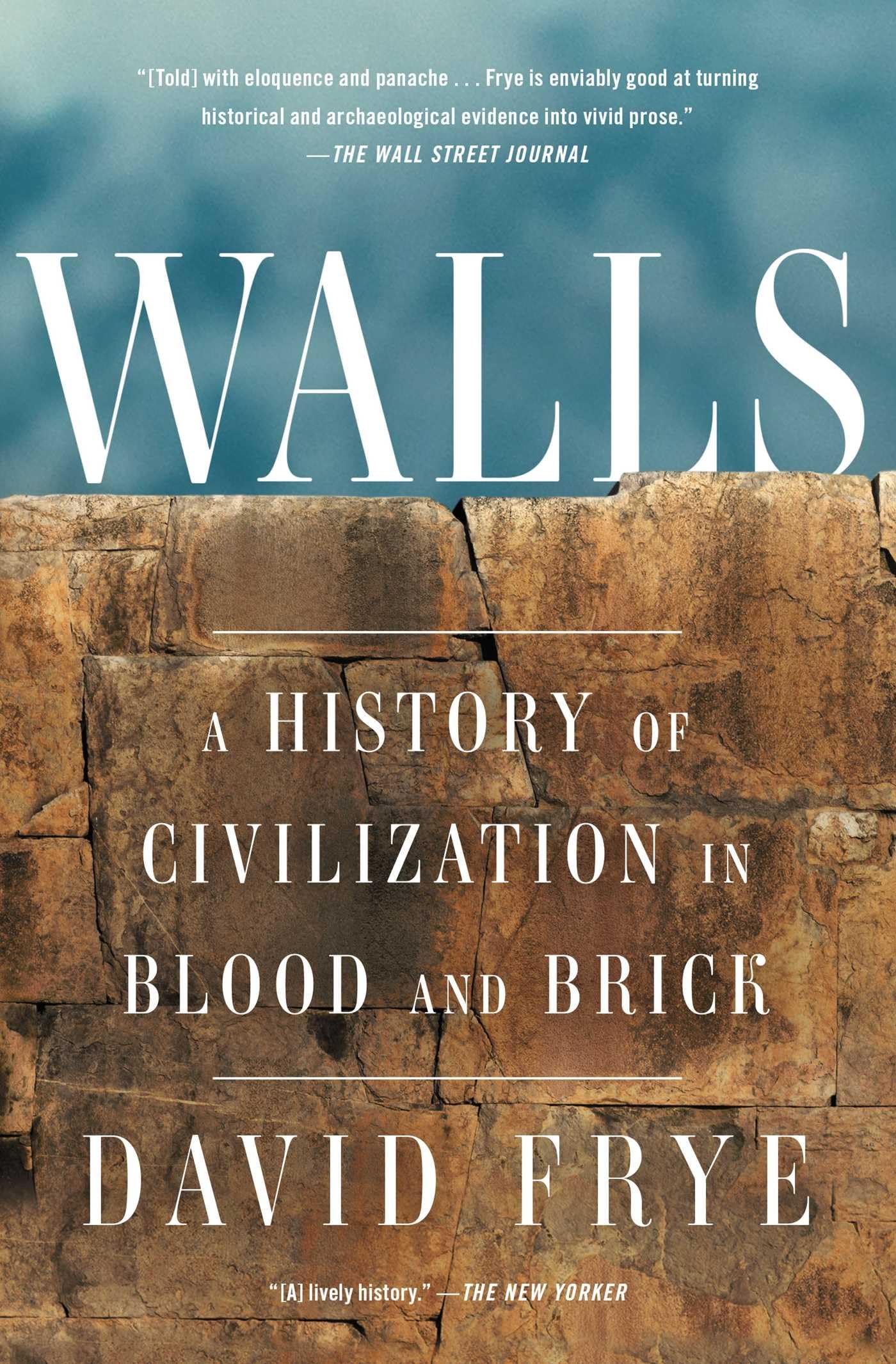
Walls: A History of Civilization in Blood and Brick (Gift for History Buffs)
$15.37
by David Frye



“A lively popular history of an oft-overlooked element in the development of human society” ( Library Journal )—walls— and a haunting and eye-opening saga that reveals a startling link between what we build and how we live. With esteemed historian David Frye as our raconteur-guide in Walls , which Publishers Weekly praises as “informative, relevant, and thought-provoking,” we journey back to a time before barriers of brick and stone even existed—to an era in which nomadic tribes vied for scarce resources, and each man was bred to a life of struggle. Ultimately, those same men would create edifices of mud, brick, and stone, and with them effectively divide humanity: on one side were those the walls protected; on the other, those the walls kept out. The stars of this narrative are the walls themselves—rising up in places as ancient and exotic as Mesopotamia, Babylon, Greece, China, Rome, Mongolia, Afghanistan, the lower Mississippi, and even Central America. As we journey across time and place, we discover a hidden, thousand-mile-long wall in Asia's steppes; learn of bizarre Spartan rituals; watch Mongol chieftains lead their miles-long hordes; witness the epic siege of Constantinople; chill at the fate of French explorers; marvel at the folly of the Maginot Line; tense at the gathering crisis in Cold War Berlin; gape at Hollywood’s gated royalty; and contemplate the wall mania of our own era. Hailed by Kirkus Reviews as “provocative, well-written, and—with walls rising everywhere on the planet—timely,” Walls gradually reveals the startling ways that barriers have affected our psyches. The questions this book summons are both intriguing and profound: Did walls make civilization possible? And can we live without them? Find out in this masterpiece of historical recovery and preeminent storytelling. "Fascinating and extensively researched, it's a timely reminder that the world, from gated communities to national borders, is increasingly fencing itself off." --The Herald " Walls , David Frye's fascinating and timely analysis of the rise andfall of empires, religions, cultures and languages, is so compellinglyreadable because it urges us to look closely at human artefacts soeveryday, so ordinary that we only rarely see themas instruments of power and authority." --The Australian "[Told] with eloquence and panache . . . [Frye] is enviably good atturning historical and archaeological evidence into vivid prose, and his writing is as clear as on any wall." -- Wall Street Journal "A haunting and brilliant achievement" --Tom Holland, author of Rubicon: The Last Years of the Roman Republic "David Frye's Walls turns 5,000 years of history outsidein. Instead of focusing on the centers of civilizations, he illuminatesthe boundaries where civilizations collide. From ancient Mesopotamiathrough Rome to the presidency of Donald Trump, Frye brilliantly crafts a unique view of history with valuable lessons for today." --Jack Weatherford, New York Times bestselling author of Genghis Khan and the Making of the Modern World David Frye is a professional historian, whose views have been sought ininterviews by the Science Channel, CNBC, National Geographic, theHistory Channel, BBC Radio, The Washington Post, Rolling Stone, Wired,and many other media outlets. A specialist in late ancient history,Frye received his PhD from Duke University and has participated inseveral archaeological excavations internationally. His articles haveappeared in a variety of academic journals, popular websites, magazines, and blogs, including McSweeney's, Time, BBC World History, Medium, andMHQ. Walls Midwife to Civilization: Wall Builders at the Dawn of History THE ANCIENT NEAR EAST, 2500–500 BC The great wall of Shulgi has not survived, but then, how could it? Time lay heavily across the landscape of Mesopotamia. Like some relentlessly pressing weight, it sought to smother everything that would rise up out of the flat alluvial plains of ancient Iraq. Its effects there were uncharacteristically swift, almost impatient; it destroyed things before it could age them. As early as the third millennium BC, the Mesopotamians already had a word—dul—for the shapeless lumps of dead cities that even then dotted the horizons, having long ago melted like wax under the sun. Dul eventually gave way to an Arabic word, tell, which reflected the growing obscurity shrouding the region’s past. To the Bedouins whose animals meandered around the unsightly mounds, the tells were nothing more than insignificant heaps of dirt. Only later did archaeologists realize that every one of those strange landmarks represented the ruins of a lost world. In Shulgi’s day, some four thousand years ago, Mesopotamians battled ceaselessly against the work of time. They lived as if in sand castles, forever building and rebuilding a world that would inevitably be washed away. Nothing endured. The great fertile fields that fed the cities were a mirage. If the worke