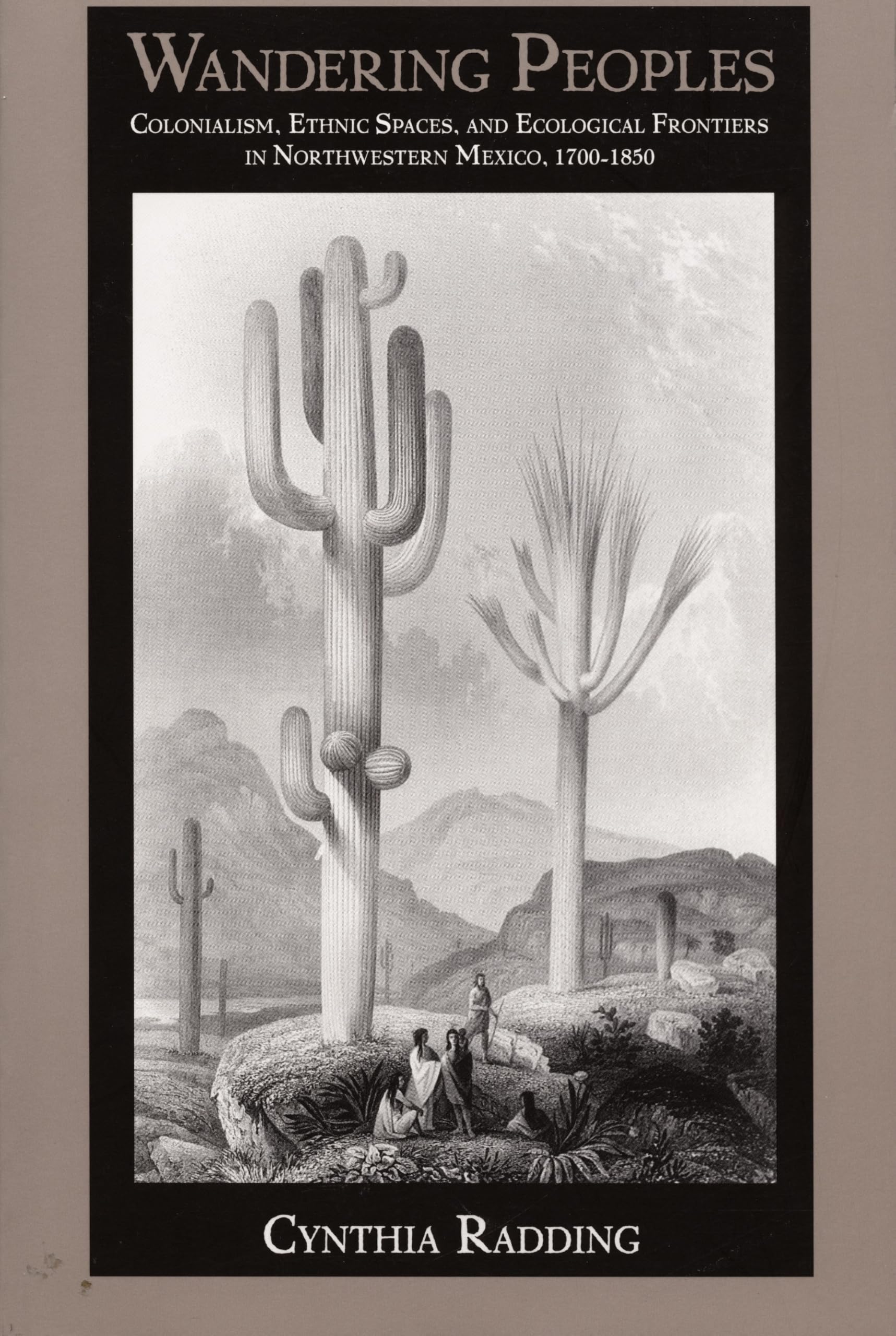
Wandering Peoples: Colonialism, Ethnic Spaces, and Ecological Frontiers in Northwestern Mexico, 1700-1850 (Latin America Otherwise)
$36.39
by Cynthia Radding PhD



Wandering Peoples is a chronicle of cultural resiliency, colonial relations, and trespassed frontiers in the borderlands of a changing Spanish empire. Focusing on the native subjects of Sonora in Northwestern Mexico, Cynthia Radding explores the social process of peasant class formation and the cultural persistence of Indian communities during the long transitional period between Spanish colonialism and Mexican national rule. Throughout this anthropological history, Radding presents multilayered meanings of culture, community, and ecology, and discusses both the colonial policies to which peasant communities were subjected and the responses they developed to adapt and resist them. Radding describes this colonial mission not merely as an instance of Iberian expansion but as a site of cultural and political confrontation. This alternative vision of colonialism emphasizes the economic links between mission communities and Spanish mercantilist policies, the biological consequences of the Spanish policy of forced congregación , and the cultural and ecological displacements set in motion by the practices of discipline and surveillance established by the religious orders. Addressing wider issues pertaining to ethnic identities and to ecological and cultural borders, Radding’s analysis also underscores the parallel production of colonial and subaltern texts during the course of a 150-year struggle for power and survival. “ Wandering Peoples is an example of regional history at its best. Cynthia Radding is one of the finest practitioners in the emerging field of Latin American ecological history; indeed, she is playing a major role in shaping the field. This book is an important and innovative contribution to colonial Mexican studies and will resonate with scholars working on any part of the globe who are engaged with its key themes.”—Ann Wightman, Wesleyan University “Here, for the first time, we get an extensive treatment of the ‘ordinary’ men and women who populated the missions, presidios, mining camps, and other settlements of Sonora—they have names, identities, agendas, and complex strategies for coping with the multiple demands they face. Those specializing in other geographical areas—not just Latin Americanists—would do well to consider the concrete grounding of this working model.”—Cheryl Martin, The University of Texas, El Paso ""Wandering Peoples" is an example of regional history at its best. Cynthia Radding is one of the finest practitioners in the emerging field of Latin American ecological history; indeed, she is playing a major role in shaping the field. This book is an important and innovative contribution to colonial Mexican studies and will resonate with scholars working on any part of the globe who are engaged with its key themes."--Ann Wightman, Wesleyan University Cynthia Radding is Assistant Professor of History at the University of Illinois at Urbana-Champaign. Wandering Peoples Colonialism, Ethnic Spaces, and Ecological Frontiers in Northwestern Mexico, 1700-1850 By Cynthia Radding Duke University Press Copyright © 1997 Duke University Press All rights reserved. ISBN: 978-0-8223-1899-6 Contents About the Series, List of Illustrations, Figures, Tables, Preface, Abbreviations, Introduction: The Social Ecology of the Sonoran Frontier, Peasants and Indians on the Sonoran Frontier, Peasant Culture and the Reconstitution of Ethnic Space, Ethnic Discourse and the Multiple Voices of Cultural History, Part I Los Sonoras and the Iberian Invasion of Northwestern Mexico, 1 Ethnic Frontiers in the Sonoran Desert, 2 Amerindian Economy in Sonora, 3 Native Livelihood and the Colonial Economy, Part II The Intimate Sphere of Ethnicity: Household and Community, 4 Sexuality, Marriage, and Family Formation in Sonora, 5 "Gypseys" and Villagers: Shifting Communities and Changing Ethnic Identities in Highland Sonora, Part III Rival Proprietors and Changing Forms of Land Tenure, 6 Land and the Indian Común, 7 Peasants, Hacendados, and Merchants: The Cultural Differentiation of Sonoran Society, Part IV Ethnogenesis and Resistant Adaptation, 8 Cultural Endurance and Accommodation to Spanish Rule, 9 Patterns of Mobilization, Conclusions: Contested Space, Peasants and Indians in Sonora, A Contested Hegemony, Notes, Preface, Introduction: The Social Ecology of the Sonoran Frontier, 1 Ethnic Frontiers in the Sonoran Desert, 2 Amerindian Economy in Sonora, 3 Native Livelihood and the Colonial Economy, 4 Sexuality, Marriage, and Family Formation in Sonora, 5 "Gypseys" and Villagers: Shifting Communities and Changing Ethnic Identities in Highland Sonora, 6 Land and the Indian Común, 7 Peasants, Hacendados, and Merchants: The Cultural Differentiation of Sonoran Society, 8 Cultural Endurance and Accommodation to Spanish Rule, 9 Patterns of Mobilization, Conclusions: Contested Space, Glossary, Select Bibliography, Primary Sources, Secondary Sources, Index,