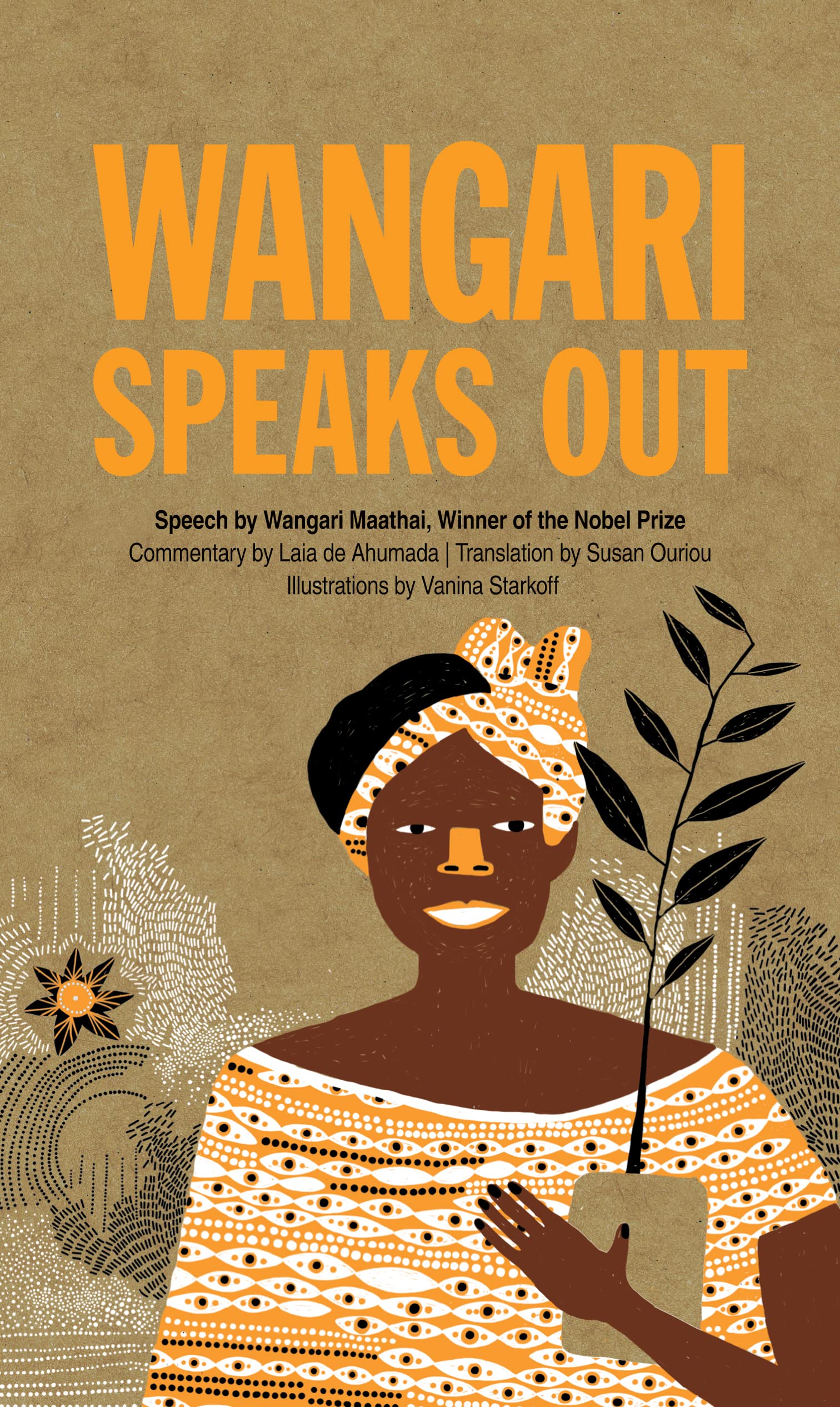



Wangari Maathai was the first African woman and first environmentalist to receive a Nobel Peace Prize. In 1977 in Kenya, she started the Green Belt Movement. Wangari’s goals had been to use tree planting to restore the environment while providing income and resources to African women. The group’s objectives broadened to the protection of human and environmental rights, civic education, and the promotion of democratic values while valuing the cultural heritage of Africa. The GBM has now planted tens of millions of trees. In her acceptance speech, Wangari explains that “the state of any country’s environment is a reflection of the kind of governance in place, and without good governance there can be no peace.” The efforts of the GBM and other organizations led to the peaceful transition to a democratic society in Kenya, and the tree became a symbol of the democratic struggle. Her speech is strikingly illustrated and followed by an analysis written by Laia de Ahumada. The Speak Out series publishes the most inspiring speeches of our times, then deconstructs them to give young readers a deeper understanding of global issues and the power of language to influence them. Key Text Features biographical information definitions explanation facts headings historical context illustrations informational note Correlates to the Common Core State Standards in English Language Arts: CCSS.ELA-LITERACY.RI.4.2 Determine the main idea of a text and explain how it is supported by key details; summarize the text. CCSS.ELA-LITERACY.RI.6.3 Analyze in detail how a key individual, event, or idea is introduced, illustrated, and elaborated in a text (e.g., through examples or anecdotes). CCSS.ELA-LITERACY.RI.6.6 Determine an author's point of view or purpose in a text and explain how it is conveyed in the text. CCSS.ELA-LITERACY.RI.6.9 Compare and contrast one author's presentation of events with that of another (e.g., a memoir written by and a biography on the same person). “This short 75-page book punches way above its weight ... Highly recommended for readers interested in the environment and sustainability, politics, and contemporary history.” ― Children's Literature Comprehensive Database WANGARI MAATHAI (1940-2011) was recognized internationally for her environmental and social activism and was the first African woman to win a Nobel Peace Prize. She was also the first woman in East and Central Africa to earn a doctorate degree, and in 2002 she was elected to the parliament of Kenya as Assistant Minister for Environment, Natural Resources and Wildlife. LAIA DE AHUMADA is a writer and researcher. She has a doctorate in Catalan philology and helped create the Terra Franca Association and the Heura Open Center. She lives in Barcelona, Spain. VANINA STARKOFF is a graphic design graduate but discovered that her true passion lies in the world of images and children’s books. Her first book was a finalist in the III Premio Internacional Compostela for Illustrated Books, and she was selected twice as a finalist for the Golden Pinwheel Young Illustrators Competition in Shanghai. She was born in Buenos Aires, Argentina, and now lives in Brazil. SUSAN OURIOU is an award-winning fiction writer and literary translator with over seventy translations and co-translations of fiction, non-fiction, children’s and young-adult literature to her credit. She has received the Governor General’s Literary Award for Translation and, in 2024, her translation of Catherine Leroux's The Future won CBC's Canada Reads. Her translations have also been long-listed for awards such as the International Dublin Literary Award, the Carol Shields Prize for Fiction and the Giller Prize. as well as appearing on IBBY’s Honor List. She has also published Nathan , a novel for young readers, and Damselfish , short-listed for the WGA's Georges Bugnet award for fiction.