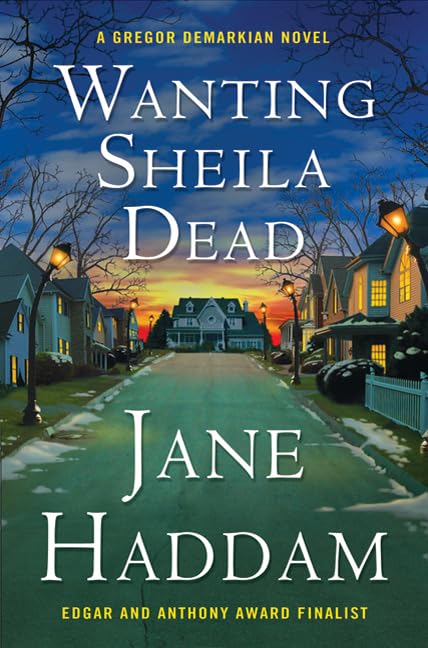



“Haddam manages to produce each time a layered, richly peopled, and dryly witty book with a plot of mind-bending complexity.” —Houston Chronicle on Glass Houses Sheila Dunham is a gossip columnist’s dream—she’s famous, loud and, to most who meet or see her, deeply offensive. As a result, she’s been fired from every job on television she’s ever had—first as a serious journalist, then as a personality, finally as a reality show judge. Now she’s producing and hosting her own reality show, “America’s Next Top Anchor,” shot in her hometown of New Fenwick, Connecticut. Everyone she employs is terrified of her; everyone one else hates her. And everybody seems to want Sheila dead. Finally it seems someone has decided to try. After millions of dollars of jewels are stolen from her home, she is found beaten into unconciousness, next to the murdered body of a local girl. If nothing else, her show’s ratings are going to improve. Gregor Demarkian, a retired FBI agent, is already scheduled to appear on her show but he’s going to consult on the biggest murder case to hit that part of Connecticut since the Revolutionary War. But how do you narrow down the suspects when the victim was hated by everyone? The Gregor Demarkian series, well past its twentieth volume, shows no signs of lethargy or a paucity of ideas. This time the former FBI agent is asked to consult on a case involving an assault on a widely disliked reality-TV host, the murder of a young girl with the host at the time of the assault, and a cast of potential killers that would rival an Agatha Christie novel. (In fact, the book is modeled after a Christie novel, which Haddam acknowledges with the occasional allusion to Dame Agatha.) Setting a mystery in the world of reality TV is not a brand new idea, either: Ben Elton did it in 2001’s Dead Famous, to name but one. But, as fans of the Demarkian novels know, Haddam isn’t interested in retracing someone else’s steps. Her take on reality TV, its egos and backstage battles, is fresh and entertaining, and (as usual) the mystery is sharply plotted. Eventually Haddam may have to deal with the fact that Demarkian’s age will prevent him from continuing to solve crimes, but let’s hope that’s not for a while yet. --David Pitt “Outstanding...Haddam has few peers at misdirection, and she celverly satirizes the reality show industry while continuing to add depth to her lead.”— Publishers Weekly (starred review) “Haddam’s series characters are engaging as always, including Demarkian’s quirkly Armenian neighborhood, which has enough character to count as one.”— Charlotte News Observer “Her take on reality TV, its egos and backstage battles, is fresh and entertaining, and (as usual) the mystery is sharply plotted. Eventually Haddam may have to deal with the fact that Demarkian’s age will prevent him from continuing to solve crimes, but let’s hope that’s not for a while yet.”— Booklist "Haddam gleefully satirizes reality TV and offers a well though out appreciation of Agatha Christie’s novels, which she lets Demarkian savor for the first time.”— Kirkus Reviews JANE HADDAM, author of more than twenty novels, has been a finalist for both the Edgar and the Anthony award. She lives in Litchfield County, Connecticut. 1 The line began to form in front of the great double doors of the Milky Way Ballroom at just after six in the morning. By ten, when the rain started to fall, it went to the end of the block and around the corner and to the end of the block again and around the corner again. It was at least four women across. Nobody could pass through any of those stretches of sidewalk except by walking half in the gutter. Olivia Dahl was standing at the window of the third-floor office when the lightning first lit up the sky. She had been in the office since six herself, but not always in the window. CLIPBOARDS, she had written across her steno pad, and BALLPOINT PENS, as if she were about to forget, either. This was the first day of the new season, the day without which the season could not happen, and Olivia, as always, had had a perfect memory for details. The phone buzzed on the desk behind her. Sheila Dunham’s voice came into the room like battery acid over a bullhorn. That was a metaphor that made no sense. Olivia didn’t care. It fit exactly. “I don’t know where the hell my blue dress is,” Sheila said. “What the hell did you do to my blue dress? And I don’t care if Oprah is God, she’s a fat pig and I don’t want her near the auditions. Why the woman thinks she has to make a statement about everything on the planet is beyond me. Find my blue dress, for God’s sake, or I’m going to fire you.” Sheila wouldn’t fire a stock boy on audition day. She would not fire Olivia ever. Olivia knew it. She stayed where she was at the window, watching the rain come down in sheets and the women hold newspapers over their heads for protection. There would be at least another forty-five minutes before the doors opened. Even then, only