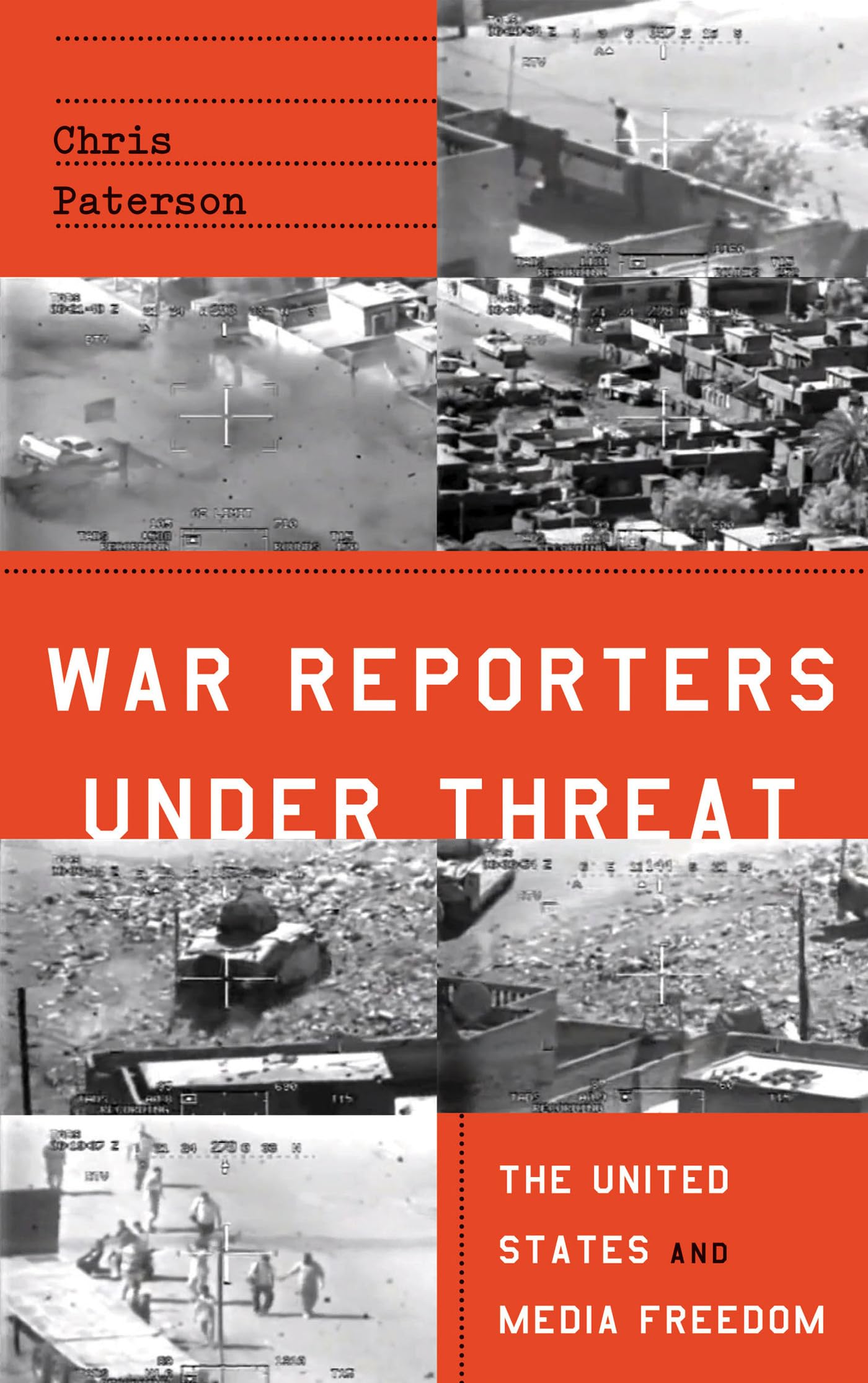



War Reporters Under Threat describes the threat of violence facing war reporters from the United States government and some of its closest allies. Chris Paterson argues that what should have been the lesson for the press following the invasion of Iraq - that they will be treated instrumentally by the US government - has been mostly ignored. As a result, even nominally democratic states cannot be counted upon to protect journalists in conflict, and urgent reform of legal protections for journalists is required. War Reporters Under Threat combines critical scholarship with original investigation to assess the impact of the US government's obsession with information control and protection of its own troops. While the press-military relationship has been well researched, this book is the first to elaborate the US government threat to journalists. 'Reminds us journalists always to ask the question: 'Are we mere messengers and voyeurs of war, or is the message we carry so valuable to the world beyond that it's worth the risk?'' -- John Pilger 'In the shadow of 9/11 Paterson accuses the United States of acting with impunity in its targeting and killing of journalists and media workers. He provides a painstaking, thoughtful and ultimately damning case to answer over military adventures' -- Aidan White, director of the Ethical Journalism Network and former Director General of the International Federation of Journalists Chris Paterson teaches at the School of Media and Communication at the University of Leeds, and is a former television news photographer. He is the author of The International Television News Agencies (2011), and the the co-editor of Making Online News: Newsroom Ethnographies in the Second Decade of Internet Journalism (2011) and Making Online News: The Ethnography of New Media Production (2008). War Reporters Under Threat The United States and Media Freedom By Chris Paterson Pluto Press Copyright © 2014 Chris Paterson All rights reserved. ISBN: 978-0-7453-3417-2 Contents Preface, viii, 1. A Hidden War on the Media, 1, 2. The Culture of Press Intolerance: Collaboration and Suppression, 19, 3. Patterns of Violence: The Media Installation and the Media Worker, 58, 4. Media Response, 106, 5. Legality, 130, 6. Invisible Conflict?, 150, Appendix 1: A Chronology of Attacks on Media Facilities and Personnel Linked to the US Government, 165, Appendix 2: Media Safety and Media Freedom Organisations, 170, Notes, 171, Index, 213, CHAPTER 1 A Hidden War on the Media The purpose of this book is to examine and expose a deadly paradox which has become apparent since 9/11: that of an entrenched culture of acceptance and impunity which permits states that are nominally democratically governed, human rights oriented, and bound by democratically established national and international legal conventions, to conceal violations of human rights and rules of war, and to kill, injure and arrest those journalists who are in a position to witness and report on those violations. Such states do so virtually without challenge, for only infrequently do the many defenders of the right to practice journalism freely and safely look closely at the democracies with vibrant commercial press systems, the world's 'models' of press freedom. This chapter suggests why this vital story about the storytellers remains substantially hidden from public discourse, and situates press coercion and intimidation by the US within the context of that government's 'strategic narrative' of the Middle East conflict constructed for international and domestic consumption. We also consider how, in an age of 'virtuous war' and 'worthy and unworthy victims', attacks on journalists come to be easily dismissed as irrelevant within a broader, highly ambiguous, global struggle. In the mid-2000s, for the first time, the US was ranked by the Committee to Protect Journalists (CPJ), one of the leading journalists' rights organisations (and the US one at that), as one of the worst threats to press freedom, having imprisoned more journalists in the preceding year than all but five other nations. Had the CPJ included a more complete list of temporary detentions of journalists and those who assist them, the US would probably have ranked first. In his important essay on the pattern of violence until late 2003, veteran UK television journalist Nik Gowing writes that the accumulated evidence, 'suggests at best a culture of military indifference and inefficiency to the business of explaining the deaths of media personnel. At worst it suggests a policy of endorsing and covering up firstly the targeting, then either the maiming or killing, of media personnel'. Since Gowing wrote, the evidence has only grown stronger. The tendency to violently restrain the free practice of journalism and the free circulation of information has long been observed – and quite thoroughly documented – both in relation to undemocratic and autocrat