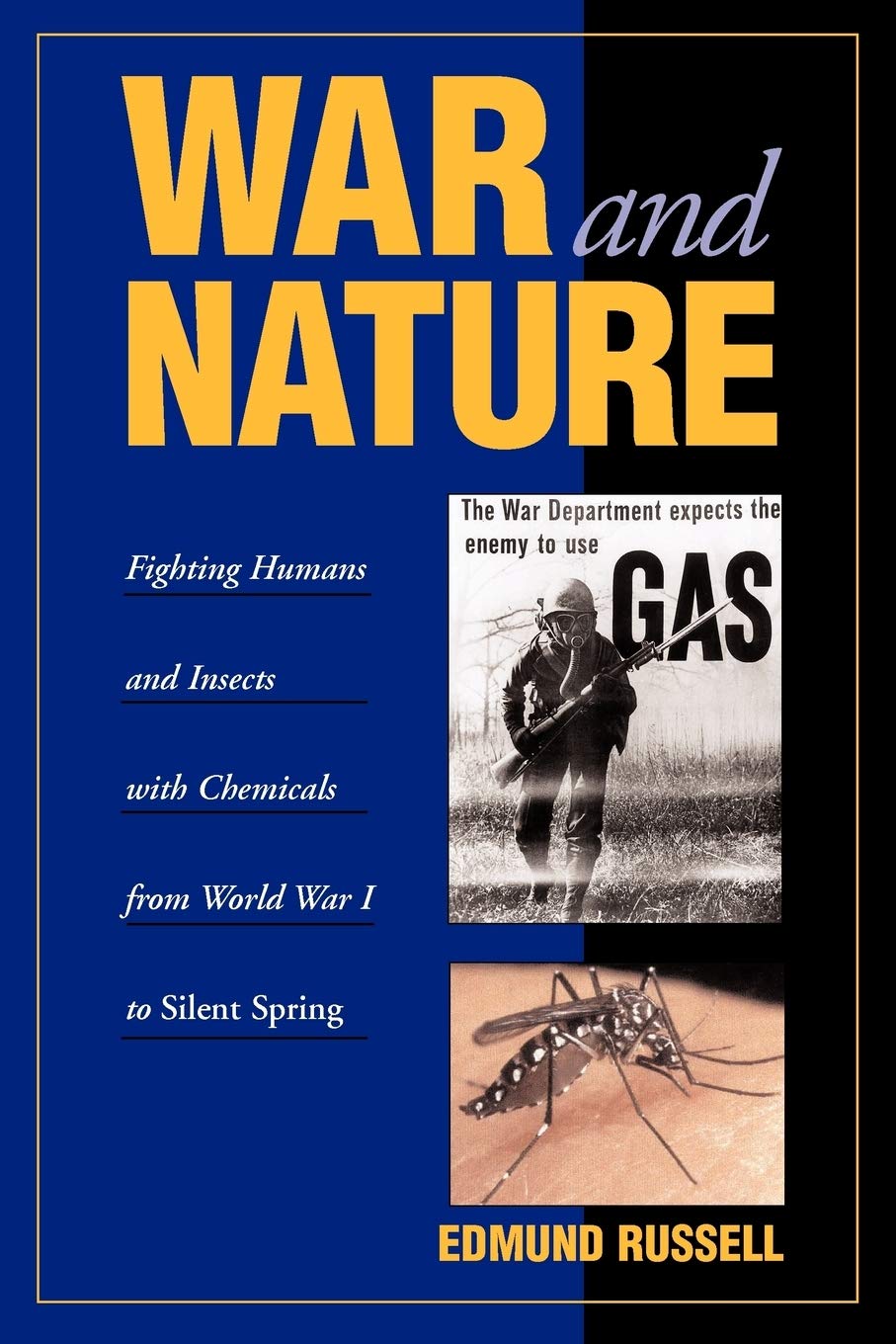
War and Nature: Fighting Humans and Insects with Chemicals from World War I to Silent Spring (Studies in Environment and History)
$19.68
by Edmund Russell



While cultural and scholarly traditions have led us to believe that war and control of nature are separate, there are many more similarities than most people might suspect. Tracing the history of chemical warfare and pest control, Edmund Russell shows how war and control of nature coevolved. Ideologically, institutionally, and technologically, the paths of chemical warfare and pest control intersected repeatedly in the twentieth century. War and Nature helps us to understand the impact of war on nature and vice versa, as well as the development of total war, and the rise of the modern environmental movement. Edmund Russell is an assistant professor in the Division of Technology, Culture, and Communication in the School of Engineering and Applied Science at the University of Virginia. This is his first book. "...this fine study is a welcome addition to American environmental, military, and scientific historical scholarship and deserves a wide readership." American Historical Review "Well written and readable, and the author's theories are well supported." Military Review "War and Nature does an excellent job of weaving together research on chemical use against human and insect enemies of the United States from World War I to the present. The author did a thorough job in doing research for his doctoral dissertation, and has presented it in a very readable fashion. The footnotes and index to this work are quite thorough and useful...In all this is an interesting presentation of material that documents one aspect of the military industrial complex that has become an integral part of our lives. Highly recommended for students of history, business, and the environment." E-Streams "Edmund Russell's fascinating and provocative study explores several seemingly disparate historical realities - U.S. military strategy and propaganda during World Wars I and II, the rhetoric of the Cold War, and post-1945 insecticide research and advertising - to show the subtle connections among them. This brilliany and original book brings together important strands of twentieth-century American history in fresh and disturbing ways." Paul Boyer, Washburn Observatory "Russell admirably achieves his purpose, reinforcing his case with careful scholarship." Military History "This topical, judicious book will appeal to environmentalists, academics, and sophisticated lay readers." Publisher's Weekly "An interesting and highly unusual comparison of the parallel--but sometimes intersecting--chemical wars waged against humans and bugs...For students of both war and ecology, this is a remarkable and fascinating study that draws heavily on primary sources; it is particularly timely as awareness grows of what war does to the environment, as well as to people." Eliot A. Cohen, Foreign Affairs "[A] careful, factual, well-documented examination of the scientific and rhetorical intersection of chemical warfare and pest control. The possibility of this coverage would never have occurred to me, or I suspect to most people, but Russell shows, in convincing detail, how it exists and operates." Washington Post Book World "Edmund Russell's fascinating and provocative study explores several seemingly disparate historical realities - U.S. military strategy and propaganda during World Wars I and II, the rhetoric of the Cold War, and post-1945 insecticide research and advertising - to show the subtle connections among them. This brilliant and original book brings together important strands of twentieth-century American history in fresh and disturbing ways." Paul Boyer, Washburn Observatory "Elegant in its simplicity." Journal of the History of Medicine This 2001 book shows the intersection of chemical warfare and pest control in the twentieth century. Edmund Russell is the Hall Distinguished Professor of US History at the University of Kansas. He works primarily in environmental history and the history of technology. He is the author of Evolutionary History: Uniting History and Biology to Understand Life on Earth (Cambridge University Press, 2011), and co-editor, with Richard Tucker, of Natural Enemy, Natural Ally: Toward an Environmental History of War (2004). Russell's work has won the Edelstein Prize of the Society for the History of Technology, the Rachel Carson Prize, and the Leopold-Hidy Prize of the American Society for Environmental History and the Forum for the History of Science in America. Used Book in Good Condition