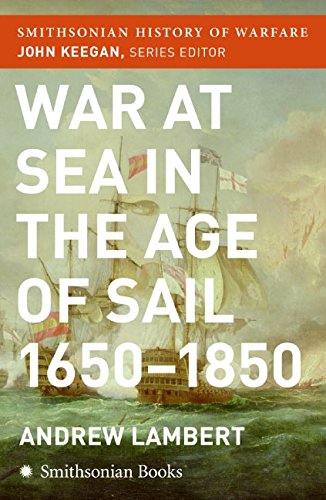



Our fascination with the drama of war at sea is as strong today as it was in the heyday of the sailing ship.This book, written by one of the world's foremost authors on naval warfare, describes the dramatic battles of an age when sail was supreme. Andrew Lambert 's comprehensive history examines key naval conflicts from the highest strategic level right down to the experience of the ordinary sailor. Fully illustrated throughout, this book incorporates computer-generated cartography that brings the sea battles to life. An in-depth look at ship design and the "floating culture" onboard - The Anglo-Dutch Wars of 1650–74, when English commanders challenged Dutch sea power with superior speed, close quarters fighting, and fireships - The rise and fall of the French Navy under the Sun King, Louis XIV - The Napoleonic Wars, the defeat of the French fleet, and the rise of British Royal Navy hero Admiral Lord Horatio Nelson Our fascination with the drama of war at sea is as strong today as it was in the heyday of the sailing ship.This book, written by one of the world's foremost authors on naval warfare, describes the dramatic battles of an age when sail was supreme. Andrew Lambert 's comprehensive history examines key naval conflicts from the highest strategic level right down to the experience of the ordinary sailor. Fully illustrated throughout, this book incorporates computer-generated cartography that brings the sea battles to life. An in-depth look at ship design and the "floating culture" onboard - The Anglo-Dutch Wars of 1650–74, when English commanders challenged Dutch sea power with superior speed, close quarters fighting, and fireships - The rise and fall of the French Navy under the Sun King, Louis XIV - The Napoleonic Wars, the defeat of the French fleet, and the rise of British Royal Navy hero Admiral Lord Horatio Nelson Andrew Lambert is professor of naval history at King's College, London, and vice-president for the British Commission for Maritime History. His publications include Warrior: The First Ironclad and The Crimean War: British Grand Strategy Against Russia, 1853–60 . War at Sea in the Age of Sail (Smithsonian History of Warfare) By Andrew Lambert HarperCollins Publishers, Inc. Copyright © 2005 Andrew Lambert All right reserved. ISBN: 0060838558 Chapter One The Organization of Navies The shape of navies Between 1650 and 1850 navies developed from small forces, largely reinforced with hired merchant ships in wartime, to vast bureaucratic standing services which imposed professional standards on officers and, increasingly, on men, and had large reserves of purpose-built warships, dockyards and arsenals devoted to their maintenance. Each state developed its own style of naval administration, but the basic requirement of sustained political and financial support, with informed political decision-making, was actually achieved by surprisingly few - essentially only the maritime powers. Navies developed alongside the nation states that they served. Only strong, centrally controlled states had the tax-raising powers to fund standing navies, which, like contemporary armies, were invariably involved in revenue collection. Within those states, support for navies came from a variety of sources. In absolutist regimes the personal wishes of the monarch prevailed. Often prestige was more important than fighting strength, although the two requirements were not necessarily mutually exclusive. Republics and constitutional monarchies proved better able to sustain naval power, for the politics of such states reflected the interests of several groups that benefited from naval strength: merchants, coastal towns, colonial speculators and investors. That these states also tended to be maritime indicates a strong link between the economic life of the nation and the political system it develops. Through the power of the purse, these groups determined what type of navy was maintained, and often how it was used. Each state built a navy to meet its individual needs. A close examination of the mixture of ship types, officers and men, infrastructure and administration that the major nations acquired is the most compelling evidence of their aims and ambitions. States with extensive maritime interests would try to control the seas for their own use, and to deny them to their rivals. The classic sea-control strategy of the sailing ship era required a superior battle fleet to secure command, either by defeating the enemy fleet in battle, or by blockading it in its base. When control of the sea was in doubt, navies could attempt to exert local or temporary sea control for specific purposes, such as escorting merchant ships. Spain and, after 1714, the Netherlands built cruiser navies to convoy their merchant shipping, because they depended on sea communications but lacked the economic power to achieve sea control. A state without vital maritime interests could resort to sea denial, attempting to lim