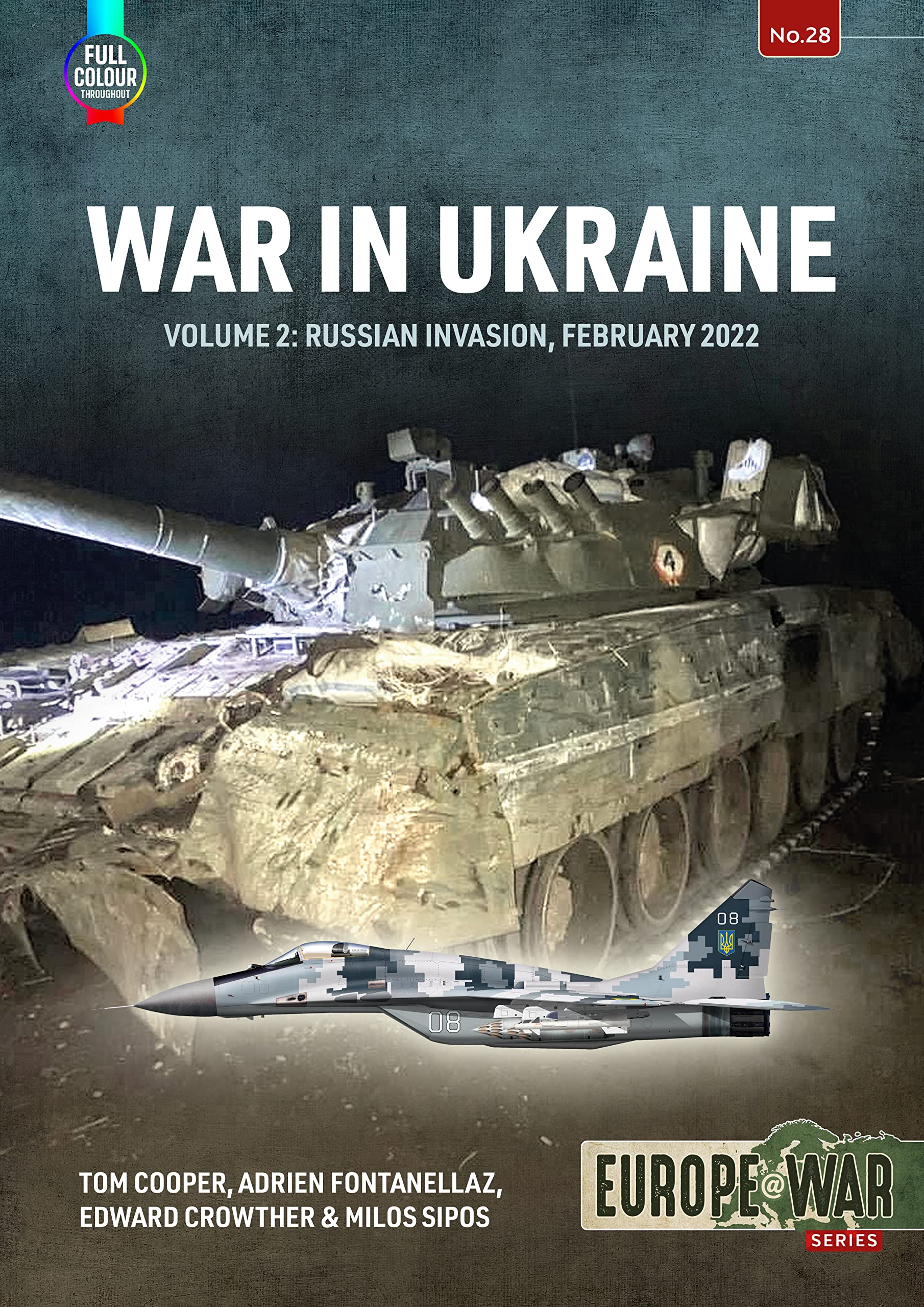
War in Ukraine - Volume 2: Russian Invasion, February 2022 (Europe@War)
$21.90
by Tom Cooper



"The reader will be hard pressed to find another book providing this sort of detailed information. It is liberally illustrated with battlefield photographs and good maps." ― Military Heritage Magazine On 24 February 2022, eight years after invading the Crimean Peninsula of Ukraine and organizing an illegal referendum in support of a subsequent Russian annexation, President of the Russian Federation Vladimir Putin ordered a full-scale invasion of Ukraine. Both Western and Russian intelligence services expected the invasion to quickly topple the democratically elected government in Kyiv and, with the help of collaborators, to overrun the Ukrainian armed forces in a matter of between 3 and 14 days. Early on 24 February, the Armed Forces of the Russian Federation (VSRF) launched a series of missile and artillery strikes on the main air bases and dozens of other military facilities in Ukraine. Immediately afterwards, the VSRF launched a ground invasion, with its forces advancing on Kyiv, Chernihiv, Kharkiv, Mariupol, Melitopol, and Kherson. Although following a build-up that had begun in April 2021, and expected by many, the onslaught still came as a major surprise for the Ukrainian government, the Ukrainian armed forces, and the majority of its allies in the West, and also for the mass of officers and other ranks of the VSRF, many of whom believed that they were only to participate in exercises. However, the deeper the Russians rolled into Ukraine, the more resistance they encountered: while some Russian units performed as expected, elsewhere whole armies began falling apart when ordered to advance at maximum possible speed without the necessary firepower and logistic support. After suffering catastrophic losses while failing to reach downtown Kyiv, and failing to reach and enter Chernihiv and Kharkiv, the war in northern and north-eastern Ukraine quickly settled down into a bloody stalemate. In the south, the Russians initially advanced at an astonishing rate, securing Melitopol during the second day of their invasion, and Kherson only a few days later. It was only once President Putin attempted to accelerate the rate of advance through ordering heliborne operations deeper into Ukraine that the VSRF suffered a severe blow in the fighting for Voznesensk and Mykolaiv, and its advance in this part of the country also came to an end. Richly illustrated with color photography and full color artworks, and providing a detailed study of the organization and order of battle of the armed forces involved on both sides, Volume 2 of War in Ukraine provides the first detailed account of the first two weeks of the Russian invasion of Ukraine in 2022. "The reader will be hard pressed to find another book providing this sort of detailed information. It is liberally illustrated with battlefield photographs and good maps." Military Heritage Magazine "Helion continues its excellent record on relevant and concise reference material on current events and military operations." AMPS “It is most highly recommended for those interested in this on-going conflict.” ModelingMadness.com “This is the book for those who are interested in current events and will recommend the book to those interested in this particular event.” IPMS/USA “Looking forward to the next volume. Enjoyed it.” Historical Miniatures Gaming Society "These volumes have provided greater clarity about the war, since the media’s reporting on the war has been, by necessity, lacking in important details. If one is interested in the background to the war and, especially, who has been fighting it, then read these volumes." The Journal of the Air Force Historical Foundation Tom Cooper is an Austrian aerial warfare analyst and historian. Following a career in worldwide transportation business – during which he established a network of contacts in the Middle East and Africa – he moved into narrow-focus analysis and writing on small, little-known air forces and conflicts, about which he has collected extensive archives. This has resulted in specialization in such Middle Eastern air forces as of those of Egypt, Iran, Iraq, and Syria, plus various African and Asian air forces. Except for authoring and co-authoring more than 30 books - including about a dozen of titles for Helion’s @War series - and over 1000 articles, Cooper is a regular correspondent for multiple defense-related publications. Adrien Fontanellaz, from Switzerland, is a military history researcher and author. He developed a passion for military history at an early age and has progressively narrowed his studies to modern-day conflicts. He is a member of the Scientific Committee of the Pully-based Centre d’histoire et de prospective militaries (Military History and Prospectives Center), and regularly contributes for the Revue Militaire Suisse and various French military history magazines. He is co-founder and a regular contributor to the French military history website L’autre cotè de la colline