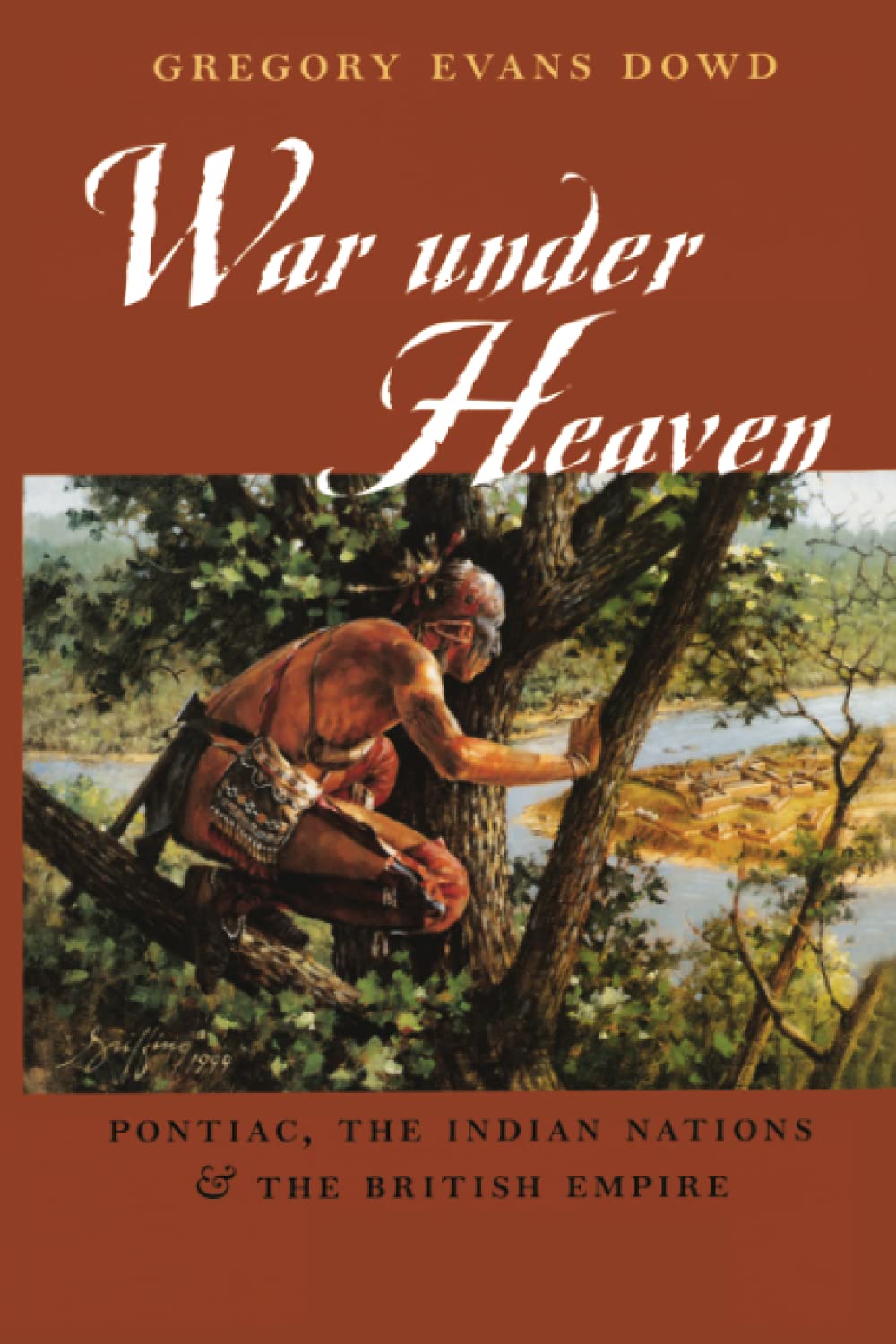
War under Heaven: Pontiac, the Indian Nations, and the British Empire
$25.95
by Gregory Evans Dowd



Honorable Mention from the Association of American Publishers Professional and Scholarly Publishing Awards for History The 1763 Treaty of Paris ceded much of the continent east of the Mississippi to Great Britain, a claim which the Indian nations of the Great Lakes, who suddenly found themselves under British rule, considered outrageous. Unlike the French, with whom Great Lakes Indians had formed an alliance of convenience, the British entered the upper Great Lakes in a spirit of conquest. British officers on the frontier keenly felt the need to assert their assumed superiority over both Native Americans and European settlers. At the same time, Indian leaders expected appropriate tokens of British regard, gifts the British refused to give. It is this issue of respect that, according to Gregory Dowd, lies at the root of the war the Ottawa chief Pontiac and his alliance of Great Lakes Indians waged on the British Empire between 1763 and 1767. In War under Heaven , Dowd boldly reinterprets the causes and consequences of Pontiac's War. Where previous Anglocentric histories have ascribed this dramatic uprising to disputes over trade and land, this groundbreaking work traces the conflict back to status: both the low regard in which the British held the Indians and the concern among Native American leaders about their people's standing―and their sovereignty―in the eyes of the British. Pontiac's War also embodied a clash of world views, and Dowd examines the central role that Indian cultural practices and beliefs played in the conflict, explores the political and military culture of the British Empire which informed the attitudes its servants had toward Indians, provides deft and insightful portraits of Pontiac and his British adversaries, and offers a detailed analysis of the military and diplomatic strategies of both sides. Imaginatively conceived and compellingly told, War under Heaven redefines our understanding of Anglo-Indian relations in the colonial period. Shifting from councils at frontier outposts to deliberations at Whitehall, Dowd elucidates the contradictions in British policy toward Indian sovereignty that helped ignite the conflict . . . His explication of both sides' strategies and tactics in the ferocious struggle is both sober and gripping. And, in perhaps his most original contribution, he skillfully uses the perforce meager evidence to analyze the religious dimensions of the Indians' resistance. A stylish writer with a talent for compression, Dowd engages and advances while making the lines of those debates clear to the general reader. His book is the best account of its subject. ―Benjamin Schwarz, Atlantic Monthly Masterful and nuanced . . . Dowd is especially original in his analysis of the war's legacy. Its prime lesson, its ambiguity, was part of a larger crisis of empire . . . [Pontiac's War] rippled far into the American future. This tightly written and engaging history brings it alive and lifts it convincingly to its proper place as a turning point in the continental story. ―Elliott West, Washington Times Dowd draws on his considerable expertise of eighteenth-century Native American resistance movements to construct a detailed retelling of the rebellion . . . Dowd gives us a fine history. ―Michael McDonnell, Times Literary Supplement Provocatively written and masterfully researched, Dowd's important new monograph . . . challenges much of the recent scholarship on the conflict, offering a bold new interpretation that links this Indian war with broader themes in Atlantic and Native American History . . . Merits the attention of all students of early American history. ―Jon Parmenter, Journal of American History Among historians of early America, the consensus in recent years has been to underplay Pontiac's role as a visionary patriot chief but at the same time to elevate the conflict that bears his name from a 'rebellion' to an all-out war that stopped British imperial expansion in its tracks, at least temporarily. Gregory Evans Dowd provides a thoughtful, expertly researched articulation of that consensus in his new book, which is certain to supplant Howard Peckham's Pontiac and the Indian Uprising as the definitive scholarly account of the conflict . . . This fine book raises important questions about how we should situate Pontiac's War (or Rebellion, if you like) in the larger story of Britain's eighteenth-century imperial expansion and U.S. empire building to this day. ―Timothy J. Shannon, Common-Place Dowd strips away the mythology that has long clouded the reputation of this accomplished Ottawa leader. At the same time, Dowd brilliantly demonstrates that the conflict between the British and the various unified Indian nations was not over land or trade but rather British respect of Indian sovereignty . . . An elegantly written ethnohistorical study. ― Library Journal Dowd's arguments are convincing, his prose is accessible and vibrant, the research is prodigious,