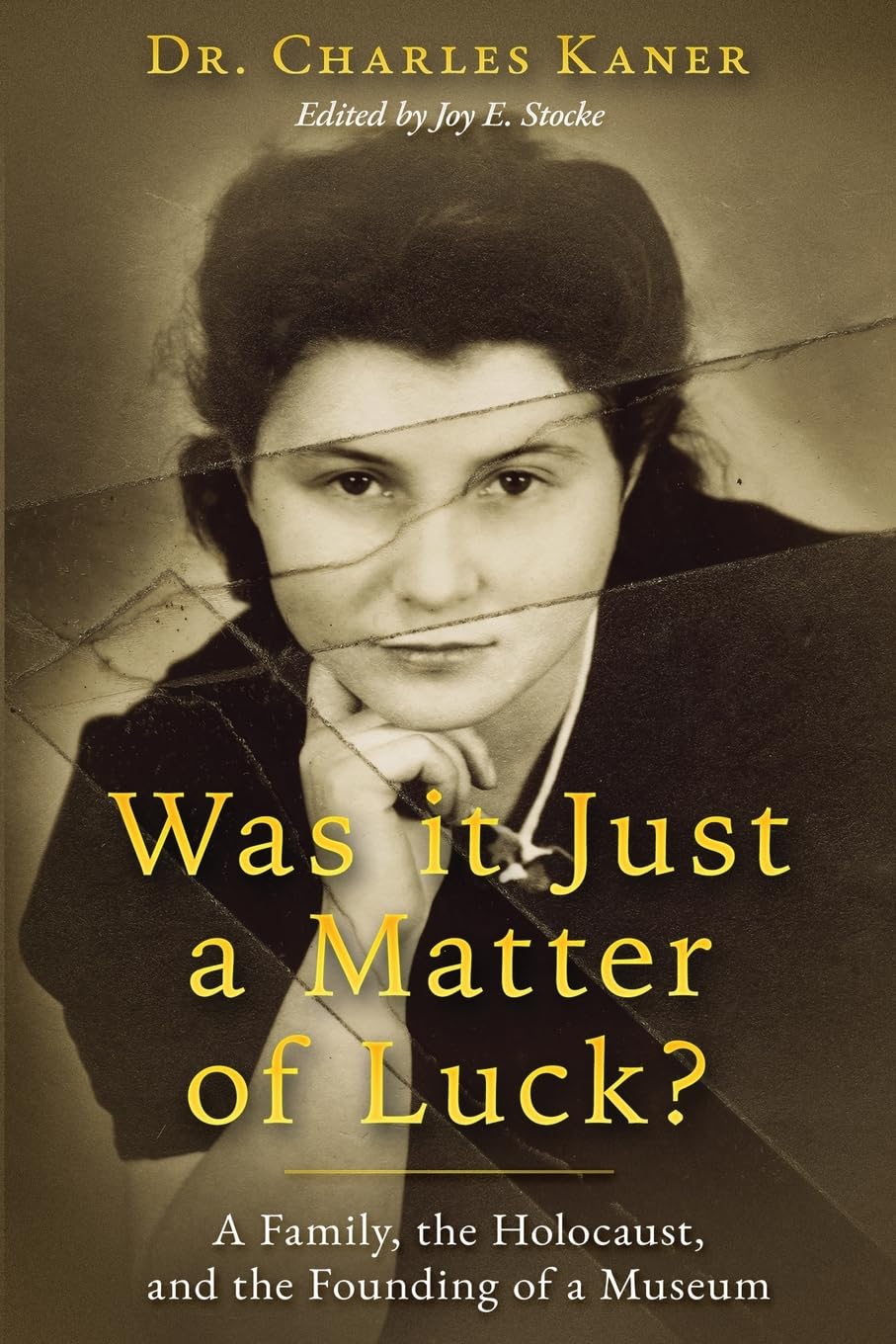
Was it Just a Matter of Luck?: A Family, the Holocaust, and the Founding of a Museum (Holocaust Survivor True Stories)
$17.95
by Dr. Charles Kaner



In Was it Just a Matter of Luck? Dr. Charles Kaner weaves an unflinching, moving account of his family’s survival during the Holocaust with the story of how those memories – and his mother’s fierce devotion to testimony – helped shape a new era of remembrance in America. At the heart of the narrative stands his mother, Ray Kaner, whose courage, intelligence, and will to live carried her through the ghetto and the horrors of Auschwitz, Hambüren, and Bergen-Belsen. Tracing Ray’s life from an idyllic childhood in interwar Poland through the collapse of her world, Kaner brings readers inside the Łódź Ghetto with striking immediacy: the hunger that distorted time, the humiliation of forced labor, and the desperate ingenuity that kept Ray and her sister Sally alive. Through Ray’s memories – told to her son decades later during the COVID lockdown – Kaner reconstructs the threads of chance, instinct, and resilience that repeatedly saved her life when the slightest misstep could have meant death. Parallel to his mother’s journey runs Kaner’s own: a boy raised in Brooklyn by survivors who rarely spoke of themselves; a dentist who built a life in New York; and, ultimately, an adult son determined to understand how his mother survived when so many did not. As he listens to Ray recount her childhood, the deaths of her parents, her years of slave labor, and the scars of liberation, Kaner also revisits the extraordinary second act of her life. In the 1970s, as her daughter Debbie entered high school, Ray helped pioneer one of the earliest efforts to collect survivor testimonies – grassroots work that would contribute to the founding of the Center for Holocaust Studies at Flatbush Yeshiva, a precursor to the Museum of Jewish Heritage in New York City. Kaner shows how Ray’s lifelong insistence on telling the truth of what she lived became a moral engine that shaped institutions, touched generations of students, and continues to shape her family’s understanding of history, family, and obligation. Both an intimate family chronicle and a sweeping historical testimony, Was it Just a Matter of Luck? reveals how a single survivor’s voice – clear, human, and uncompromising – can illuminate the Holocaust anew. It is a tribute to a mother’s strength, a son’s quest to understand, and the responsibility we all bear to remember. Dr. Charles Kaner's devotion to preserving his mother Ray's story, just as she worked to preserve the stories of so many like her, is evident in his new book. The Museum of Jewish Heritage. A Living Memorial to the Holocaust will forever be grateful to Ray Kaner, her work, and her legacy. Her impact will be felt for many generations to come, as will the impact of this wonderful new book written by her son. - Jack Kliger, President & CEO of the Museum of Jewish Heritage. A Living Memorial to the Holocaust; Battery Park, New York City Dr. Charles Kaner's in-depth portrayal of his mother's life, told largely in her own words, presents a powerful narrative filled with joy, pain, tragedy, and - most importantly - luck. Rachella Kaner emerges as a remarkable human being whose long life is recounted with vivid and compelling detail. The central lesson for me is the tragic reality that antisemitism and the targeting of innocent Jews should never have been tolerated. Rachella's story, however, reminds us that the political and racist ideologies responsible for her suffering did not end with the Holocaust. Tragically, similar patterns of hatred and persecution have been repeated throughout history and continue into the 21st century. Rachella Kaner's life stands as a powerful model of hope, resilience, and human dignity - qualities that are urgently needed today. At the same time, her story warns us of the slow, slippery path by which hate and discrimination begin, gradually intensify, and ultimately devastate the lives of innocent people. This book should be required reading for all, especially for young people who are far removed from the horrors and crimes of the Holocaust and who may be vulnerable to repeating its tragic lessons, if they are forgotten. - Dr. Amid I. Ismail, Dean and Laura H. Carnell Professor, Temple University Maurice H. Kornberg School of Dentistry, Philadelphia, Pennsylvania My heros, like Rachel "Ray" Kaner, demonstrate resilience and courage. Hardship shapes depth of character; those who suffer often emerge with the greatest strength. - Steven Lamn, MD, Susa Frankel Clinical Professor of Medicine, New York University School of Medicine, son of Holocaust survivors When people of Europe affected by the Holocaust tell their children to "never forget," the survivors like Ray Kaner need no such admonition because they "always remember." The Holocaust painted an indelible pall on Ray's youth and family by forcing her to watch the relentless cruelty of an alien force who had only one aim, which was to obliterate anyone racially similar to her. She watched young children like her put to